








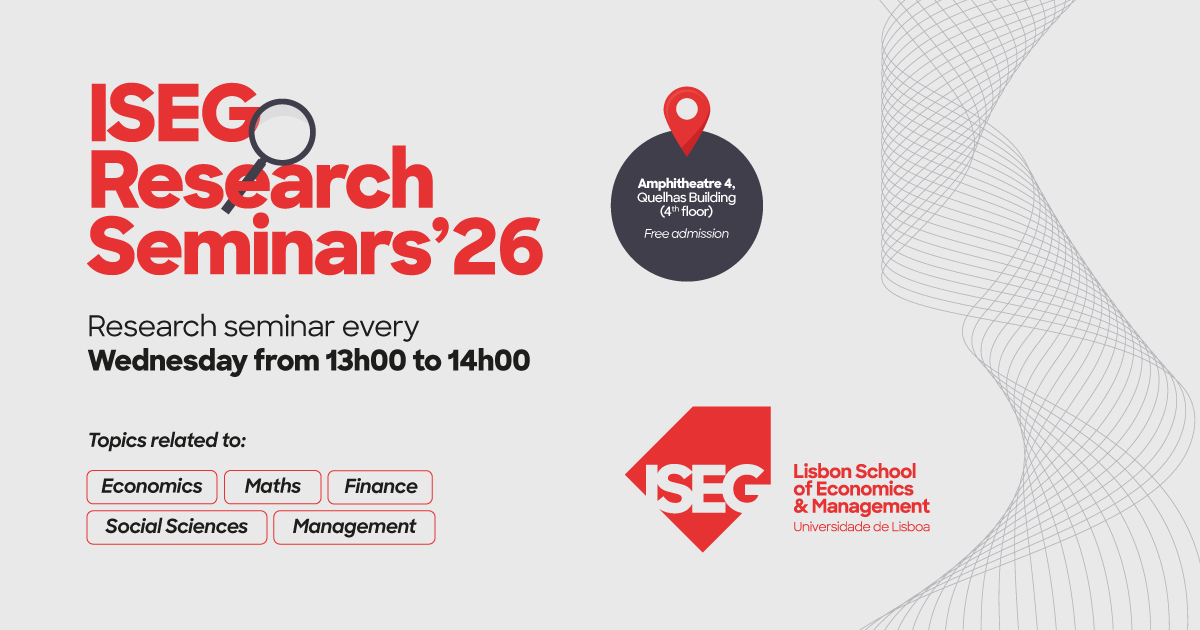
Na quarta-feira, dia 11 de março, entre as 13h00 e as 14h00, tem lugar uma sessão dos ISEG Research Seminars. O orador convidado será Patrícia Justino (UNU – WIDER).
Os Seminários ISEG Research decorrem semanalmente, às quartas-feiras, contando com a participação de docentes do ISEG, bem como de outras instituições de ensino nacionais e internacionais.
Abstract
This paper examines the erosion of trust as a global phenomenon and explores its implications for social cohesion and governance. Drawing on data from the World Values Survey and regional barometers, the analysis focuses on the two key dimensions of trust—interpersonal and institutional—across different socio-economic and geopolitical contexts. The results reveal a sharp global decline in institutional trust, while interpersonal trust follows a more mixed trajectory. Trust erosion appears particularly pronounced in low-income countries and among younger generations, where it is exacerbated by factors such as inequality, corruption, and political instability. The findings further show that trust levels significantly influence social cohesion, civic engagement, and perceptions of governance. In particular, the analysis identifies a positive correlation between institutional trust and support for economic redistribution, highlighting the role of effective governance in fostering trust. The paper concludes by emphasizing the importance of institutional reform and international cooperation to rebuild trust—especially in fragile states—in order to strengthen social contracts and promote sustainable development.
No próximo dia 17 de julho de 2026, realiza-se a 14th UECE Conference on Economic and Financial Adjustments, um encontro internacional dedicado à análise dos desafios económicos e financeiros contemporâneos.
A conferência reunirá investigadores e académicos para debater temas centrais na área dos ajustamentos económicos e financeiros, promovendo a partilha de investigação recente e o diálogo científico num ambiente de excelência académica.
O keynote speaker será Roel Beetsma, University of Amsterdam, uma referência internacional nas áreas de macroeconomia e economia pública.
Comissão Organizadora Local
Call for Papers
As submissões deverão ser enviadas para rem@iseg.ulisboa.pt até 31 de maio de 2026.
A conferência é organizada no âmbito da UECE (Research Unit on Complexity and Economics), contando com o apoio institucional do ISEG – Universidade de Lisboa.
Mais informações no site da conferência AQUI.
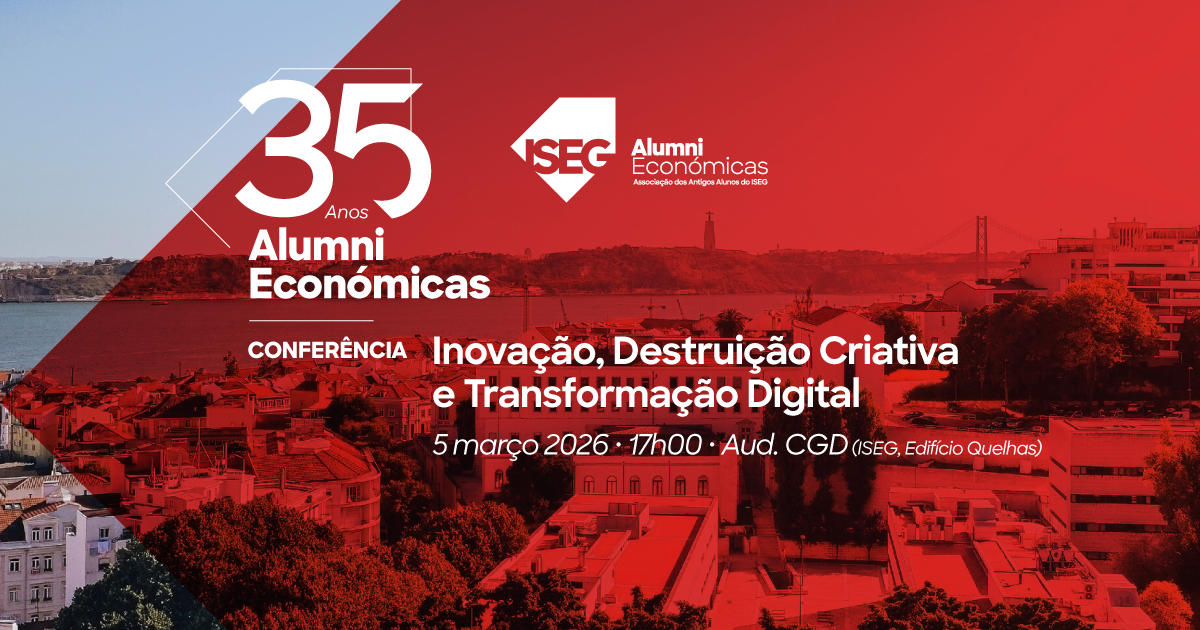
No âmbito das comemorações do 35.º aniversário da ISEG Alumni Económicas, realiza-se a conferência “Inovação, Destruição Criativa e Transformação Digital”, integrada no Ciclo de Conferências “Para onde vão o Mundo, a Europa e Portugal?”.
A sessão terá lugar no Auditório CGD (Edifício Quelhas, 2.º piso), com início às 17h00, e contará com o seguinte programa:
Abertura
Eduardo Catroga, Presidente da Comissão das Comemorações dos 35 Anos
Inovação, Deep-Tech e Destruição Criativa
Yasser Omar, Professor no IST e Presidente do Portuguese Quantum Institute
A Liderança Tecnológica na Era da Inteligência Artificial
Ana Figueiredo, CEO da MEO
Painel | A Perspetiva do Mercado da Transição Digital
Hervé Silva, Lead Partner de AI & Data da Deloitte
Pedro Faustino, CEO da Axians
Sandra Maximiano, Presidente da ANACOM
Sofia Marta, Country Manager da Google Cloud
Moderação: Ana Cordeiro, Conselho Estratégico para a Transformação Digital
Conclusões da Sessão
Conselho Estratégico para a Transformação Digital
Encerramento
A conferência é organizada em conjunto com o Conselho Estratégico para a Transformação Digital da ISEG Alumni Económicas.
A entrada é gratuita, mediante registo prévio.
No dia 19 de fevereiro, o OAIP – Observatório de Acção e Inovação Pedagógica do ISEG promove o seminário “A Matemática é Divertida: Jogos, Desafios e Gamificação no Ensino Superior”, dirigido a docentes, com o objetivo de divulgar boas práticas e experiências educativas que respondem aos novos desafios pedagógicos no ensino superior.
A oradora convidada é Catarina Frois Pacheco, Professora no ISCTE e no Instituto Politécnico de Setúbal.
Nesta sessão serão partilhadas estratégias de gamificação que têm vindo a ser aplicadas em aulas práticas de Matemática a estudantes de licenciatura em diversas áreas das Ciências e Engenharia. Serão apresentados exemplos concretos, como escape rooms, concebidos para consolidar conteúdos previamente leccionados de forma lúdica, colaborativa e orientada para a resolução de problemas.
Estas abordagens visam aumentar a motivação, o envolvimento e a participação ativa dos alunos. Serão igualmente discutidos os impactos destas práticas pedagógicas na motivação e no desempenho dos estudantes, bem como boas práticas para a sua implementação em diferentes contextos curriculares.
Embora ilustradas no contexto da Matemática, as metodologias são transversais e aplicáveis a qualquer área científica.
A sessão decorrerá em Português, com início às 12h30, no Auditório 2 (Edifício Quelhas).
Entrada livre.
O quarto seminário da série Research Seminars in Mathematics Applied to Economics and Management, organizado pela ISEG Research, terá como oradora convidada Francesca Vocaturo, Professora Associada na Universidade da Calábria (Itália), com reconhecida atividade científica na área da Investigação Operacional.
Os seus principais interesses de investigação centram-se na Logística e na Otimização, incluindo otimização estocástica e combinatória, tendo desenvolvido trabalho e colaborações internacionais e publicado em revistas e livros da área.
Este seminário, intitulado “Exploring Stochastic Vehicle Routing Problems in Reverse Logistics”, representa uma oportunidade privilegiada para conhecer contributos recentes de investigação de reconhecida relevância internacional.
A sessão realiza-se no dia 21 de janeiro, às 11h00, no Anfiteatro 3 (Edifício Quelhas).
Entrada livre.
No próximo dia 17 de dezembro, às 11h, realiza-se o terceiro seminário da série Research Seminars in Mathematics Applied to Economics and Management, co-organizado pela ISEG Research.
O seminário conta com a participação do Professor Emmanuel Lepinette, do Centre de Recherche en Mathématiques de la Décision (CEREMADE), reconhecido internacionalmente pelo seu contributo científico.
Este evento representa uma oportunidade privilegiada para conhecer contributos recentes de investigação de reconhecida relevância internacional.
Todos/as os/as interessados/as são convidados a assistir e a participar na sessão.
🗓️ 17 dezembro 2025 | 11h
📍 Local: Anfiteatro 1 do Quelhas, ISEG
Título: Conditioning random sets with applications in finance.
Abstract: In this talk, I will introduce new notions of conditional random sets that I have developed over the past few years. These concepts provide a powerful framework for addressing problems in mathematical finance, particularly in the context of super-hedging under market incompleteness. My main motivation arises from the need to handle financial market models with transaction costs, where the classical notion of a martingale measure is no longer valid. This setting calls for a novel theoretical approach as well as the development of efficient numerical procedures. I will present several models that have been completely solved within this framework and illustrate that the proposed numerical methods perform effectively on real financial data.
Na quarta-feira, dia 3 de dezembro, entre as 13h00 e as 14h00, tem lugar uma sessão dos ISEG Research Seminars. O orador convidado será José Pedro Pontes (ISEG), que irá apresentar o paper “Education spread, technology, and population density“.
Os Seminários ISEG Research decorrem semanalmente, às quartas-feiras, no Anfiteatro 4 do Edifício Quelhas (4.º piso), contando com a participação de docentes do ISEG, bem como de outras instituições de ensino nacionais e internacionais.
Entrada livre
We model the expansion of (higher) education in an economy composed by regions that only differ in population density. The schooling process takes place sequentially across regions in descending order of demographic density and it implies a substitution of modern industrial technologies for traditional, land-based ones.
Under the crucial assumption that young people may travel to school within the region where they live, but not across regions, the model explains why both the literacy rate and per capita income increase, albeit at a decreasing rate. Furthermore, is allows us to understand why the average students’ commuting distance tends to rise despite the geographical decentralization of the educational system.
No dia 27 de novembro, às 19h00, tem lugar o seminário “The Future of the Actuarial Profession”, no Anfiteatro 4 (Edifício Quelhas).
A sessão terá como oradora Carla Sá Pereira, Partner da Ernst & Young.
Entrada livre.
Na quarta-feira, dia 19 de novembro, entre as 13h00 e as 14h00, tem lugar uma sessão dos ISEG Research Seminars. O orador convidado será João Pereira dos Santos (ISEG), que irá apresentar o paper “Gendered Judgments of Misbehavior: Evidence from the World Youth Day Pilgrims and Lisbon citygoers.“.
Os Seminários ISEG Research decorrem semanalmente, às quartas-feiras, no Anfiteatro 4 do Edifício Quelhas (4.º piso), contando com a participação de docentes do ISEG, bem como de outras instituições de ensino nacionais e internacionais.
We present the results of the first field experiments on prescriptive gender stereotyping in moral judgments. The first survey experiment was conducted during the 2023 World Youth Day in Lisbon, an event with Pope Francis that gathered 2 million pilgrims from around the world. We asked 1,800 pilgrims from 80 nationalities to evaluate hypothetical norm-violating scenarios involving lying, sexual promiscuity, and parental care, with varying genders. To assess external validity, we replicated the same questionnaire in multiple non-religious field settings, allowing us to compare judgments across contexts with different levels of religiosity. What did we find? Join us to discuss whether moral judgments differ by gender, whether context matters, and how religiosity shapes these perceptions.
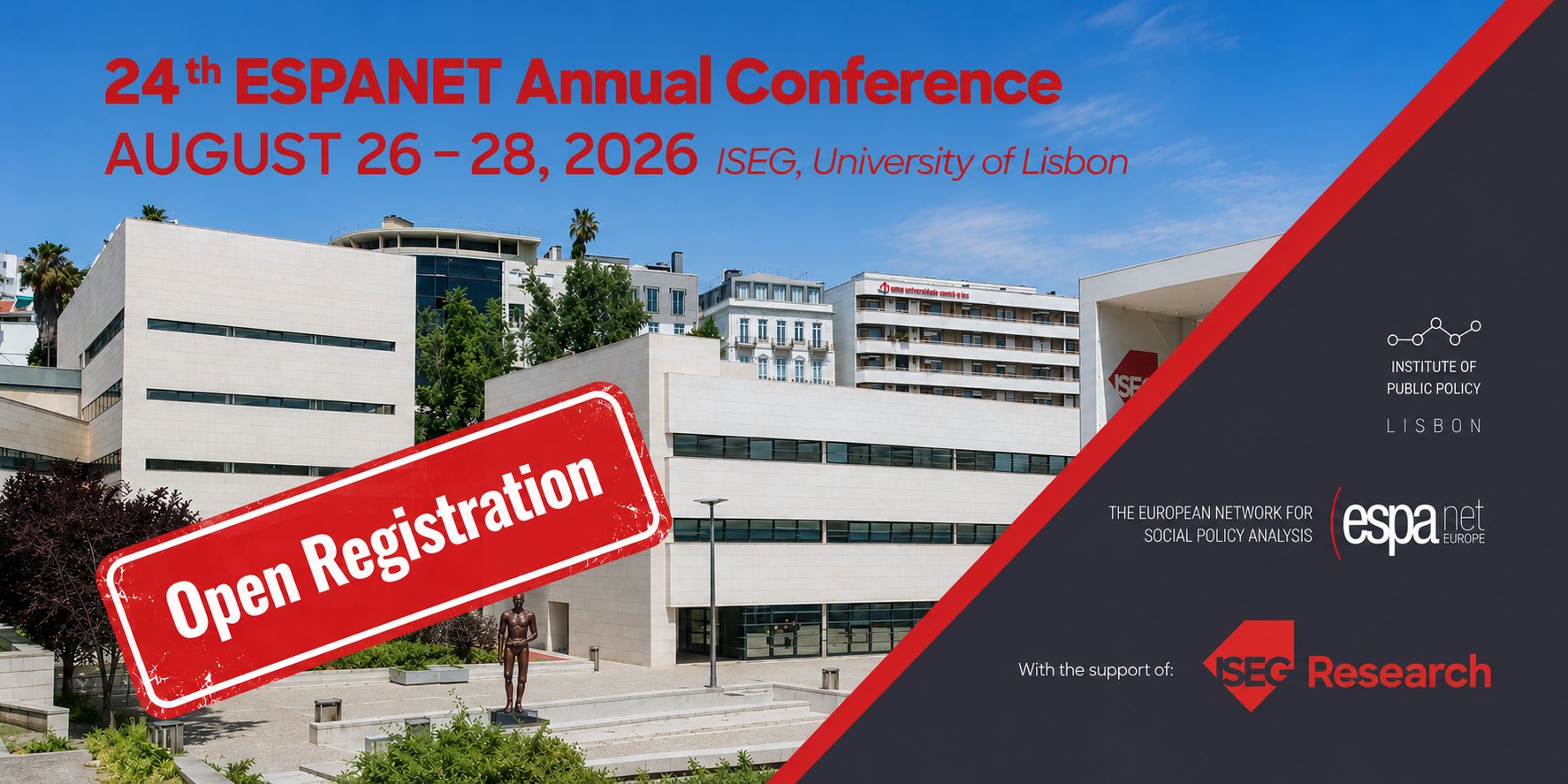
Deadline for Early Bird Registration: 30th of June 2026
For instructions on the Registration process click here
The European Social model is under pressure, both from external sources and from within.
Today’s global geo-economic and strategic environment is shaped by commercial tensions, the heightening of (the threat of) military conflicts, the challenges imposed by climate change, and the structural change in economic processes as result of technological innovation and AI.
At the same time, the increased popularity of radical right-wing and populist forces is reshaping the politics of the welfare state, in terms of both the composition of pro-welfare constituencies, and the welfare agendas these parties pursue.
The 24th ESPAnet Annual Conference in Lisbon, 2026, aims to assess how these and other key developments are re-shaping political and policy debates in Europe. What should be the mission and the perimeter of the Welfare State in European societies? Who is deserving of social protection? And how is social protection best delivered?
| Date | End | Results | |
| Call for Proposals | 4/12/2025 | 16/01/2026 | 31/01/2026 |
| Call for Papers | 01/02/2026 | 17/05/2026 | 31/05/2026 |
| Registration | 01/06/2026 | 14/08/2026 | – |
| Final Programme | 15/08/2026 | – | – |
| On-site Conference | 26/08/2026 | 28/08/2026 | – |
Programme Overview (Draft Version)
The European Social Model faces growing pressure from global economic tensions, rising military threats, climate change, technological transformation, and AI. At the same time, the rise of radical right-wing and populist movements is reshaping welfare politics, influencing both support for social protection and policy priorities. The 2026 ESPAnet Conference in Lisbon will examine how these changes are redefining the welfare state in Europe, including its purpose, scope and methods of delivering social protection.
With this in mind, we have organised the content into a series of streams, which we invite you to explore.
| 1. Welfare States, Demography and Bodies [more info] |
| 2. Time-Related Social Policies in the World of Work and Care [more info] |
| 3. Providing Social Security for Older People: Interactions of Different Social Policies, their Drivers and Outcomes [more info] |
| 4. Disability, Citizenship, and the Future of the Welfare State in Europe [more info] |
| 5. The Politics of Education [more info] |
| 6. The Matthew Effect in Social and Educational Policies and the Intergenerational Transmission of Disadvantages Over the Life Course [more info] |
| 7. Employment Policies and the Quest for a European Labour Market [more info] |
| 8. Families in Transition: Rethinking Social Policy Design [more info] |
| 9. The Role of the European Union in Caregiving and Parenting: What Direction are Family Policies Taking? [more info] |
| 10. New Perspectives on Poverty and Economic Inequality [more info] |
| 11. Pensions in the 21st century: Challenges, Policy Feedback and Political Dynamics [more info] |
| 12. Social Policy Context of Life-Course Transitions [more info] |
| 13. De-Standardization of Retirement Pathways: Conceptual, Institutional, and Life-Course perspectives [more info] |
| 14. Welfare States and Migration: Welfare Attitudes and Welfare Access [more info] |
| 15. Transformative Social Policy in Times of Climate Change [more info] |
| 16. Sustainable Welfare and Eco-Social Policy [more info] |
| 17. Scarring Effects of the Pandemic: Inequality, Poverty, and Social Policy After COVID-19 [more info] |
| 18. Food Insecurity and Food Assistance: The Need for Social Policy [more info] |
| 19. Reconfiguring Welfare in the Triple Transition: Comparative Perspectives from Europe and East Asia [more info] |
| 20. Southern European Welfare Model’ Revisited: 30 Years On [more info] |
| 21. The Future of Social Europe: Policies, Outcomes and Political Legitimacy [more info] |
| 22. The Political Economy of the Welfare State across Time and Space [more info] |
| 23. The Politics of Welfare State Reform [more info] |
| 24. Restructuring Welfare Under Pressure: Juridification, Fragmentation and “Wrong-Pocket” Dilemmas [more info] |
| 25. Territorial Inequalities and the Welfare State: The Spatial Politics of Service Delivery [more info] |
| 26. Data, AI and Digital Infrastructure. Reshaping the Moral Economy of Welfare States [more info] |
| 27. Who Deserves Support? Deservingness, Poverty, and Activation in Contemporary Welfare States [more info] |
| 28. Political Representation of the Poor in Social Policy [more info] |
| 29. Policy Engagement, Knowledge Exchange, and Impact: Strengthening Evidence-Based Social Policy Research [more info] |
| 30. Social Workers and Social Policy: Policy Takers or Policy Makers? [more info] |
| 31. Causal Inference in Social Policy Analysis [more info] |
| 32. The Future of Policy Analysis Using Artificial Intelligence [more info] |
| 33. Teaching Social Policy in Higher Education [more info] |
| 34. Open Stream [more info] |
| 35. ‘Pitch Your Book’ Sessions [more info] |
Abstract submissions are made in the Conference website, and must cover the following items:
Please note that:
Selection Procedure:
Mara Yerkes (Utrecht University) and Hervig Immervol (OECD) are internationally recognised scholars whose work has significantly advanced research, informed policy debates, and shaped thinking in their respective fields. Through their keynote addresses, will offer valuable insights, innovative perspectives, and thought-provoking reflections that will enrich our discussions throughout the conference.
We are honoured to welcome these distinguished speakers and look forward to the knowledge, inspiration, and engagement they will bring to our international community of researchers, practitioners, and policymakers.
WORK-LIFE BALANCE: AN INVISIBLE CHALLENGE FOR THE EUROPEAN SOCIAL MODEL?
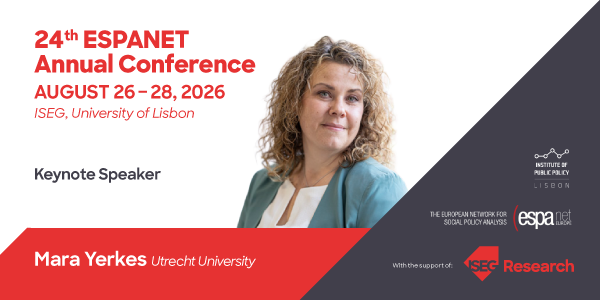
Work-life balance is a central pillar of the European Social Model. Yet despite far-reaching policy efforts, such as those contained in the European Work-Life Balance Directive, work-life ‘balance’ remains unequally distributed and experienced within and across countries. These inequalities can’t be addressed without going beyond work-life balance – to the core of social policy design, financing and implementation in contemporary welfare states, characterised by decentralization, digitalization and an emphasis on individual responsibility. In my keynote, I will outline how – against this backdrop and the decades-long invisibility of care – the reality of work-life balance for many working parents and carers is a navigational mess. And how having to navigate multiple policy and system landscapes allows social inequalities to persist or even worsen. In short, I will speak about how the social policy infrastructures inherent in contemporary welfare states have helped work-life balance shift from central pillar to an invisible, internal challenge to the European Social Model itself.
Short Bio:
Mara Yerkes is Full Professor of Comparative Social Policy in relation to Social Inequalities at Utrecht University. Yerkes comparatively researches welfare states and industrial relations at national and local levels and how these relate to inequalities in work, care, communities and families, with a particular focus on intersectional gender inequalities.
SOCIAL PROTECTION AND THE GREEN TRANSITION: EVIDENCE, KNOWLEDGE GAPS AND POLICY CHALLENGES
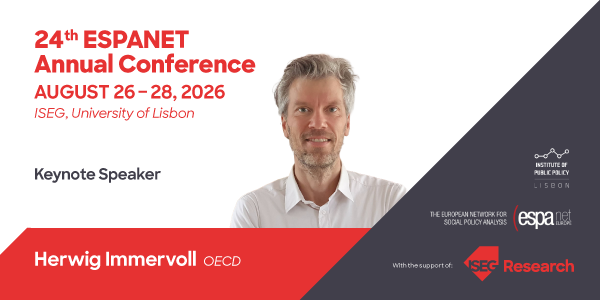
In this keynote, I will discuss how contemporary welfare states can move beyond merely cushioning structural change to actively shaping a socially robust and politically durable green transition. I will argue, first, that a “just transition” is not only an equity imperative but also a central condition for sustaining public support for ambitious climate policies. Understanding public attitudes, perceived burdens, and trust in institutions is therefore integral to the design, sequencing, and communication of climate and social policies, rather than a secondary consideration. Second, I will present evidence suggesting that, on the one hand, average household burdens arising from existing carbon prices are often overstated in political debate when compared with other shocks, such as recent spikes in inflation. On the other hand, disadvantaged households can already face additional carbon-related costs that are several times higher, as a share of income, than those experienced by top-income groups. Finally, I will explore why this compensatory potential remains underutilised in current policy practice and consider the implications for the future of European social models.
Short Bio:
Dr Herwig Immervoll is with the Directorate for Employment, Labour and Social Affairs at the OECD. He heads work on social benefits and the green transition and held earlier staff positions at the World Bank and the University of Cambridge. Herwig has led research projects and policy dialogue on inequality trends and redistribution, income and employment support, population ageing, and social policy responses to economic crises. Ongoing work includes advancing social protection in changing labour markets and climates, and supporting governments in making social policies more accessible, people-centred and fiscally sustainable.
The Conference fee includes coffee breaks and lunches on all three days of the Congress, Welcome Reception and Conference Dinner (August 27). (Note: Insurance, accommodation, and travel costs are not included in the Conference fee.)
Payment: Payment can only be made via bank transfer. Payment must be made within 30 days of Registration. Further instructions provided during the Registration process.
Invoicing: An invoice will be issued within 15 days upon payment confirmation of payment by the Organising Committee.
Cancellation policy: If participants need to cancel the registration, they will receive a 50% refund if they cancel until July 20, 2026 (50% cancellation fee). After July 20, 2026, no refund will be provided (100% cancellation fee).
| Registration 1 june – 14 august | Fees |
| Early Bird : 1 june – 30 june | 325€ / Phd Students – 175€ |
| Regular: 1 july – 31 july | 375€ / Phd Students – 225€ |
| Late: 1 august – 14 august | 400€ / Phd Students – 250 € |
More To Come Soon
The use of public transport is recommended, with destinations at the Assembleia da República or Calçada da Estrela stops, both located just a few minutes’ walk from the campus. The following lines serve these areas:
Bus
706-727 Av. D. Carlos I 1 minute by foot
713-773 Rua Borges Carneiro | 5 minutes by foot
714-760-774 Largo Conde Barão | 5 minutes by foot
728 Av. 24 de Julho | 7 minutes by foot
Tram
28-25 Calçada da Estrela | 2 minutes by foot
15-18 Av. 24 de Julho | 5 minutes by foot
Metro
Yellow Line leave at Rato Station | 10 minutes by foot
Green Line leave at Station Cais do Sodré | 15 minutes by foot
Train
Cascais Line leave at Santos Station | 7 minutes by foot
Campus Access
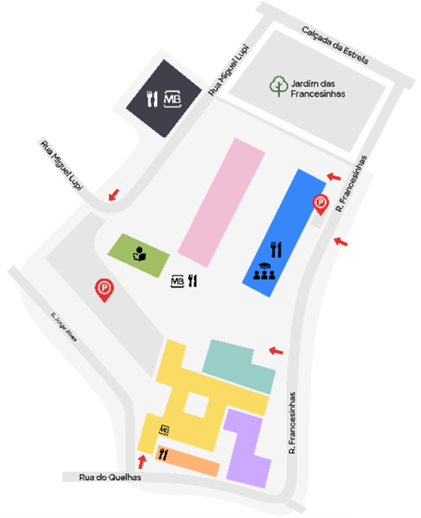
The campus can be accessed through two main entrances:
• Entrance via Rua das Francesinhas: you should proceed up the interior campus stairs to the top, where you will find the Quelhas 6 building. Please then follow the signage on site.
• Direct entrance via Rua do Quelhas, no. 6, or through the parking access: these entrances provide direct access to the building. Please then follow the signage on site.
We recommend, to use the Rua das Francesinhas Entrance.
During the event, visible signage will be placed throughout the campus indicating the way to ‘ESPAnet Conference’.
The Conference does not have any specific protocols concerning discount prices for accommodation. However, there are a set of nearby hotels that you can check for accommodation:
We would remind participants that the Conference takes place during the tourism high season in Lisbon, which means that finding accommodation can be challenging and prices might be higher than expected – if you leave it late to book your accommodation. Therefore, we advise participants to book their accommodation as soon as possible.
The Institute of Public Policy – Lisbon (IPP) is an academic-based, independent and nonpartisan think tank dedicated to improving the quality of public debate and making political decision-making processes more informed and rigorous.
Its mission is to contribute to the continuous improvement of the analysis of institutions and public policies, with a particular focus on Portugal and Europe, through the production and dissemination of relevant research.
IPP operates as a multidisciplinary think tank, combining economic analysis with political science across four main areas:
Its research is shared through publications and regular media engagement, while also fostering scientific and cultural exchange between Portugal, Europe, Portuguese-speaking countries, and, secondarily, the United States.
The Institute is guided by values such as freedom, pluralism, independence, innovation and rigor, as well as reciprocity, solidarity, and the pursuit of knowledge and the common good, aiming to promote a more open, informed and just society.
The work of the Organizing Committee is supported by the members of the Scientific Committee:
Carlos Farinha Rodrigues, University of Lisbon, ISEG Research
Elvira Pereira, University of Lisbon, ISCSP
Alexandra Lopes, University of Porto
Rui Branco, New University of Lisbon
Alexandre Afonso, Leyden University
Amílcar Moreira, IPP / ISEG Research
Carlos Farinha Rodrigues, IPP / ISEG Research
Daniela Craveiro, ISEG Research
Helena Gata, ISEG Research
Paula Cristina Albuquerque, ISEG Research
Susana Brissos, ISEG Research
If you have any questions regarding the conference, please contact us at: espanetlisbon@iseg.ulisboa.pt