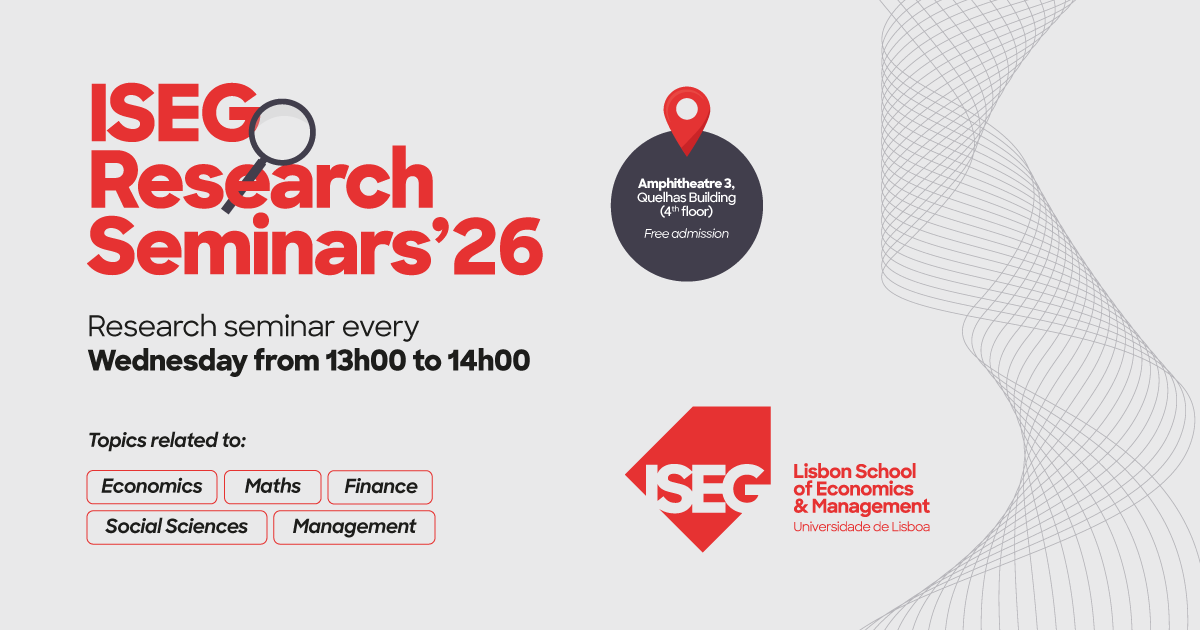











No dia 13 de maio, entre as 13h00 e as 14h00, tem lugar uma sessão dos ISEG Research Seminars. A oradora convidada será Ayala Arad, da Universidade de Tel Aviv .
Os Seminários ISEG Research decorrem semanalmente, às quartas-feiras, contando com a participação de docentes do ISEG, bem como de outras instituições de ensino nacionais e internacionais.
Title
An Experimental Study of Decision Rules in General vs. Concrete Insurance Problems
Abstract
Experimental work typically studies how individuals respond to particular, concrete decision problems. Yet many real-world choices are made at a more general level: decision makers often step back to determine how they would act across related situations with varying parameters. Such general strategies also appear in delegation and automation, where people provide guidelines for agents or algorithms to apply broadly. We introduce an incentive-compatible method to elicit free-text decision rules for general decision problems. Participants describe a rule to an automated system that applies it across concrete cases. A between-subject design compares choices under a General treatment to manual Case-by-case choices, while also collecting the written rules intended to replicate those choices. In an online experiment, participants made 20 incentivized binary insurance choices with varying loss probabilities and premiums. Insurance demand was lower under the abstract, rule-guided mode. When participants later reviewed the concrete outcomes of their rules, only half adjusted some choices, indicating overall endorsement of rule-based decision making. Revisions slightly increased insurance uptake, yet Case-by-case rates remained higher. These findings show that decision mode, abstract versus concrete, shapes behavior in ways consistent with construal-level theory (the impact of psychological distance). The methodology highlights distinctive procedural rules and provides a versatile tool for studying how individuals structure choices across contexts.