










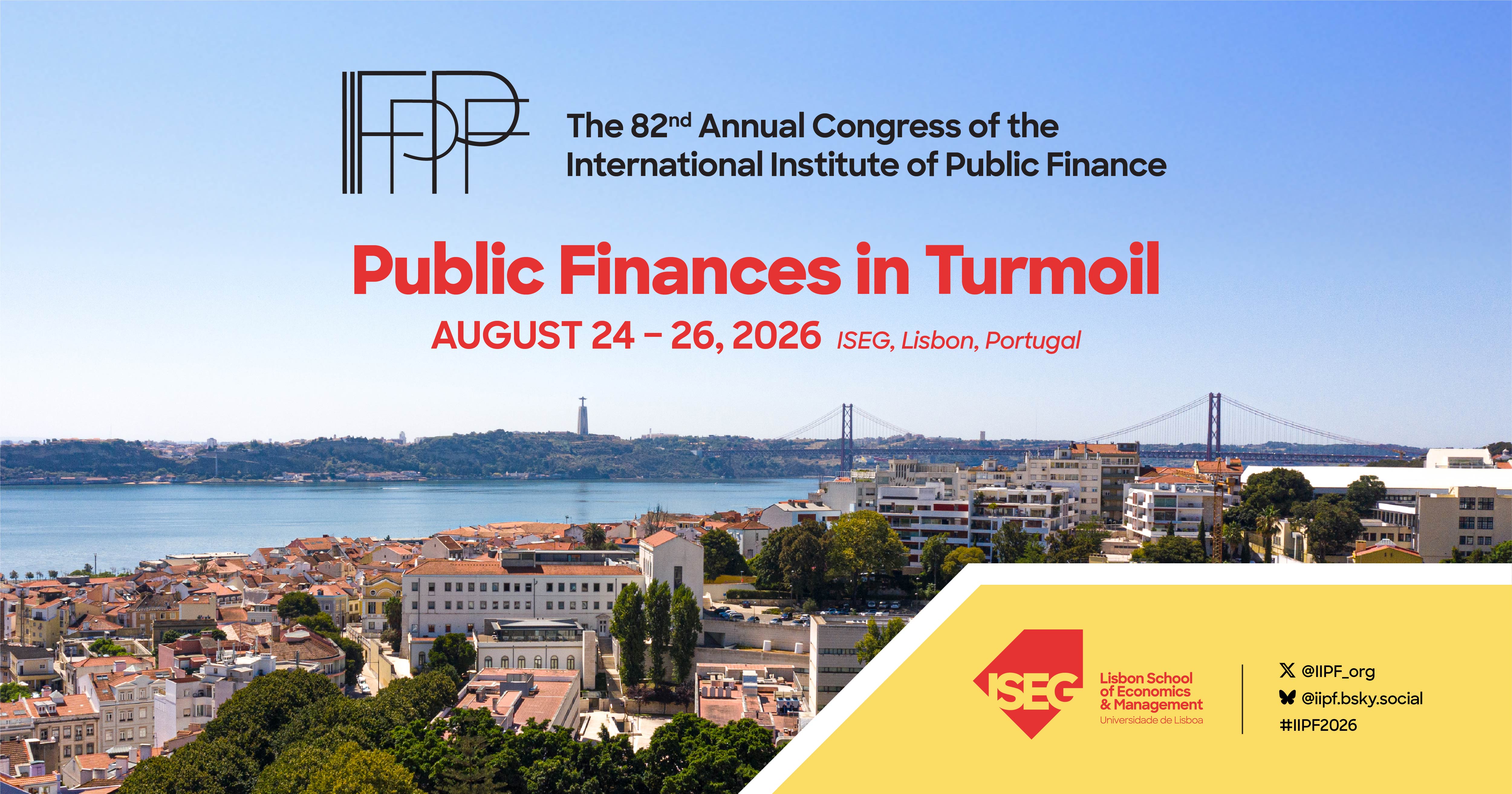
ISEG — Lisbon School of Economics & Management is hosting the 82nd Annual Congress of the International Institute of Public Finance (IIPF), one of the world’s most prestigious gatherings in the field of public finance.
Under the theme “Public Finances in Turmoil”, the congress aims to bring together academics, researchers, and policymakers to discuss the challenges and uncertainties shaping public finances in an era marked by economic crises, geopolitical shifts, and structural transitions. The event seeks to contribute to the global debate on budgetary sustainability, tax reforms, and the role of the State in an unstable economic environment, further strengthening Lisbon’s position as a centre of excellence in economic and finance research.
The local organisation is led by António Afonso, Brigitte Ferreira, José Alves and João Pereira dos Santos, lecturers and researchers at ISEG. The Scientific Committee is chaired by Naomi Feldman, from the Hebrew University of Jerusalem, and Dirk Foremny, from the University of Barcelona.
Call for papers
Public finances are under increasing strain in many parts of the world, reflecting a combination of slowing growth, rising debt levels, and heightened uncertainty in global markets. Advanced economies face mounting fiscal pressures linked to aging populations, structural deficits, and the long-term costs of health and social programs. In emerging and developing economies, governments must manage more volatile revenue streams, limited access to financing, and the persistent effects of economic shocks. Across different country contexts, these pressures have challenged established policy frameworks and raised new questions about the sustainability and effectiveness of current fiscal strategies. Given the high degree of global economic interconnectedness, the difficulties countries face in maintaining stable public finances have implications that extend beyond national borders. Fiscal consolidation efforts, debt restructuring processes, and responses to inflation can affect trade patterns, investment flows, and development prospects worldwide. At the same time, this period of fiscal turbulence provides an opportunity to reassess policy tools, draw on new analytical insights, and learn from the varied experiences of countries confronting similar constraints.
The keynote lectures of the conference will consider these issues and explore how governments might adapt public finance practices to better address the challenges ahead.
The conference will also host several events such as a mentoring program for young scholars in the field, and a networking reception for female scholars.
Prospective contributors, both practitioners and academics, are invited to submit papers on any topic within the field of public economics. The papers to be presented at the IIPF Congress will be selected by the Scientific Committee. Only completed papers in PDF format will be considered. Non–IIPF members must pay a submission fee of €20. Presenting authors from lower-income countries may apply for potential travel grants (within the submission form).
Acceptance decisions will be communicated in April 2026. Decisions on contributions from participants who need to apply for a visa (please note this when submitting your paper on the platform) will be prioritized in the weeks after the submission deadline in order to facilitate the visa application process. Presenting authors of accepted papers are required to become members of the IIPF and to confirm their presentation by registering by June 1, 2026. Payment of the annual membership fee ensures a reduced registration rate. For more information about IIPF membership please visit www.iipf.org/mbshp.
Authors who wish to be considered for the IIPF Young Economists Award, the IIPF Peggy and Richard Musgrave Prize (both for authors under 40 years), or the International Tax and Public Finance PhD Student Prize should indicate this when submitting papers for presentation. More information on the awards is available at www.iipf.org/awards.
Selected papers from the 2026 IIPF Congress will be published in a special issue of International Tax and Public Finance. To be considered for publication in this issue, papers must be submitted to the journal by September 15, 2026.
Important dates
| Deadline for Paper Submission | February 15, 2026 |
| Deadline for Payment of Membership or Submission Fee to the IIPF | February 15, 2026 |
| Notification of Paper Acceptance | early April, 2026 |
| Registration Start | early April, 2026 |
| Registration Deadline for Presenters | June 1, 2026 |
| Submission Deadline for ITAX special issue | September 15, 2026 |
Registration
Registration will be possible (with ConfTool account) as from April 2026 here.
| Regular Fee (deadline for presenters until June 1, 2026) | Late fee (deadline only for non-presenting participants after June 1, 2026) | |
| Registration Members | 425 € | 500 € |
| Registration Non-Members (only for non-presenting participants) | 575 € | 650 € |
| PhD students (lower rate) | 200 € | 250 € |
| Accompanying | 210 € | 210 € |
The conference fee includes coffee breaks and lunches on all three days of the Congress, welcome reception, social event and conference dinner (August 26). (Note: Insurance, accommodation, and travel costs are not included in the conference fee.)
Presenting authors of accepted papers are required to be or become members of the IIPF (annual fee: 120 € / reduced: 72 €) and to confirm their presentation by registering by June 1, 2026. Payment of the annual membership fee ensures a reduced registration rate.
Cancellation policy: If participants need to cancel the registration, they will receive a 50% refund if they cancel until July 20, 2026 (50% cancellation fee). After July 20, 2026, no refund will be provided (100% cancellation fee).
Accommodation
Committee Members
- Adam Lavecchia, McMaster University
- Alexandre Gnaedinger, University of Mannheim
- Ana Gamarra Rondinel, University of Melbourne
- Christian Traxler, Hertie School
- Clara Martínez-Toledano, Imperial College London
- Christian Traxler – Hertie School, Germany
- David Seim, Stockholm University
- Edoardo Di Porto, Sapienza University of Rome
- Francisco De Lima Cavalcanti, Universidade Federal de Pernambuco – PIMES
- Georg Thunecke, Max Planck Institute for Tax Law and Public Finance
- Irem Guceri, University of Oxford
- Isabel Mico-Millan, Banco de España
- Isabel Z. Martínez, KOF Institute ETH Zurich
- Jakob Brounstein, Institute for Fiscal Studies
- Javier Feinmann, Paris School of Economics
- Johanne Søndergaard, Copenhagen Business School
- Juan Rios, PUC Rio
- Juliana Londoño-Vélez, UCLA
- Julie Brun Bjørkheim, Institute for Social Research
- Katarzyna Bilicka, Utah State University
- Kristoffer Berg, University of Cambridge
- Laura Kawano, University of Michigan (OTPR)
- Leopoldo Fergusson, Universidad de los Andes
- Marcelo Bergolo, IECON – Universidad de La República
- Mariana Zerpa, University of Chile
- Mariona Segu, CY Cergy Paris Université
- Matthew Amalitinga Abagna, Tax Justice Network
- Miguel Almunia, CUNEF Universidad
- Nathan Seegert, Northeastern University
- Ronald B. Davies, University College Dublin
- Sebastien Bradley, Drexel University
- Sutirtha Bagchi, Villanova University
- Tomer Blumkin, Ben Gurion University of the Negev
- Tuomas Kosonen, VATT Institute for Economic Research, Helsinki
- Xuan Wang, Peking University
- Yeliz Kaçamak, Bogazici University
Keynotes
Keynote Speakers


Keynote Panel

About IIPF
The International Institute of Public Finance (IIPF) is the world organization of public finance economists, comprising approximately 500 members from over 50 countries. In an increasingly specialized academic field, the IIPF seeks to generate intellectual interchanges among public finance experts. The Institute’s annual congress is the main forum for its activities, which include organizing academic events, promoting the exchange of knowledge between academics and practitioners of all nationalities, and awarding prizes for outstanding academic achievements.
The congress also provides an opportunity for the IIPF governing bodies to convene (Board of Management, General Assembly of Members). The IIPF is currently administered by an Executive Committee consisting of President James R. Hines (University of Michigan, US) and two Vice Presidents, Sara LaLumia (Williams College, US) and Claus Thustrup Kreiner (University of Copenhagen, Denmark). The legal and administrative seat of the non-profit organization IIPF is in Munich, Germany.
Further information is available at www.iipf.org.
What else to do in Lisbon
Lisbon is the beautiful 2 000 years old capital of Portugal, which is one of the most charismatic and vibrant cities of Europe. The traditional heritage blends with remarkable modernism and progressive thinking.
There are countless experiences waiting for you:
Explore Historic Neighborhoods
Wander through Alfama, Bairro Alto, and Chiado, where narrow streets, colorful tiles, and hidden viewpoints tell the story of Lisbon’s past.
Enjoy the Local Cuisine
Taste traditional Portuguese dishes such as bacalhau à brás or sardinhas assadas, and don’t miss the famous pastéis de bacalhau and pastéis de nata.
Discover Iconic Landmarks
Visit Belém Tower, Jerónimos Monastery, and the Monument to the Discoveries for a glimpse into Portugal’s maritime history.
Take in Panoramic Views
Climb the São Jorge Castle or relax at one of the many miradouros (viewpoints) to enjoy breathtaking views over the city and the Tagus River.
Experience the Nightlife
Bairro Alto comes alive at night with bars, live music, and Fado performances—a unique way to experience Lisbon’s musical soul.
Day Trips Around Lisbon
Consider short trips to Sintra, with its fairy-tale palaces, or Cascais and Estoril for beautiful beaches and seaside charm. Discover more about Lisbon here.
Contacts
In case of administrative questions (registration, local arrangements) please contact us at iipf2026@iseg.ulisboa.pt (Brigitte Ferreira, local event manager)
In case of questions on the paper submission, submission/membership fees, IIPF in general, please contact hebele@iipf.org (Barbara Hebele, IIPF Administration Manager)