









Com uma programação ampla e diversificada, a edição de 2025 oferece à comunidade do ISEG múltiplas oportunidades de aprendizagem, reflexão e participação em torno das várias dimensões da sustentabilidade.
Este é também o momento em que partilhamos os progressos alcançados em 2024, através da apresentação do Relatório de Sustentabilidade, e em que promovemos, ao longo da semana, debates e atividades dedicadas a temas como a inovação e o impacto social, a igualdade de género nas estratégias empresariais, a transição climática, a educação para a sustentabilidade, a comunicação positiva e o bem-estar, bem como a integração dos princípios ambientais, sociais e de governação (ESG) nas organizações.
Toda a comunidade do ISEG é convidada a participar ativamente em desafios criativos e colaborativos, como o Hackathon do Future Founders, a envolver-se em atividades práticas na Mini-Floresta, a assistir a workshops interativos sobre a crise climática e a integrar sessões de formação e reflexão conduzidas por especialistas, docentes e parceiros institucionais.
| 20 de outubro | 13h00 – 15h00 Hackathon – Future Founders – “Diversity by Design: Building Inclusive Clinical Trials from the Start”. Empresa convidada: IQVIA é uma líder global em ciência de dados, tecnologia e saúde, presente em mais de 100 países. Local: Sala 308, Quelhas 6 Link de Inscrição 16h00 – 18h00 Green Step – AEISEG Local: Sala de Convívio da Associação de Estudantes |
| 22 de outubro | 14h30 Sessão de formação para staff: Comunicação Positiva: Prevenção do Comportamentos Autolesivos Local: Sala Iapmei, Quelhas 6 15h30 – 17h00 Navigating The Climate Crisis Workshop, com Youth Climate Leaders Portugal – Sesão em EN Local: Sala 214, Francesinhas 1 Link de inscrição 18h00 – 18h20 Apresentação do Relatório de Sustentabilidade Local: Auditório 2, Quelhas 6 18h20 – 19h30 Pitches finais e Cerimónia de Entrega do Prémio ESG ISEG Local: Auditório 2, Quelhas 6 18h30 – 19h30 Talk: O Pilar Social na Estratégia de Sustentabilidade das Empresas, com Pedro Aragão Morais, Fundador da Sector 3 – Social Brokers Local: Sala Delta, Quelhas 6 |
| 23 de outubro | 9h30 – 12h30 Atividade de expansão, limpeza na Mini-Floresta, com Oriana Brás Local: Mini-floresta Link de inscrição 12h30-14h00 Evento para docentes e staff: Aulas com Impacto: PRME e i5, com as professoras Winnie Picoto e Helena Jerónimo Local: Auditório 2 |
| 24 de outubro | 9h30 – 11h30 Round table – Inovação, Sustentabilidade e Impacto Social , como integrar a igualdade de género nas estratégias ESG? Atividade acontece no âmbito da iniciativa conversas sustentáveis da Plataforma Lisboa Sustentável da CML. Local: Palácio das Galveias. Link para incrição 18h00 -20h30 ECRA Roadshow – Apresentação da certificação e métricas padronizadas para avaliação de riscos climáticos. Local: Auditório 4, Quelhas 6 |
| 28 de outubro Evento Extra | 20h30 Wicket Accelerator com Manuel Laranja Acelerador de inovação que conta com o apoio de técnicas de system thinking para diagnosticar e propor ações dirigidas a grandes desafios sociais e ambientais Local: Sala 108, Francesinhas 1 |
No dia 27 de outubro, não perca o seminário “Marketing Analytics no Mundo Digital“, organizado no âmbito do Mestrado em Marketing do ISEG.
O tema será apresentado por Grazi Sbardelotto, Partener e Vice – presidente da PMWEB.
O seminário decorre das 18h30 às 20h30, no Auditório 5 (Quelhas).
Entrada gratuita, sujeita a pré-inscrição neste LINK.
No âmbito das comemorações do 35º aniversário da ISEG Alumni Económicas, temos o prazer de o/a convidar para a conferência “O Desenvolvimento do Capital Humano, do Talento e do Empreendedorismo”, integrada no Ciclo de Conferências “Para onde vão o Mundo, a Europa e Portugal?.
A sessão irá decorrer no Auditório CGD (Edifício Quelhas, 2º Piso), com início agendado para as 17h00, tendo Joana Pais, Miguel St. Aubyn e Nuno Crato como oradores.
A entrada é livre, sujeita a inscrição prévia neste link.
Contamos consigo.
Na quarta-feira, dia 8 de outubro, entre as 13h00 e as 14h00, tem lugar mais uma sessão dos ISEG Research Seminars, com Ulrich Doraszelski (Universidade da Pensilvânia), que irá apresentar o paper “Production Function Estimation without Invertibility: Imperfectly Competitive Environments and Demand“.
Os Seminários ISEG Research decorrem semanalmente, às quartas-feiras, no Anfiteatro 4 do Edifício Quelhas (4.º piso), contando com a participação de docentes do ISEG, bem como de outras instituições de ensino nacionais e internacionais.
Entrada livre.
We advance the proxy variable approach to production function estimation. We show that the invertibility assumption at its heart is testable. We characterize what goes wrong if invertibility fails and what can still be done. We show that rethinking how the estimation procedure is implemented either eliminates or mitigates the bias that arises if invertibility fails. In particular, a simple change to the first step of the estimation procedure provides a first-order bias correction for the GMM estimator in the second step. Furthermore, a modification of the moment condition in the second step ensures Neyman orthogonality and enhances efficiency and robustness by rendering the asymptotic distribution of the GMM estimator invariant to estimation noise from the first step.
Na quarta-feira, dia 1 de outubro, entre as 13h00 e as 14h00, tem lugar mais uma sessão deste ano letivo dos ISEG Research Seminars, com Ludgero Glorias (Universidade de Surrey), que irá apresentar o paper “Nonparametric “rich covariates” without saturation“.
Os Seminários ISEG Research terão lugar semanalmente, às quartas-feiras, no Anfiteatro 4 do Edifício Quelhas (4.º piso), contando com a participação de docentes do ISEG, bem como de outras instituições de ensino nacionais e internacionais.
Entrada livre.
We consider two nonparametric approaches to ensure that linear instrumental variables estimators satisfy the rich-covariates condition emphasized by Blandhol et al. (2025), even when the instrument is not unconditionally randomly assigned and
the model is not saturated. Both approaches start with a nonparametric estimate of the expectation of the instrument conditional on the covariates, and ensure that the rich-covariates condition is satisfied either by using as the instrument the difference between the original instrument and its estimated conditional expectation, or by adding the estimated conditional expectation to the set of regressors. We derive asymptotic properties when the first step uses kernel regression, and assess finite-sample performance in simulations where we also use neural networks in the first step. Finally, we present an empirical illustration that highlights some significant advantages of the proposed methods.
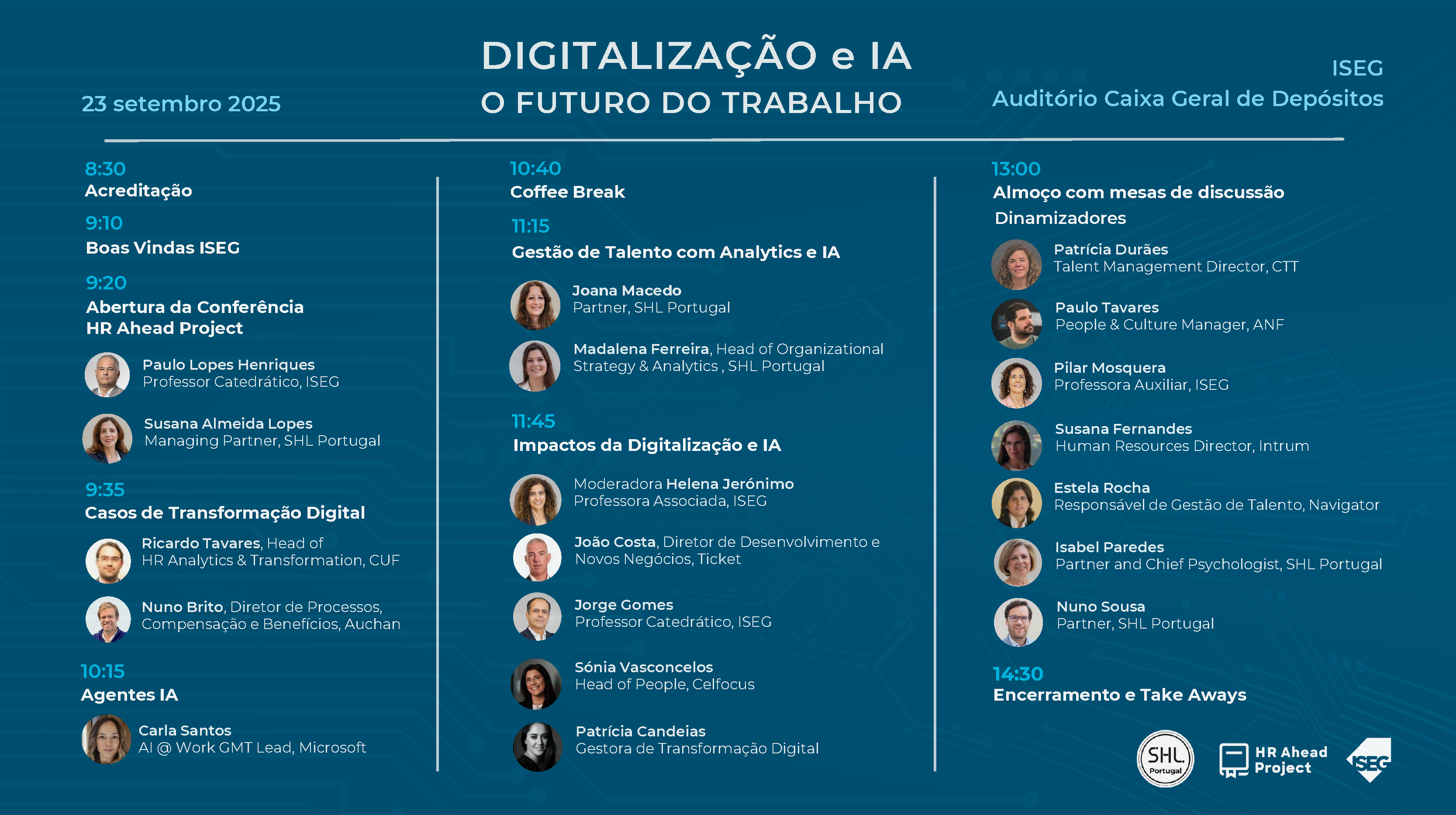
No dia 23 de setembro, realiza-se a conferência “O Futuro do Trabalho“, organizada em parceria pela SHL Portugal e a plataforma HR Ahead Project do ISEG.
A conferência inicia-se às 9h10, no Auditório CGD do ISEG, numa manhã especialmente dedicada a Gestores e Diretores de Recursos Humanos, onde será apresentado e debatido um novo modelo de competências destinado a apoiar as organizações portuguesas na resposta aos desafios atuais e futuros.
Entre os temas em destaque, estarão:
• As exigências de reskilling e upskilling
• O papel dos líderes na gestão da mudança
• As intervenções possíveis e necessárias nas organizações
• A relevância estratégica dos RH neste novo cenário
Tudo isto numa conversa sobre como transformar o tempo libertado pela Inteligência Artificial em ação com impacto humano e organizacional.
A conferência contará com a participação dos professores do ISEG Paulo Lopes Henriques, Helena Jerónimo e Jorge Gomes e Pilar Mosquera.
Entrada gratuita, sujeita a pré-inscrição neste link.
Na quarta-feira, dia 10 de setembro, entre as 13h00 e as 14h00, tem lugar a primeira sessão deste ano letivo dos ISEG Research Seminars, com Monica Achim (Babes-Bolyai University).
Os Seminários ISEG Research terão lugar semanalmente, às quartas-feiras, no Anfiteatro 4 do Edifício Quelhas (4.º piso), contando com a participação de docentes do ISEG, bem como de outras instituições de ensino nacionais e internacionais.
Entrada livre.
The purpose of our research is to estimate the effects of state revenues from various types of taxes upon the corruption and shadow economy phenomena for a generous sample of worldwide countries. We validate the quadratic approach for the impact of taxes upon financial and economic crime phenomena. Corporate and individual income taxes, as well as property and goods and services taxes hold a more pronounced impact on both corruption and shadow economy of developed countries, as compared to developing countries, the steepness of the (inversely) U-shaped curve being lighter for the latter. Social contributions and taxes on payroll and workforce slightly support the parametric approach. The inflection points stand as threshold values that draw important exclamation marks in terms of public policies, in order to use taxes as a means of decreasing financial and economic crime phenomena. Those thresholds express the resilience levels of those groups of countries, as maximum or minimum points of the specific taxes, beyond which the trend of financial and economic crime phenomena is reversed.
A Conferência International 2025 sobre Ética e Independência, organizada pelo International Ethics Standards Board for Accountants (IESBA), irá acontecer no ISEG, no dia 15 de setembro.
Sob o tema “Ética e Independência na Auditoria: Pilares de Resiliência e Competitividade em Tempos de Incerteza”, a conferência reunirá reguladores, investidores, standard setters, firmas de contabilidade e auditoria e líderes profissionais e empresariais. O objetivo é analisar o papel central da ética na preservação da confiança e estabilidade, bem como no apoio à inovação num contexto de disrupção.
Os oradores principais incluem Maria Luís Albuquerque, Comissária Europeia para os Serviços Financeiros e para a União da Poupança e dos Investimentos, Jean-Paul Servais, Presidente da IOSCO, e Joaquim Miranda Sarmento, Ministro de Estado e das Finanças de Portugal e professor no ISEG.
A participação é gratuita, mas os lugares são limitados à capacidade da sala.
Mais informações e inscrições aqui
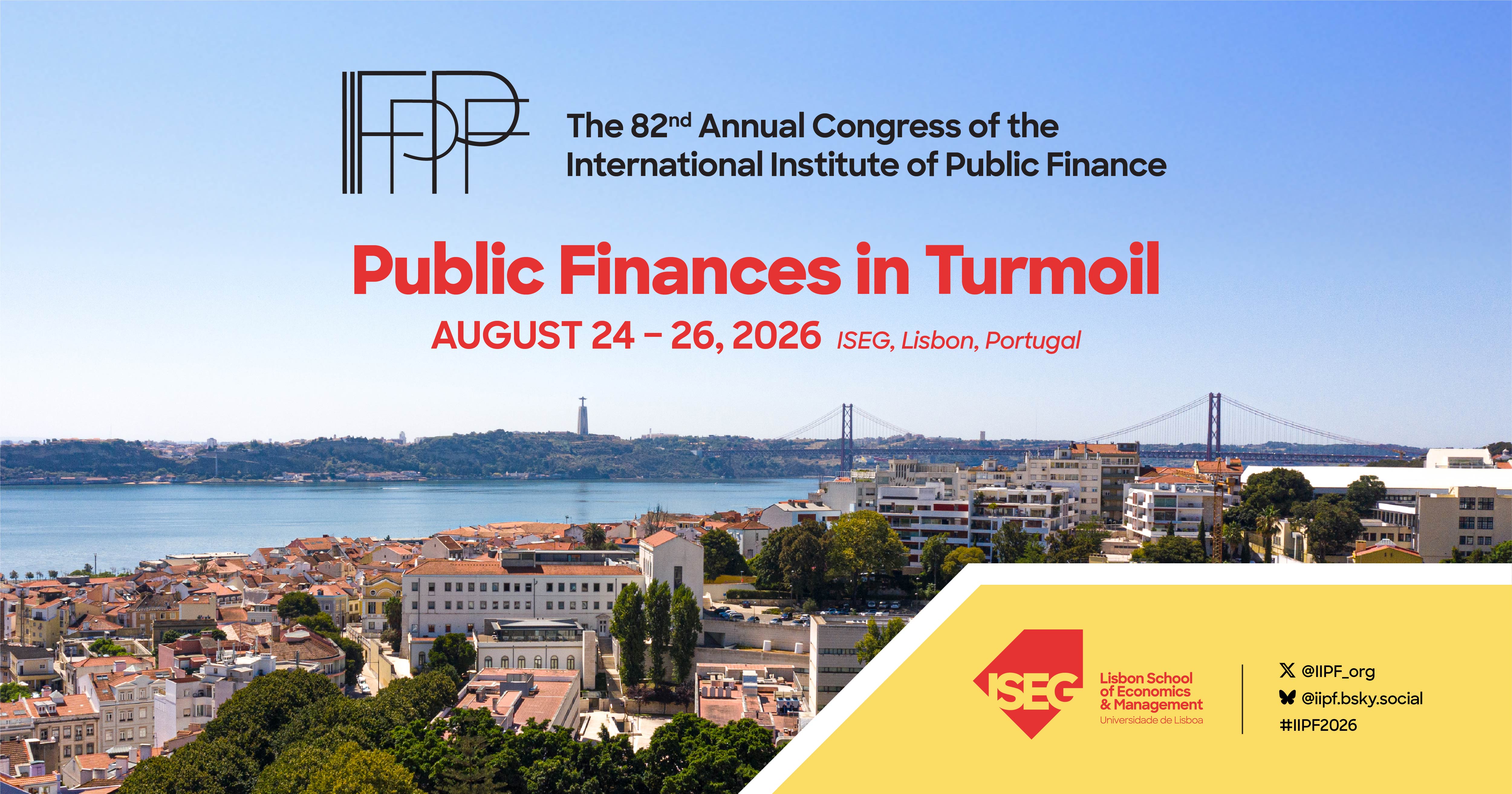
ISEG — Lisbon School of Economics & Management is hosting the 82nd Annual Congress of the International Institute of Public Finance (IIPF), one of the world’s most prestigious gatherings in the field of public finance.
Under the theme “Public Finances in Turmoil”, the congress aims to bring together academics, researchers, and policymakers to discuss the challenges and uncertainties shaping public finances in an era marked by economic crises, geopolitical shifts, and structural transitions. The event seeks to contribute to the global debate on budgetary sustainability, tax reforms, and the role of the State in an unstable economic environment, further strengthening Lisbon’s position as a centre of excellence in economic and finance research.
The local organisation is led by António Afonso, Brigitte Ferreira, José Alves and João Pereira dos Santos, lecturers and researchers at ISEG. The Scientific Committee is chaired by Naomi Feldman, from the Hebrew University of Jerusalem, and Dirk Foremny, from the University of Barcelona.
Public finances are under increasing strain in many parts of the world, reflecting a combination of slowing growth, rising debt levels, and heightened uncertainty in global markets. Advanced economies face mounting fiscal pressures linked to aging populations, structural deficits, and the long-term costs of health and social programs. In emerging and developing economies, governments must manage more volatile revenue streams, limited access to financing, and the persistent effects of economic shocks. Across different country contexts, these pressures have challenged established policy frameworks and raised new questions about the sustainability and effectiveness of current fiscal strategies. Given the high degree of global economic interconnectedness, the difficulties countries face in maintaining stable public finances have implications that extend beyond national borders. Fiscal consolidation efforts, debt restructuring processes, and responses to inflation can affect trade patterns, investment flows, and development prospects worldwide. At the same time, this period of fiscal turbulence provides an opportunity to reassess policy tools, draw on new analytical insights, and learn from the varied experiences of countries confronting similar constraints.
The keynote lectures of the conference will consider these issues and explore how governments might adapt public finance practices to better address the challenges ahead.
The conference will also host several events such as a mentoring program for young scholars in the field, and a networking reception for female scholars.
Prospective contributors, both practitioners and academics, are invited to submit papers on any topic within the field of public economics. The papers to be presented at the IIPF Congress will be selected by the Scientific Committee. Only completed papers in PDF format will be considered. Non–IIPF members must pay a submission fee of €20. Presenting authors from lower-income countries may apply for potential travel grants (within the submission form).
Acceptance decisions will be communicated in April 2026. Decisions on contributions from participants who need to apply for a visa (please note this when submitting your paper on the platform) will be prioritized in the weeks after the submission deadline in order to facilitate the visa application process. Presenting authors of accepted papers are required to become members of the IIPF and to confirm their presentation by registering by June 1, 2026. Payment of the annual membership fee ensures a reduced registration rate. For more information about IIPF membership please visit www.iipf.org/mbshp.
Authors who wish to be considered for the IIPF Young Economists Award, the IIPF Peggy and Richard Musgrave Prize (both for authors under 40 years), or the International Tax and Public Finance PhD Student Prize should indicate this when submitting papers for presentation. More information on the awards is available at www.iipf.org/awards.
Selected papers from the 2026 IIPF Congress will be published in a special issue of International Tax and Public Finance. To be considered for publication in this issue, papers must be submitted to the journal by September 15, 2026.
| Deadline for Paper Submission | February 15, 2026 |
| Deadline for Payment of Membership or Submission Fee to the IIPF | February 15, 2026 |
| Notification of Paper Acceptance | early April, 2026 |
| Registration Start | early April, 2026 |
| Registration Deadline for Presenters | June 5, 2026 |
| Submission Deadline for ITAX special issue | September 15, 2026 |
Registration will be possible (with ConfTool account) as from April 2026 here.
| Regular Fee (deadline for presenters until June 5, 2026) | Late fee (deadline only for non-presenting participants after June 5, 2026) | |
| Registration Members | 425 € | 500 € |
| Registration Non-Members (only for non-presenting participants) | 575 € | 650 € |
| PhD students (lower rate) | 200 € | 250 € |
| Accompanying | 210 € | 210 € |
The conference fee includes coffee breaks and lunches on all three days of the Congress, welcome reception, social event and conference dinner (August 26). (Note: Insurance, accommodation, and travel costs are not included in the conference fee.)
Presenting authors of accepted papers are required to be or become members of the IIPF (annual fee: 120 € / reduced: 72 €) and to confirm their presentation by registering by June 1, 2026. Payment of the annual membership fee ensures a reduced registration rate.
Cancellation policy: If participants need to cancel the registration, they will receive a 50% refund if they cancel until July 20, 2026 (50% cancellation fee). After July 20, 2026, no refund will be provided (100% cancellation fee).
Here are some suggestions, chosen for their proximity to the congress venue:
⭐ 4 stars
💶~300€ per night
📍900m from ISEG
🚶♀️13 min walking distance or bus 713
⭐ 3 stars
💶~180€ per night
📍1km from ISEG
🚶♀️14 min walking distance or bus 706/727
⭐ 5 stars
💶~350€ per night
📍1.2km from ISEG
🚶♀️16 min walking distance or bus 773
⭐ 5 stars
💶~580€ per night
📍1.2km from ISEG
🚶♀️17 min walking distance or bus 706
⭐ 3 stars
💶~100€ per night
📍1.1km from ISEG
🚶♀️14 min walking distance or bus 773/706/727
⭐ 3 stars
💶~150€ per night
📍1.9km from ISEG
🚶♀️27 min walking distance or bus 706/727
⭐ 4 stars
💶~200€ per night
📍800m from ISEG
🚶♀️12 min walking distance or bus 727/706
⭐ 2 stars
💶 ~100€/night
📍 350 m from ISEG
🚶♀️ 5 min walking distance
⭐ 3 stars
💶 ~90€/night
📍 350 m from ISEG
🚶♀️ 5 min walking distance
⭐ 3 stars
💶 ~100€/night
📍 2,2 km from ISEG
🚍 727 (10–15 min)
💶 ~100-150€/night
📍 800 m from ISEG
🚶♀️ 12 min walking distance
⭐ 2 stars
💶 120-150€/night
📍 1,3 km from ISEG
🚶♀️ 20 min walking distance
🚋 28E | 🚍 774
⭐ 3 stars
💶 ~100€/ night
📍 1,5 km from ISEG
🚶♀️ 20 min walking distance
🚋 28E | 🚍 774, 706
⭐ 2 stars
💶 80–100€/ night
📍 1,3 km from ISEG
🚶♀️ 18 min walking distance
🚋 28E | 🚍 774
⭐ 2 stars
💶 100–150€/night
📍 1,6 km from ISEG
🚶♀️ 22 min walking distance
🚍 Transportes: 706 ou 714
You can find a large number of Hostels in Lisbon



The International Institute of Public Finance (IIPF) is the world organization of public finance economists, comprising approximately 500 members from over 50 countries. In an increasingly specialized academic field, the IIPF seeks to generate intellectual interchanges among public finance experts. The Institute’s annual congress is the main forum for its activities, which include organizing academic events, promoting the exchange of knowledge between academics and practitioners of all nationalities, and awarding prizes for outstanding academic achievements.
The congress also provides an opportunity for the IIPF governing bodies to convene (Board of Management, General Assembly of Members). The IIPF is currently administered by an Executive Committee consisting of President James R. Hines (University of Michigan, US) and two Vice Presidents, Sara LaLumia (Williams College, US) and Claus Thustrup Kreiner (University of Copenhagen, Denmark). The legal and administrative seat of the non-profit organization IIPF is in Munich, Germany.
Further information is available at www.iipf.org.
Lisbon is the beautiful 2 000 years old capital of Portugal, which is one of the most charismatic and vibrant cities of Europe. The traditional heritage blends with remarkable modernism and progressive thinking.
There are countless experiences waiting for you:
Explore Historic Neighborhoods
Wander through Alfama, Bairro Alto, and Chiado, where narrow streets, colorful tiles, and hidden viewpoints tell the story of Lisbon’s past.
Enjoy the Local Cuisine
Taste traditional Portuguese dishes such as bacalhau à brás or sardinhas assadas, and don’t miss the famous pastéis de bacalhau and pastéis de nata.
Discover Iconic Landmarks
Visit Belém Tower, Jerónimos Monastery, and the Monument to the Discoveries for a glimpse into Portugal’s maritime history.
Take in Panoramic Views
Climb the São Jorge Castle or relax at one of the many miradouros (viewpoints) to enjoy breathtaking views over the city and the Tagus River.
Experience the Nightlife
Bairro Alto comes alive at night with bars, live music, and Fado performances—a unique way to experience Lisbon’s musical soul.
Day Trips Around Lisbon
Consider short trips to Sintra, with its fairy-tale palaces, or Cascais and Estoril for beautiful beaches and seaside charm. Discover more about Lisbon here.
In case of administrative questions (registration, local arrangements) please contact us at iipf2026@iseg.ulisboa.pt (Brigitte Ferreira, local event manager)
In case of questions on the paper submission, submission/membership fees, IIPF in general, please contact hebele@iipf.org (Barbara Hebele, IIPF Administration Manager)
ISEG – Lisbon School of Economics & Management
R. Francesinhas 21, 1200-675 Lisboa
O ISEG – Lisbon School of Economics & Management, o SOCIUS/ISEG Research e o EIM – Environment, Innovation and Management organizam a conferência PRSDA 2025 – Innovation-Driven Environmental Management and Regional Sustainability, no próximo dia 18 de julho de 2025.
A conferência, a realizar no ISEG, pretende discutir estratégias inovadoras de gestão ambiental e sustentabilidade regional, com o apoio da Changsha University of Science and Technology e da Pacific Rim Sustainable Development Association.
O evento conta com a presença dos professores Mariya Gubareva e Tiago Cardão-Pito, do ISEG, e do doutorando em Economia do ISEG, Yu-Jie Liang.
Programa aqui.
A participação nas sessões da conferência é gratuita, condicionada apenas à capacidade das salas. O programa social, contudo, destina-se exclusivamente a convidados.