








On Wednesday, October 22nd, frim 13.00 to 14.00, there will be another session of the ISEG Research Seminars, for which Jon Fiva (Norwegian Business School), who will present the paper on "Vetting for Virtue: Democracy's Challenge in Excluding Criminals from Office“.
The ISEG Research Seminars are held every week on Wednesdays in Lecture Theatre 4 of Quelhas (4th floor), with the participation of professors from ISEG and other Portuguese and international universities.
Free admission.
How effective are democratic systems in preventing individuals with criminal backgrounds from holding political office? We investigate this question for the case of Norway, which has no legal restrictions against felons running for office. We analyze local election candidates from 2003 to 2019, paired with administrative records of criminal offenses. We demonstrate that individuals with criminal records are systematically penalized at every stage of their political careers. Candidates are less likely to have criminal records than the general population, with elected officials less likely to have criminal backgrounds than their unelected peers, and mayors being the most lawful. In Norway's flexible-list PR system where parties rank candidates and voters can cast personal votes for preferred candidates-our evidence shows that party gatekeeping accounts for most filtering, while personal votes contribute little at the margin.
On 28th October, another seminar in the series of Development Studies Seminars 2025-2026. Entitled "Industrial Policy and African-based Manufacturing: Institutional Dimensions. The event will feature the participation of Professor Howard Stein (Department of African American and African Studies, University of Michigan, USA).
The seminar will take place from 18.00 to 20.00, in Novo Banco Lecture Theatre (Quelhas, ISEG).
Free admission.
The Lisbon DLBC Network, in collaboration with various social currency initiatives in Spain, is organizing the 1st Iberian Social Currency MeetingThe event will take place in Lisbon on October 24 and 25, 2025. This meeting is being held with the support of ISEG Research at ISEG - Lisbon School of Economics & Management.
This event will bring together researchers, civil society organizations and international community initiativeswith the aim of deepening the debate on the social and complementary currencies as a tool for social, economic and ecological transformation. The aim is to create a space for dialog, mutual learning and coordination between Iberian initiatives, promoting the strengthening of networks and the emergence of new collaborations.
Social currencies have taken on an increasingly important role in promoting the solidarity economy, from territorial cohesion team and transition to more sustainable and inclusive models.
| 24th October | Sessions at ISEG Lisbon School of Economics & Management (Auditorium 5, entrance on Rua das Francesinhas) |
| 25th October | Activities in DLBC Lisbon Resource Center and in the Carnide Cultural Centerboth located in the Padre Cruz neighborhood |
Programme Conference
Registration at the Conference
Dinner registration Set for October 24th
Lunch registration Set for October 25th
Further information here

With a wide and diversified programand 2025 edition offers the ISEG community multiple opportunities to learning, reflection and participation around the various dimensions of sustainability.
This is also the moment when we share the progress made in 2024by presenting the Sustainability Reportand which we promote throughout the week, debates and activities dedicated to themes such as innovation and social impactand gender equality in business strategiesand climate transitionand education for sustainabilityand positive communication and well-beingas well as the integration of environmental, social and governance (ESG) principles in organizations.
All ISEG community is invited to actively participate in creative and collaborative challenges, such as the Future Founders Hackathonto get involved in practical activities at Mini-forestand attend interactive workshops on the climate crisis and the integrate training and reflection sessions conducted by experts, teachers and institutional partners.
| 20 October | 13h00 - 15h00 Hackathon - Future Founders - "Diversity by Design: Building Inclusive Clinical Trials from the Start". Invited company: IQVIA is a global leader in data science, technology and health, present in more than 100 countries. Venue: Room 308, Quelhas 6 Registration link 16h00 - 18h00 Green Step - AEISEG Venue: Student Association Lounge |
| 22nd October | 14.30 Training session for staff: Positive Communication: Preventing Self-Injurious Behavior Venue: Sala Iapmei, Quelhas 6 15.30 - 17.00 Navigating The Climate Crisis Workshop, with Youth Climate Leaders Portugal - EN session Venue: Room 214, Francesinhas 1 Link for enrolment 18h00 - 18h20 Presentation of Sustainability Report Venue: Auditorium 2, Quelhas 6 18h20 - 19h30 Final pitches and ISEG ESG Award Ceremony Venue: Auditorium 2, Quelhas 6 18h30 - 19h30 Talk: The Social Pillar in Corporate Sustainability Strategywith Pedro Aragão Morais, Founder of Sector 3 - Social Brokers Venue: Sala Delta, Quelhas 6 |
| 23rd October | 9:30 a.m. - 12:30 p.m. Expansion activity, cleaning in the Mini-Forest, with Oriana Brás Location: Mini forest Link tonscription 12h30-14h00 Event for teachers and staff: Lessons with Impact: PRME and i5with teachers Winnie Picoto and Helena Jerónimo Venue: Auditorium 2 |
| 24th October | 9h30 - 11h30 Round table - Innovation, Sustainability and Social Impact , how to integrate gender equality into ESG strategies? The activity takes place as part of the Sustainable Conversations initiative of CML's Sustainable Lisbon Platform. Venue: Galveias Palace. Registration link 18h00 -20h30 ECRA Roadshow - Presentation of certification and standardized metrics for climate risk assessment. Venue: Auditorium 4, Quelhas 6 |
| 28th October Extra Event | 20.30 Wicket Accelerator with Manuel Orange Innovation accelerator with the support of system thinking to diagnose and propose actions aimed at major social and environmental challenges Venue: Room 108, Francesinhas 1 |
On October 27, don't miss the seminar "Marketing Analytics in the Digital World", organized as part of ISEG's Master's in Marketing.
The topic will be presented by Grazi SbardelottoPartener and Vice President of PMWEB.
The seminar takes place from 6:30 p.m. to 8:30 p.m. in Auditorium 5 (Quelhas).
Admission is free, subject to pre-registration on this LINK.
As part of the 35th anniversary celebrations of ISEG Alumni Económicas, you are invited to the conference 'The Development of Human Capital, Talent and Entrepreneurship', part of the cycle of conferences "Where is it that the world, Europe and Portugal are heading?"
The session will take place in the CGD Auditorium (Quelhas, 2nd Floor), starting at 17.00. Joana Pais, Miguel St. Aubyn and Nuno Crato are speakers.
Free admission, subject to prior registration on this link.
We're counting on you.
On Wednesday, 8 October, frim 13.00 to 14.00, there will be another session of the ISEG Research Seminars, for which Ulrich Doraszelski (University of Pennsylvania), who will present the paper on "Production Function Estimation without Invertibility: Imperfectly Competitive Environments and Demand“.
The ISEG Research Seminars are held every week on Wednesdays in Lecture Theatre 4 of Quelhas (4th floor), with the participation of professors from ISEG and other Portuguese and international universities.
Free admission.
We advance the proxy variable approach to production function estimation. We show that the invertibility assumption at its heart is testable. We characterize what goes wrong if invertibility fails and what can still be done. We show that rethinking how the estimation procedure is implemented either eliminates or mitigates the bias that arises if invertibility fails. In particular, a simple change to the first step of the estimation procedure provides a first-order bias correction for the GMM estimator in the second step. Furthermore, a modification of the moment condition in the second step ensures Neyman orthogonality and enhances efficiency and robustness by rendering the asymptotic distribution of the GMM estimator invariant to estimation noise from the first step.
On Wednesday, 1 October, from 13.00 to 14.00, another session of this academic year's ISEG Research Seminars, for which Ludgero Glorias (University of Surrey), who will present a paper on “Nonparametric 'rich covariates' without saturation“.
The ISEG Research Seminars take place each week, on Wednesdays, in Lecture theatre 4 of Quelhas (4th floor), with the participation of ISEG professors, as well as professors from other Portuguese and international universities.
Free admission.
We consider two non-parametric approaches to ensure that linear instrumental variables estimators satisfy the rich-covariates condition emphasised by Blandhol et al. (2025), even when the instrument is not unconditionally randomly assigned and
the model is not saturated. Both approaches start with a nonparametric estimate of the expectation of the instrument conditional on the covariates, and ensure that the rich-covariates condition is satisfied either by using as the instrument the difference between the original instrument and its estimated conditional expectation, or by adding the estimated conditional expectation to the set of regressors. We derive asymptotic properties when the first step uses kernel regression, and assess finite-sample performance in simulations where we also use neural networks in the first step. Finally, we present an empirical illustration that highlights some significant advantages of the proposed methods.
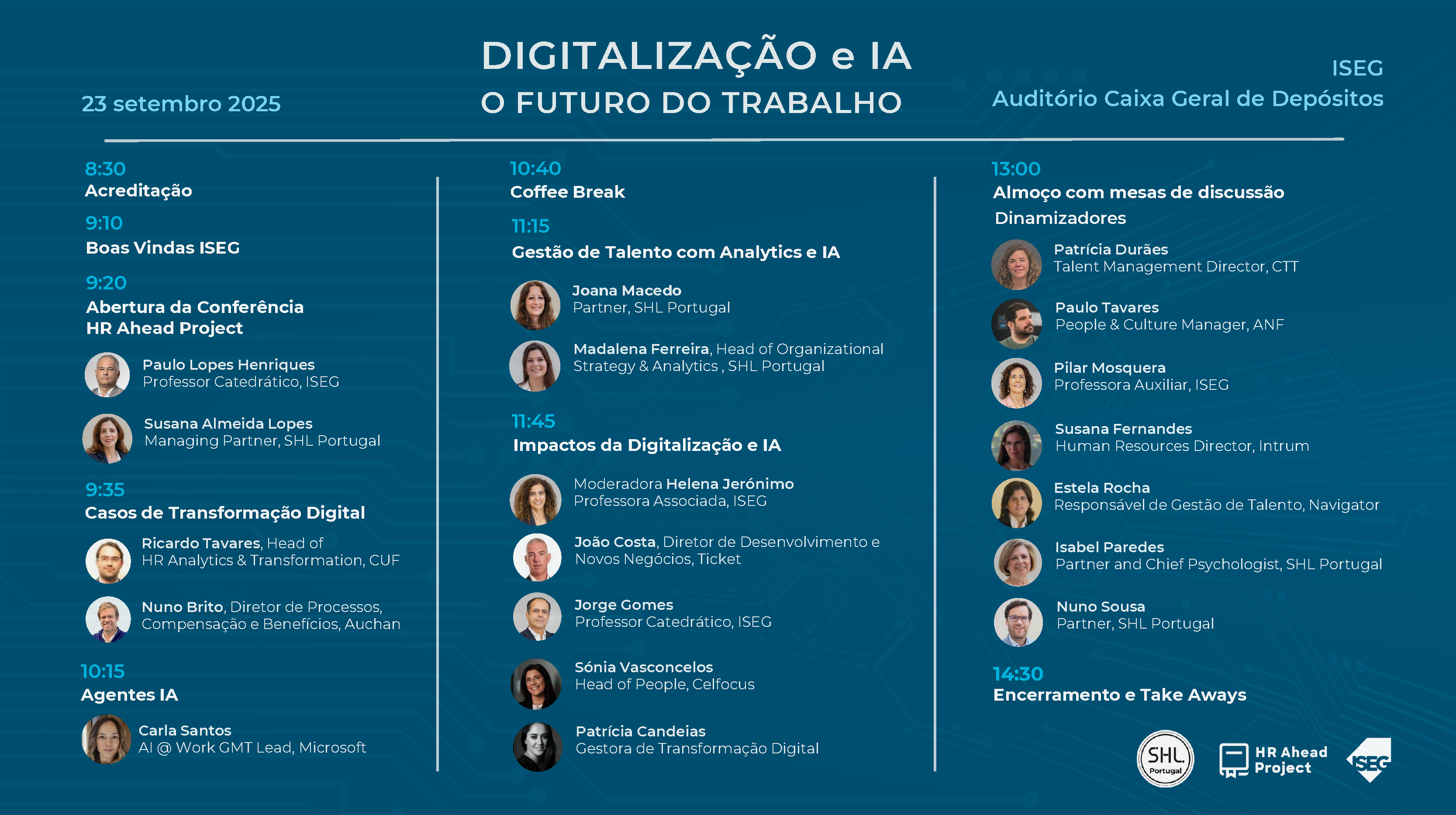
On 23 September, the conference ‘The Future of Work‘ will be held, organised in partnership with SHL Portugal and the HR Ahead Project .
The conference starts at 9.10 in ISEG's CGD Auditorium, on a morning especially dedicated to Human Resources Managers and Directors, during which a new competency model will be presented and debated which is designed to help Portuguese organisations respond to current and future challenges.
Among the topics highlighted will be:
- The requirements of reskilling and upskilling
- The role of leaders in managing change
- Possible and necessary interventions in organisations
- The strategic relevance of HR in this new scenario
All this in a conversation about how to transform the time freed up by Artificial Intelligence into action with human and organisational impact.
The conference will be attended by professors from ISEG Paulo Lopes Henriques, Helena Jeronimo and Jorge Gomes and Pilar Mosquera.
Free admission, subject to prior registration on this link.
On Wednesday, 10 September, from 13.00 to 14.00, there will be the first session of this academic year of the ISEG Research Seminars, for which Monica Achim (Babes-Bolyai University).
The ISEG Research Seminars are held every week, on Wednesdays, in Lecture theatre 4 of Quelhas (4th floor), with the participation of ISEG faculty, as well as professors from other Portuguese and international universities.
Free admission.
The purpose of our research is to estimate the effects of state revenues from various types of taxes upon the corruption and shadow economy phenomena for a generous sample of countries worldwide. We validate the quadratic approach for the impact of taxes upon financial and economic crime phenomena. Corporate and individual income taxes, as well as property and goods and services taxes hold a more pronounced impact on both corruption and shadow economy of developed countries, as compared to developing countries, the steepness of the (inversely) U-shaped curve being lighter for the latter. Social contributions and taxes on payroll and workforce slightly support the parametric approach. The inflection points stand as threshold values that draw important exclamation marks in terms of public policies, in order to use taxes as a means of decreasing financial and economic crime phenomena. Those thresholds express the resilience levels of those groups of countries, as maximum or minimum points of the specific taxes, beyond which the trend of financial and economic crime phenomena is reversed.