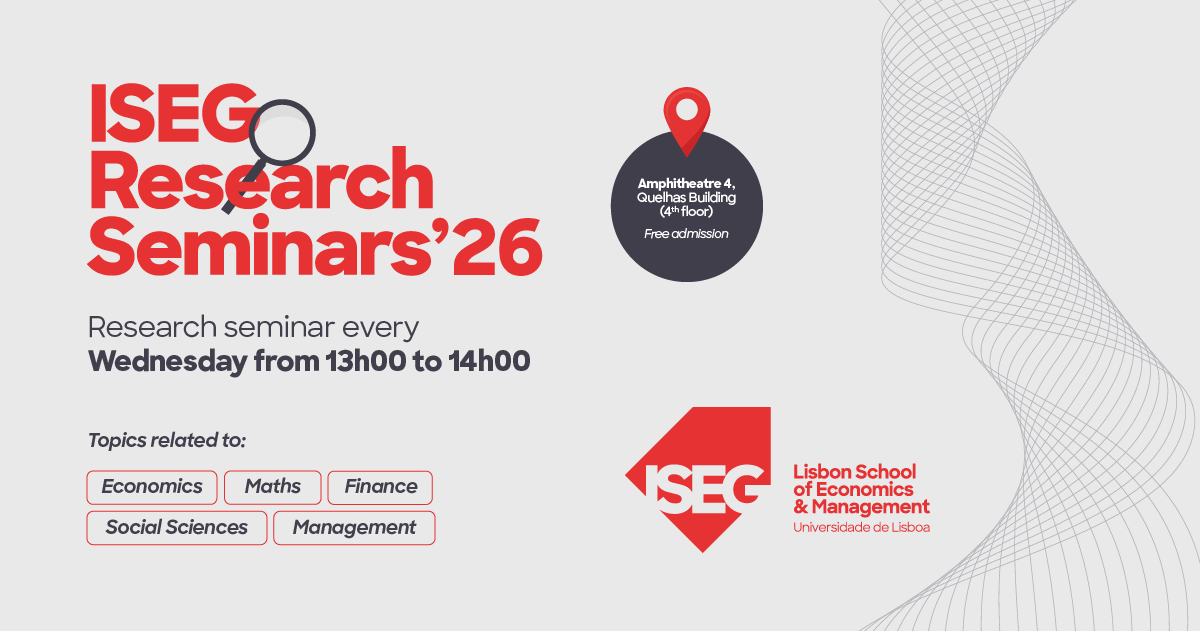











On October 7th, a session of the ISEG Research Seminars will take place from 13.00 to 14.00. The guest speaker will be Vik Singh at Toronto Metropolitan University. This session will take place in Amphitheater 4 (Quelhas Building, 4th floor).
The ISEG Research Seminars are held every week on Wednesdays, with the participation of professors from ISEG, as well as from other Portuguese and international educational institutions.
Title: Regional Integration as a Selective Institutional Buffer: Geopolitical Risk, Policy Uncertainty, and Financial Market Resilience
Abstract: This study introduces the Selective Institutional Shielding Hypothesis (SIHS), which posits that regional institutional architecture moderates the transmission of geopolitical risk and economic policy uncertainty into middle-power financial markets. However, this buffering capacity is asymmetric: it is effective against domestically generated shocks but leaves markets vulnerable to externally transmitted shocks. Drawing on institutional theory, Dunning’s eclectic Ownership-Location-Internationalization framework, and the regionalization perspective, the analysis proposes that supranational integration operates through four mechanisms: monetary credibility, regulatory harmonization, collective policy coordination, and shock-sharing. These mechanisms collectively reduce the domestic risk premium for firms embedded within deeper regional blocs. In contrast, bilateral market-access arrangements ensure trade continuity but lack the sovereignty-pooling and stabilization features necessary for robust institutional buffering.
The hypothesis is tested through a comparative analysis of Canada and Spain, two middle-power economies with structural similarities but fundamentally different institutional frameworks. In Spain, domestic GPR is statistically insignificant at both the aggregate and sectoral levels, consistent with the European Union functioning as an institutional shock absorber for country-specific geopolitical instability. In Canada, domestic risk is negatively priced in regulated and institutionally sensitive sectors such as utilities, consumer staples, and resources, while uncertainty regarding U.S. economic policy generates a significant negative aggregate market effect. This outcome reflects the dominance-dependence dynamic inherent in a bilateral arrangement with an asymmetric partner. Neither country is insulated from externally transmitted shocks; global geopolitical risk produces broadly negative sectoral effects in both economies, confirming the SIHS prediction of selective rather than universal buffering.