







The next seminar of the ISEG Research Seminars training webinar will be held on 23 April, from 13.00 to 14.00, in ISEG's Lecture Theatre 3 (Quelhas, 4th Floor).
The event will count with the participation of Annita Florou, from Università Bocconi (Italy), who will present the paper on 'Do Employees Value Defined Benefit Pension Plans? Evidence from Employee Satisfaction Ratings', the abstract for which can be found below.
The 2nd Semester Research Seminars will be held weekly up until 4 June and will feature members of ISEG's faculty, as well as from other Portuguese and international universities. Further information HERE.
Free admission, subject to room capacity.
Defined benefit (DB) pension plans are an important part of total employee compensation. However, DB pension plans carry risk as they are subject to minimum funding requirements. We examine the effect of a relaxation in pension funding rules on employee satisfaction by exploiting the adoption of the Moving Ahead for Progress in the 21st Century Act (MAP-21). This exogenous regulatory shock reduces minimum required pension contributions and adversely affects employee retirement security. We find that, employees of DB firms (relative to those of non-DB firms) perceive their firms, overall, and their senior managers, less favorably after MAP-21. We also provide evidence that employees are less satisfied with their senior managers only when the latter do not use the MAP-21 pension funding relief in the interest of the former, such as more investments vs shareholder payouts and CEO compensation. The documented negative MAP-21 effects are concentrated in firms where employee interests are most at risk because the labor force is not covered by a collective bargaining agreement and where DB plans are significantly underfunded. Furthermore, the impact of the regulatory shock is driven primarily by current than former employees. Overall, our results are consistent with adverse changes in pension funding rules negatively affecting employee perceptions of managers and firms.
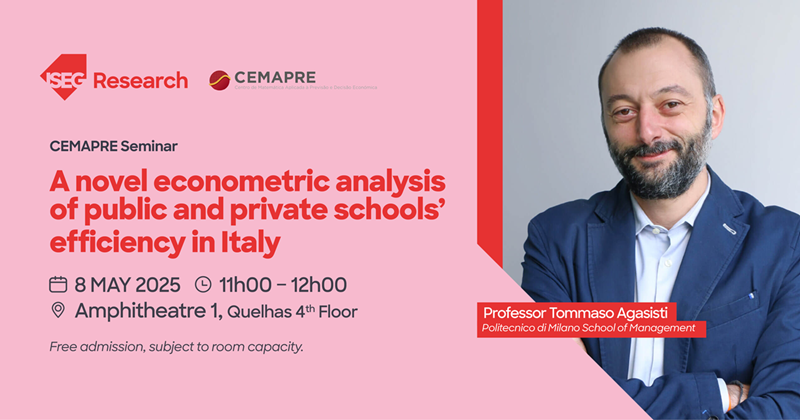
CEMAPRE/ISEG Research is organising a Seminar on 'A novel econometric analysis of public and private schools' efficiency in Italy', on 8 May, between 11.00 and 12.00, in ISEG's Lecture Theatre 1 (Quelhas, 4th Floor).
The guest speaker will be the Professor Tommaso Agasisti, of the Politecnico di Milano School of Management, who will present the paper on 'A Comparative Analysis of Public and Private Schools in Italy (with a Focus on Socioemotional Skills)', the abstract for which can be found below.
Free admission, subject to room capacity.
The present paper considers two main research questions: (i) what is the relative efficiency of Italian public and private schools in recent years? (ii) how does the inclusion of variables measuring the students' socioemotional skills affect the measurement of schools' efficiency? By answering these questions, the present paper advances the economic literature in this field in various directions. First, it provides an updated empirical view of the efficiency of public and private Italian schools. The existing studies are dated, and report results from the early 2000s - see Barbetta & Turati (2003) and Agasisti (2013). Given the continuing debate about the role of private schools for improving the level of the Italian educational system, it is important to observe if and how they are performing more efficiently than their public counterparts. Recent data and new evidence are needed, and this paper fills this gap. Second, the inclusion of indicators about socioemotional skills in the efficiency measurement of schools is a complete novelty. To the best of our knowledge, no existing academic papers tried to assess schools' efficiency considering also this dimension, with the notable exception of Vittadini et al. (2022) who, however, limited the empirical exercise to a very small sample of Italian schools in a special Province. Along with the empirical evidence of the effects of including these variables, we develop a theoretical discussion about how better to consider SES in modelling schools' efficiency.
We use data about 1,200 schools (almost 15% are private) from the OECD 2015, 2018 and 2022 editions. We use a bootstrap version of Data Envelopment Analysis as method for the empirical analysis (Simar & Wilson, 1998; 2000). DEA is a non-parametric technique widely adopted in the circumstances of schools' efficiency measurement (De Witte & Lopez Torres, 2017). To anticipate a preview of the main findings, the results indicate that private schools are statistically more efficient than public ones in all the three waves of PISA analyzed. Also, the well-known differences between schools located in North vs South Italy emerge (as in Di Giacomo & Pennisi, 2015), with the former being more efficient than the latter. When considering socioemotional skills in the educational production function, the efficiency differential between private and public schools widens - suggesting that private schools are better than public in developing this set of competences.
The ISEG Alumni Económicas Cultural Group is organising the Conference on 'In conversation with Richard Zenith, author of PESSOA: A Biography, which will take place on the 8 April, from 18.30 to 20.00, in ISEG Auditorium 3 (Quelhas, 2nd Floor). This will be the first initiative organised by the Cultural Nucleus group.
Is it possible to know who Pessoa was? Is the biographer also a pretender? These and other questions will be deciphered in this session, during which the editor, essayist and translator of Fernando Pessoa will discuss the principles, topics and writing process of his biography, followed by time to answer the most varied questions about the life and work of the pseudo poet.
Free admission, subject to capacity.

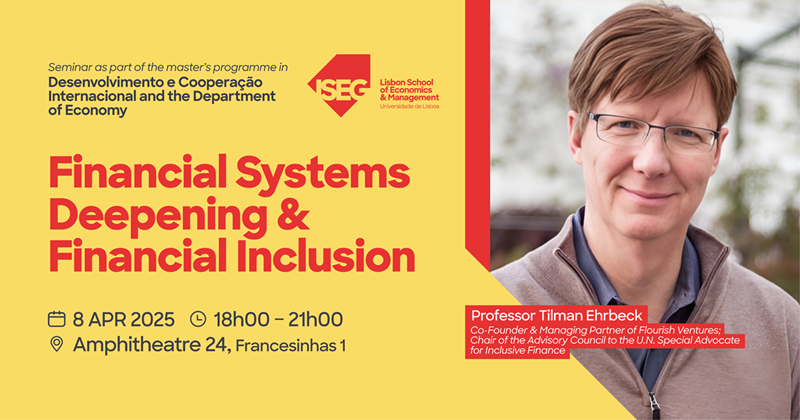
ISEG is organising a seminar on 'Financial Systems Deepening and Financial Inclusion', on 8 April, from 18.00 to 21.00, in ISEG's Lecture Theatre 24 (Francesinhas 1).
This event is being held as part of the Master's in International Development and Cooperation and will be given by Professor Tilman Ehrbeck, the Chair of the Advisory Council to the United Nations Special Advocate for Inclusive Finance in Development.
Free admission, subject to availability.
The 9 April (Wednesday), between 13.00 to 14.00, ISEG's Lecture Theatre 3 (Quelhas, Floor 4) will host a new session of the 2nd Semester of the ISEG Research Seminars.
The keynote speaker of the seminar will be Inês Faria, researcher at ISEG, who will present a paper on "Gender and Labour in Informal Economies: Digital Disasters in Mozambique“, the abstract for which can be found below.
The 2nd Semester Research Seminars will be held weekly up until 4 June and will feature members of ISEG's faculty, as well as from other Portuguese and international universities. Further information HERE.
Free admission.
Informal retail economies are prevalent at the global level and link specific supply chains to particular - material and digital - valuation processes. They occupy spaces between livelihoods, normative societal and legal frameworks and everyday life pragmatics. The local importance of informal economies differs globally and situationally, but in low-income settings they can represent about 90% of all entrepreneurial activities. Such informal livelihoods are deeply entangled with sociocultural configurations, including policy and regulatory frameworks of specific jurisdictions, and mundane elements of people's everyday lives. Based on ethnographic research in Maputo, Mozambique, in this article, I explore a particular case of informal economic activity - women-led digital disasters (used clothing) markets on WhatsApp and Instagram, which are enabled by traveling technologies - mobile money and social media - and traveling disposable commodities - used clothes. I approach this as a form of digital entrepreneurship: a practice incentivised by different institutional actors promoting financial inclusion and market making as pathways for sustainable development. Implying a process of economic and semiotic (re)valuation that crosscuts both global circulation of objects and commodities, the businesses explored in this paper shed light into grounded aspects of labour, gender, class and household management dynamics embedded in the creation of digital markets. Sharing the story of Frederica, one of my research interlocutors, as an example, I argue that narratives incentivising digital financial inclusion and entrepreneurship as a means to achieve gender empowerment and development have serious limitations: the increasing developmental focus on financial inclusion, technology and entrepreneurship seems to be lacking a solid foundation - focusing only on this dimension leaves other media of challenging inequalities, institutional insufficiencies, bureaucratic complexities and unequal power structures untouched.
On April 2nd (Wednesday), from 13h00 to 14h00, ISEG's Amphitheater 3 (Quelhas Building, 4th Floor) will host another session of the 2nd Semester of the ISEG Research Seminars.
This seminar's speaker will be Angelo Riva, from the Paris School of Economics, which will present the paper 'Flight-to-Safety and The Real Effects of Bank Runs: Evidence from the French Great Depression, which abstract can be found below.
The 2nd Semester Research Seminars will be held weekly up until 4 June and will feature members of ISEG's faculty, as well as from other Portuguese and international universities. Further information HERE.
Free admission.
We examine how safe assets can amplify financial instability and thus deepen economic crises. During the 1930-1931 French banking crisis, deposits flowed from unregulated commercial banks to government-backed Caisses d'Épargne (CEs), which invested exclusively in government debt. Geographic variation in CE density, rooted in 19th century establishment patterns, was unrelated to pre-crisis economic and banking growth rates. However, areas with higher CE densities experienced more bank branch closures during the crisis. The flight-to-safety thus led to local credit supply shocks. Using CE density as an instrument, we show that this flight-to-safety significantly reduced local aggregate income.
Next Tuesday, March 25th, between 1:00 PM and 2:00 PM, the Amphitheater 3 (Quelhas Building, 4th Floor) is the stage of another session of the 2nd Semester of the ISEG Research Seminars.
This session's speaker will be Jonathan de Quidt, from the School of Economics and Finance of the Queen Mary University of London, who will present the paper 'How Much Should We Trust Observational Estimates? Accumulating Evidence Using Randomized Controlled Trials with Imperfect Compliance', which abstract can be found below.
The 2nd Semester Research Seminars will be held weekly up until 4 June and will feature members of ISEG's faculty, as well as from other Portuguese and international universities. Further information HERE.
Free admission.
The use of observational methods remains common in program evaluation. How much should we trust these studies, which lack clear identifying variation? We propose adjusting confidence intervals to incorporate the uncertainty due to observational bias. Using data from 44 development RCTs with imperfect compliance (ICRCTs), we estimate the parameters required to construct our confidence intervals. The results show that, after accounting for potential bias, observational studies have low effective power. Using our adjusted confidence intervals, a hypothetical infinite sample size observational study has a minimum detectable effect size of over 0.3 standard deviations. We conclude that - given current evidence - observational studies are uninformative about many programs that in truth have important effects. There is a silver lining: collecting data from more ICRCTs may help to reduce uncertainty about bias, and increase the effective power of observational program evaluation in the future.
On April 10th (Thursday), ISEG Alumni Económicas celebrates its 34th anniversary with the conference 'Europe in the Multipolar Context and the Global Economy', part of the Conference Cycle 'Where are the world, Europe and Portugal heading?'.
The session will take place in the CGD Auditorium (Quelhas Building, 2nd Floor), from 6:00 PM, featuring Abel Mateus, José Félix Ribeiro, Paulo Macedo and Pedro Castro e Almeida as speakers. The moderator will be Eduardo Catroga.
After the conference, ISEG's Noble Hall (Quelhas Building, 4th Floor) will host, starting at 8:00 PM, a Dinner to celebrate the 34th anniversary of ISEG Alumni Económicas, which will feature Mário Centeno as Keynote speaker. Part of the proceeds from the dinner will contribute to support students with financial difficulties, as part of the ISEG Alumni Económicas Solidarity Program.
Both events will kick off a special year of celebrations, to mark the association's 35th anniversary.
Registration is limited and will be available until April 3rd. Secure now your spot HERE.
Next Wednesday, March 19th, between 1:00 PM and 2:00 PM, ISEG's Amphitheater 3 (Quelhas Building, 4th Floor) will once again host one of the sessions of the 2nd Semester of the ISEG Research Seminars.
This session's speaker will be Professor Francisco Queirós, which will present the paper 'Production networks, time to build and endogenous oscillations', which he co-authored. The abstract can be found below.
The 2nd Semester Research Seminars will be held weekly up until 4 June and will feature members of ISEG's faculty, as well as from other Portuguese and international universities. Further information HERE.
Free admission.
We study how sector-specific shocks propagate in a production economy with input-output linkages and heterogeneous time to build. We show that, depending on the sector and network characteristics, one-time idiosyncratic shocks can induce a non-monotonic response of aggregate output as it converges back to steady state - a phenomenon we term 'endogenous oscillations' - and get amplified over time. We study the conditions on the network structure that generate this behavior. We introduce a measure to quantify the magnitude of such endogenous oscillations generated by a single small productivity shock. We quantify the model on US input-output data, showing that for some sectors a single shock can generate aggregate fluctuations. In particular, the magnitude of oscillations is twice as large as it would be if convergence to the steady state were always monotonic.
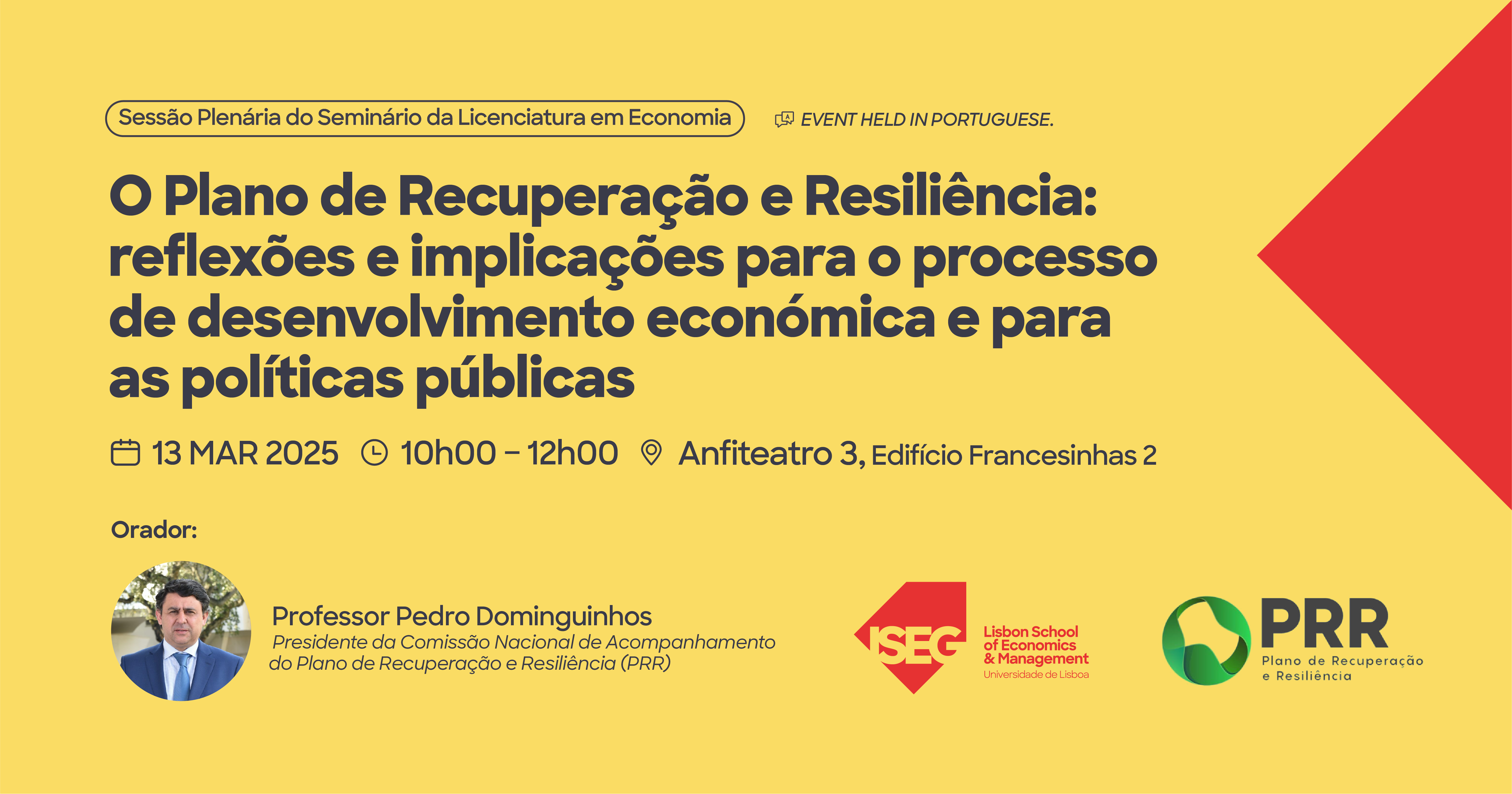
On March 13ththe Plenary Session of the Economics Bachelor's Degree Seminarwill take place from 10:00 to 12:00, in Amphitheater 3 (Building F2).
The guest speaker will be the Professor Pedro Dominguinhos,President of the National Commission for Monitoring the Recovery and Resilience Plan (PRR), who will discuss the topic "The Recovery and Resilience Plan: Reflections and Implications for the Economic Development Process and Public Policies".
The session aims to provide an in-depth analysis of the impact of the PRR on economic development and public policy strategies, fostering a space for reflection and debate among students and other interested participants.
Participation is open to the academic community and the general public.