






Next Wednesday, February 26, from 1 PM to 2 PM, the first session of the 2nd Semester of the ISEG Research Seminars will be held at ISEG's Amphitheater 3 (Quelhas Building, 4th Floor).
The speaker of the initial session will be Jason Thatcher, from the University of Colorado (USA), who will present his paper 'Designing Effective Online Experiments: A Practical Roadmap'. The abstract can be found below on this page.
The 2nd Semester Research Seminars will be held weekly up until 4 June and will feature members of ISEG's faculty, as well as from other Portuguese and international universities. Further information HERE.
Free admission.
Online experiments are increasingly used by business researchers to examine theoretical and practical challenges of contemporary organizations. In this seminar, we will review challenges tied to successfully executing online experiments that use participants recruited from online planels (such as MTurk, Prolific, or Qualtrics) or from natural populations (such as through community groups or organization). The first part of the seminar will briefly review ideas of experimental and quasi-experimental design, underscoring that kernels to solving many of the design challenges can be found in existing business research. The second part of the seminar will focus on articulating challenges and sharing applied solutions to them. Some challenges to be discussed include (a) purposeful sampling from online panels, (b) designing effective manipulations, (c) data integrity and quality checks, and (d) limitations of online experimental designs. Upon completion of the seminar, students will have a roadmap for how to conduct effective online experiments suitable for submission to top business journals such as Academy of Management Journal, Journal of Applied Psychology and MIS Quarterly.
On part of the project that aims to intensify the integration of the Sustainable Development Goals (SDGs) into ISEG's teaching activities, a working group has been set up to ensure that SDG-promoting content is taught across all courses. This group, together with the Observatory for Pedagogical Action and Innovation (OAIP), will be holding a seminar February 20, from 12:30 to 14:00, in room 101 - New Quelhas Building. with the following program:
The session will be given in Portuguese.
Free admission.
On April 23rd (Wednesday), the last i2030 Seminar of 2025 takes place at ISEG. Climate action and its role in taking sustainable measures will be the main topic.
The keynote speaker of this session will be João Dinis, environmental coordinator at Cascais City Council. The session will take place at Amphitheater 2 (Francesinhas Building 1), from 18.30.
ISEG's i2030 Seminars will take place as part of the Master's Degree in Industrial Management, Operations and Sustainability. The sessions will be conducted in English, open to the general public and feature a range of speakers and guests from such different fields as education, telecom, energy or local administration.
Admission is free, subject to the room's maximum capacity.
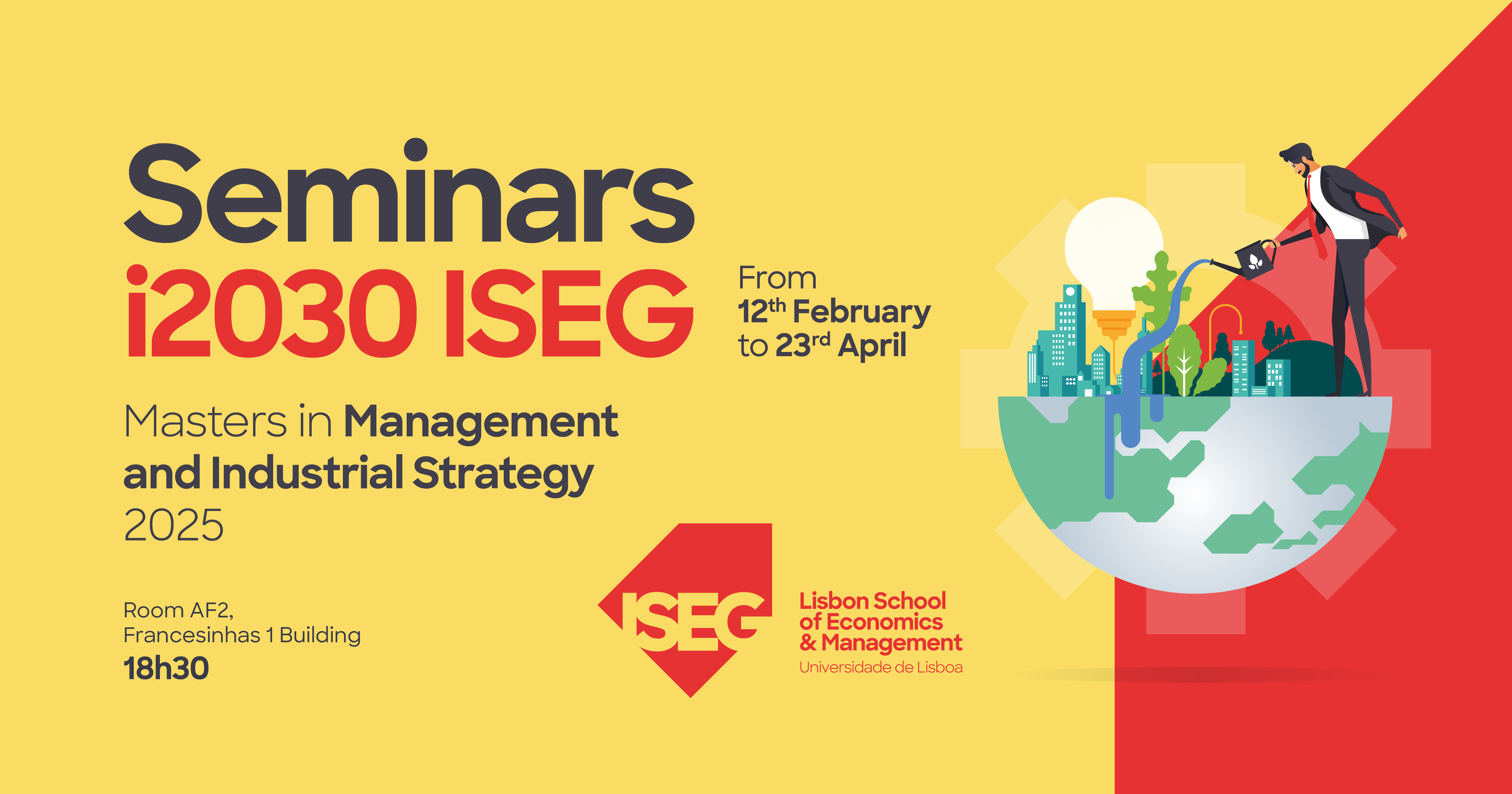
On April 9th (Wednesday), another session of the 2025 edition of the ISEG i2030 Seminars will be held. The topic of discussion will be the implementation of sustainability strategies in large players of the Indian business sector.
The speaker of this seminar will be Jacqueline Mundkur, Industry Manager and Professor at NMIMS - School of Business (Mumbai). The event will take place at ISEG's Amphitheater 2, from 6:30 pm.
ISEG's i2030 Seminars will take place as part of the Master's Degree in Industrial Management, Operations and Sustainability. The sessions will be conducted in English, open to the general public and feature a range of speakers and guests from such different fields as education, telecom, energy or local administration.
Admission is free, subject to the room's maximum capacity.
On March 26th (Wednesday), another session of the 2025 edition of the ISEG i2030 Seminars. The debate will focus on the trajectories of ecological design and how they relate to alternative socio-economic models of sustainability.
Miriam Soares, Service Readiness Specialist at Vodafone and former ISEG researcher, will be the speaker of 'Alternative socio-economic models of sustainability through ecological design trajectories', which will start from 6:30 pm at Amphitheater 2 (Francesinhas Building 1).
ISEG's i2030 Seminars will take place as part of the Master's Degree in Industrial Management, Operations and Sustainability. The sessions will be conducted in English, open to the general public and feature a range of speakers and guests from such different fields as education, telecom, energy or local administration.
Admission is free, subject to the room's maximum capacity.
On March 19th (Wednesday), another session of the 2025 edition of the ISEG i2030 Seminars will be held. The circular economy and the advantages for the industrial sector of extending the lifespan of products and materials will be the topic of debate on this date.
Marta Brazão, President of 'Circular Economy Portugal', will be the speaker of 'Waste is a design flaw: how circular economy can be a game changer for Industries', which will take place at ISEG's Amphitheater 2 (Francesinhas Building 1), starting from 6:30 pm.
ISEG's i2030 Seminars will take place as part of the Master's Degree in Industrial Management, Operations and Sustainability. The sessions will be conducted in English, open to the general public and feature a range of speakers and guests from such different fields as education, telecom, energy or local administration.
Admission is free, subject to the room's maximum capacity.
On March 12 (Wednesday), another session of the 2025 edition of the ISEG i2030 Seminars will be held. Integrated multitrophic aquaculture and how it relates with sustainability will be the subject of debate throughout the event.
Gonçalo Amorim, from 'Food4Sustainability CoLAB' will be the speaker of 'AmpliAqua: Exploring the limits of sustainable integrated multitrophic aquaculture systems', which will take place at ISEG's Amphitheater 2 (Francesinhas Building 1), starting from 6:30 pm.
ISEG's i2030 Seminars will take place as part of the Master's Degree in Industrial Management, Operations and Sustainability. The sessions will be conducted in English, open to the general public and feature a range of speakers and guests from such different fields as education, telecom, energy or local administration.
Admission is free, subject to the maximum capacity of the room.
On February 26 (Wednesday), another session of the 2025 edition of the ISEG i2030 Seminars will be held. The topic of industrial policy in developing countries will be debated.
Helena Valente, Chief Operating Officer of 'CESO Development Consultants', will be the keynote speaker of 'Industrial Policy in Developing Countries', which will take place at ISEG's Amphitheater 2 (Francesinhas Building 1), starting from 6:30 pm.
ISEG's i2030 Seminars will take place as part of the Master's Degree in Industrial Management, Operations and Sustainability. The sessions will be conducted in English, open to the general public and feature a range of speakers and guests from such different fields as education, telecom, energy or local administration.
Admission is free, subject to the maximum capacity of the room.
On February 19th (Wednesday), another session of the 2025 edition of the ISEG i2030 Seminars will be held, dedicated to the topic of corporate social responsibility.
Pedro Sirgado, from EDP, will be the speaker of 'Why should companies be socially responsible?', which will take place at ISEG's Amphitheater 2 (Francesinhas Building 1), starting at 6:30 pm.
ISEG's i2030 Seminars will take place as part of the Master's Degree in Industrial Management, Operations and Sustainability. The sessions will be conducted in English, open to the general public and feature a range of speakers and guests from such different fields as education, telecom, energy or local administration.
Admission is free, subject to the maximum capacity of the room.
On February 19th at 11.00 am, the second ADVANCE Seminar will take place at ISEG, subject to the paper An Unintended Consequence of Full Population Testing on Auditors’ Professional Skepticism.
The seminar speaker will be Anna Gold, co-author of the study, as well as Professor of Auditing and Director of the School of Accounting at the Faculty of Economics and Business Sciences at Vrije Universiteit Amsterdam (Free University of Amsterdam).
The emergence of data analytics allows auditors to test entire populations of data drawn from clients' information systems, rather than relying solely on sampling methods. While full population testing increases the sufficiency⎯or quantity⎯of evidence examined, it does not necessarily eliminate the lack of appropriateness⎯or quality⎯of that evidence. In particular, full population testing typically relies heavily on client-internal data, which are vulnerable to management manipulation, potentially reducing their appropriateness. Therefore, auditors must remain skeptical when subsequent, more appropriate evidence from external sources contradicts a client's financial reporting. In this study, we examine whether auditors employing full population testing mistakenly substitute their assessment of evidence sufficiency for their evaluation of evidence appropriateness, leading them to view clientinternal evidence as more appropriate than auditors using sample testing. Consequently, auditors using full population testing may be less likely to act skeptically when subsequent and more appropriate external evidence indicates that a fraud red flag is present. In an experiment, we find that auditors using full population testing, compared to sample testing, are less likely to exercise skeptical actions when a subsequent external industry growth trend reveals a fraud red flag. We also posit that this unintended consequence is exacerbated when full population testing results are visualized (versus tabulated), a typical format used for presenting data analytic tests in practice. However, our findings do not support this prediction.
The session will take place at Santander Room (Edifício Quelhas, Piso 3), with free admission subject to capacity.