









On May 8th, Abderrahim Taamouti (Liverpool University Management School) presents at ISEG the study "Incentive-Based Policies to Regulate Systemic Risk“.
Free admission.
Abstract:
Current banking policies, such as the Basel III reforms, lie in the distortion caused by the widespread use of prudential regulations that operate independently of any incentive-based regulatory policies. Many of these existing regulations, designed to gradually reinforce regulatory capital buffers for financial intermediaries, are discretionary and ad-hoc responses to extreme financial conditions. They lack a mechanism for involving financial institution-specific marginal risk and compliance cost. This paper introduces several incentive-based regulatory policies that can speak to the goals and methods of financial stability policies. Theoretically, we provide conditions under which our regulatory policies are cost-effective and cost-efficient. Empirically, using a sample of 82 US financial institutions, we find that real data is supporting the cost-effectiveness and cost-efficiency of our framework to regulating systemic risk.
We hereby invite you to take part in an online training on webinar on "Manage my researcher profile on Web of Science", on the 16th May, from 14:00 to 15:00.
The session will be conducted in Portuguese.
Learning objectives:
This training is free and is designed for Masters and PhD students, faculty, and researchers.
Enrolment for the training ON THIS LINK.
Further information:
formacaobib@iseg.ulisboa.pt
Library - User Training Centre
We hereby invite you to take part in an online training on webinar on “Read a researcher's profile on Web of Science", on the 15th May, from 14:00 to 15:00.
The session will be conducted in Portuguese.
Learning objectives:
This training is free and is designed for Masters and PhD students, faculty, and researchers.
Enrolment for the training ON THIS LINK.
Further information:
formacaobib@iseg.ulisboa.pt
Library - User Training Centre
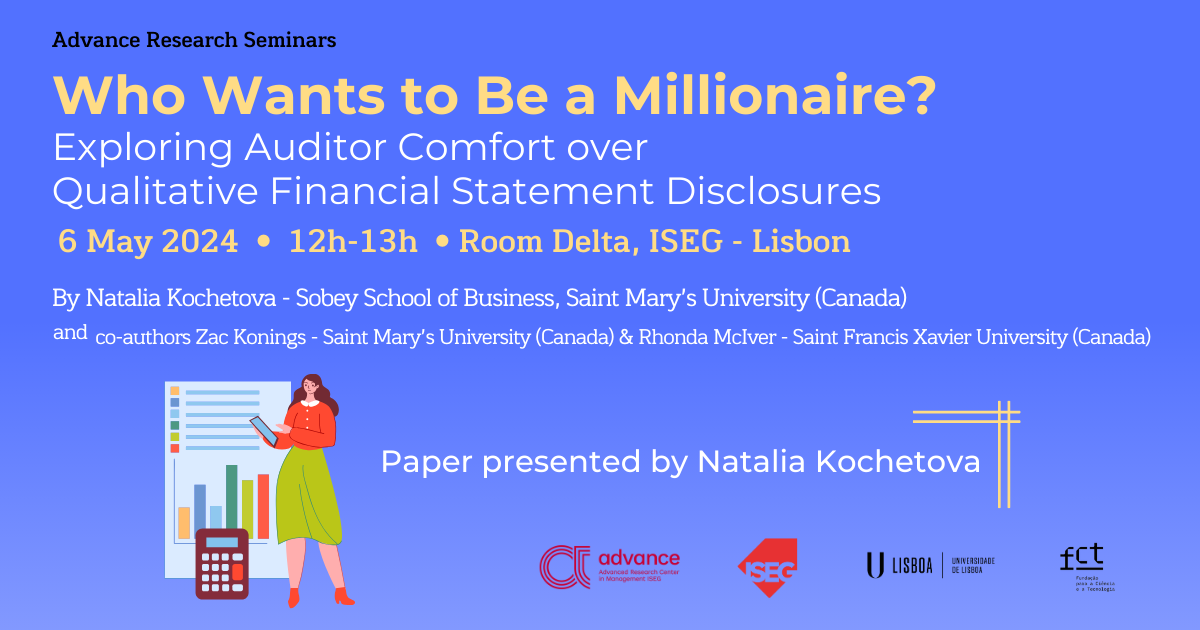
ADVANCE's next Research Seminar will take place on the 6th May 6th, 12:00. "Who Wants to Be a Millionaire? Exploring Auditor Comfort over Qualitative Financial Statement Disclosures" is the title of the paper being analysed at this seminar, which will be presented by its author, the researcher Natalia Kochetova, from the Sobey School of Business at Saint Mary's University (Canada).
The event will take place in the Delta Room at ISEG and admission is free.
On April 24th, Elisa Ossola (University of Milan-Bicocca) will present at ISEG the study "Green risk in Europe“.
Free admission.
Abstract:
Climate change poses serious economic, financial, and social challenges to humanity, and green transition policies are now actively implemented in many industrialized countries. Whether financial markets price climate risks is critical to ensuring that the necessary funding flows into environmentally sound projects and that stranded assets risk is adequately managed. In this paper, we assess climate risks for the European stock market within the context of Alessi et al. (2023) greenness and transparency factor. We show that measures of returns spreads of green vs. brown investment might reflect climate risks and assets' exposure to systematic macro-financial risk factors. These latter factors should be filtered out to measure climate risks accurately. We show that climate risks are priced in the European stock market by focusing on aggregate, industry, and company-level data. We propose a market-based green rating procedure, which might be of particular interest to evaluate non-transparent and non-disclosing companies for which ESG information is unavailable. We illustrate its implementation using a sample of over 800 non-transparent firms.
A seminar on ""Life Writing" and the Problem of Mediation in Contemporary Mozambican Historiographywill be held on the 2nd May at 18.00, presented by Colin Darch, from the University of Cape Town (South Africa).
Colin Darch is a librarian, professor, and NRF-ranked researcher with extensive experience in African countries and Brazil. He is fluent in English and Portuguese. He is interested in the political economy of intellectual property and the sociology of access rights to information across the Global South. He is also webmaster of the Mozambique History Net website (www.mozambiquehistory.net), which focuses on the period from 1960 to 1994.
The seminar will take place in the Novo Banco Lecture Theatre (Quelhas, 4th Floor).
Free admission. Enrolment for the training on this LINK.
This event is part of the Development Studies Seminars Cycle, an integral initiative of the PhD in Development Studies . Further information and the full programme can be accessed HERE.
ISEG hosts another Master's in Marketing Seminar! Day 07 MayTuesday, don't miss talk "The Sexiest Paper on Earth" with CEO of Renova Company, Paulo Pereira da Silva. The guest speaker will discuss Renova's success story, a very topical and relevant topic for marketing professionals.
The seminar takes place from 10h00 to 11h30 at the Auditorium 4 (floor 1 of the New Quelhas Building).
This is an excellent opportunity to stay on top of the latest trends and discuss the best marketing practices combined with the company's strategy.
Admission is free but subject to registration HERE.
On the 17th April, James Kohlmeyer iii will present his study on "Audit pricing and the Turnover of Board Members and Executives“.
Free admission.
Abstract:
Purpose - This study examines the association between audit fees and the turnover of board members and executives. In so doing, we seek to provide insights into the risk perceptions of auditors.
Design/Method - We develop a regression model of audit fees that includes board and executive turnover as explanatory variables. We use a large sample of firms with data collected over several years to estimate the parameters in the model.
Findings - We find that voluntary resignations of board members, and not other types of board departures, are associated with higher audit fees. Regarding CEO turnover, forced departures, and not other types of turnover, are associated with larger audit fees. CFO turnovers exhibit the same pattern. We argue that, for auditors, voluntary board turnover and forced executive turnover are signs of increased business risk of the client, which, in turn, leads to greater concerns regarding audit risk
Practical - We argue that a better understanding of auditor risk perceptions may benefit several groups: investors; professional rule making bodies; and regulators. Originality - The association between different types of board departures and audit fees has not been previously examined to our knowledge. While a prior study has investigated the association between forced CEO turnover and audit fees, no studies, to our knowledge, have examined forced CFO departures. Further, we find that forced CFO turnover has a greater association with audit fees than does forced CEO turnover.
ISEG is hosting the XVIII JUTRA MEETING - 50/20 years, which this year is on the topic of 'Slave Labor Law', as part of the of the 25 de Abril 50th anniversary celebrations.
The meeting will take place on the 26th April and will be attended by the Dean of ISEG, Professor João Duqueat the solemn opening session; Professor Sara Falcão Casaca, Chair of SOCIUS, at the opening conference; and Professor Antonio Garcia Pereira (SOCIUS/ISEG), a retired ISEG professor and Vice-Chair of the Portuguese Delegation of JUTRA, on the 1st panel.
This meeting is being organised by JUTRA - Associação Luso-Brasileira de Juristas do Trabalho, Ordem dos Advogados - Conselho Regional de Coimbra and CRL - Conselho Regional de Lisboa da Ordem dos Advogados.
The event will take place from 09.00 to 18.30 in the CGD Auditorium at ISEG (Quelhas Building, 2nd Floor).
Programme and registration available HERE.
In this ISEG i2030 session, participants will be invited to use a free, interactive "gamification" tool that helps them understand the link between our lifestyles, the energy we use and the consequences for our climate.
It is aimed at anyone interested in exploring the possibility of a low-carbon world by 2050. The Game shows that it is possible to avoid dangerous climate change and ensure that people's living standards continue to improve if we act now!
Please bring your laptop to the session so you can take part in the Game!
Free admission.