








On October 18th, Ana Rute Cardoso (ICS, ULisboa) will present at ISEG the study "Will the Gender Pay Gap Decline as Women Enter Well-paying Occupations?".
Free admission.
Abstract:
The earnings potential of a field of study is increasingly relevant for the funding of higher education institutions by the government and the choice of degree by students. There is a widespread belief that if young females choose fields of study that are currently well-paid, such as STEM, the gender pay gap will narrow once they enter the labor market. We evaluate the impact of rising feminization on wages over the life cycle across fields of study, while accounting for the changing job skill requirements. We address the following questions: How does the rate of skill change impact the earnings of higher education graduates? Does a field of study become less valued in the labor market once its share of females increases? The first step in our analysis follows Deming and Noray's (2020) to quantify the impact of changing skill requirements on wages. We subsequently introduce an additional mechanism, the gender composition of the working population. We use rich longitudinal data on the population of workers and firms in the private sector in Portugal. We exploit exogenous variation in the share of females in an occupation relying on data on the population of higher education candidates and enrolled students. [results soon]
On the 11th October, Pieter Vanhuysse will presents his study at ISEG entitled "Do low-fertility societies tax their own reproduction?".
Free admission.
Abstract:
What are the intergenerational resource transfer contributions of parents and non-parents in Europe? Using National Transfer Accounts and National Time Transfer Accounts for twelve countries around 2010, we go beyond public transfers (net taxes) to also value two statistically much less visible transfers in the family realm: of market goods and of unpaid household labor (time). Non-parents contribute almost exclusively to public transfers. But parents additionally provide still larger private transfers: mothers mainly time, fathers mainly market goods. Estimating transfer stocks over the working life, the average parental/non-parental contribution ratio in Europe flips from 0.73 (public transfers alone) to 2.66 (all three transfers combined). The highest combined parental/non-parental contribution ratios are in Sweden and Finland. Unveiling the sheer magnitude of these invisible transfer asymmetries carries multiple implications for sociological and policy debates. Societies implicitly adhere to a 'stork theory' of child-rearing when they do not account for all resources parents contribute. Better accounting could lead to a 'green moment,' as it shifts perspectives on sustainable demographic renewal. Despite below-replacement fertility levels and rising intentional childlessness, European societies may unwittingly tax rather than subsidize their own reproduction. Family-friendly policy models, such as the Nordic welfare states, do not mitigate this effect. They help parents work, but do not lower the implicit child-rearing tax parents pay.
The 7th Annual Political Economy Meeting, organized by the Portuguese Political Economy Association, will be held at ISEG from January 25 to 27, 2024, under the theme "Politics and Democracy: Reimagining the world in the 50 years since 25 April".
ISEG, CSG, SOCIUS, CEsA and ADVANCE, together with DINÂMIA'CET-Iscte, are part of the event's organizing committee. Proposals can be submitted until October 10th and thesis project proposals can be submitted until October 31st.
Further information is available on the meeting website.
.
A seminar on "International protection - framework and challenges" will be held on the 4th October, from 18.00 to 20.00, as part of the Ethics in Economics and International Business course unit of the MA in International Economics and European Studies at ISEG.
The guest speaker will be Mónica Farinha, Chair of the Portuguese Council for Refugees (CPR).
The event is open to the public and will take place in Lecture Theatre 22 (ISEG, Edifício Francesinhas 1).
We invite you to participate in the online training on "Emerging Sources Citation Index Backfile", which will take place on the 4th October, from 11:00 to 12:00.
The Emerging Sources Citation Index (ESCI) was launched in 2005 to help libraries and researchers confidently discover the content of fast-growing journals. With increasing interdisciplinarity and international collaboration, it is more important than ever to monitor research in a wide range of regions and subject areas. With over 8000 journals, ESCI forms a large part of the Web of Science core collection.
Join us for this webinar:
Further information:
formacaobib@iseg.ulisboa.pt
Library - User Training Centre
Artificial Intelligence is undoubtedly one of the biggest challenges facing contemporary societies. It has significant economic and geopolitical impacts. For these reasons, the European Union is already in a trilogue (three-way discussion between the European Parliament, the Commission and the European Council) with a view to regulating it. To this end, the Institute of Public Policy (IPP) is organizing a seminar with the participation of government officials, academics and representatives of the sector to clarify the "state of the art" regarding European regulation and the analysis of these economic and geopolitical impacts.
Don't miss this webinar which will take place at ISEG on te 2nd October, from 17.00 to 19.00, with the participation of the Chair of ANACOM, João Cadete de Matos, Steffen Hoernig, a professor at NOVA SBE and a director of the Institute of Public Policy-Lisbon, as well as members of three other European think tanks (Real Elcano/Spain; IOBE/Greece, and I-Com, Institute for Competitiveness/Italy), and also AI experts from these three countries and Portugal. Participants will be served a cocktail at the end of the event.
See the programme here.
Registration and further information here: https://bit.ly/PromethEUs-IPP
This event will be held in English.
On September 20th, Professor José Pedro Pontes (ISEG) presents the study "Education spread and economic development: Portugal 1981-2021".
Free admission.
Abstract:
We try to rationalize the fact that the impact of higher education spread on aggregate productivity tends to disappear as a higher share of people completes college. For that purpose, we model this situation by means of a coordination (Stag Hunt) game, where a youngster reaps the benefit of higher education only if there is a critical mass of students. During the initial stage the net reward of higher education is high, so that the Nash equilibrium with general enrolment is selected. As higher education becomes widespread, its relative benefit tends to decline because the relative wage of skilled labor falls with the rise in its supply and universities face diseconomies of scale as they expand over lower density territories. The decrease in the reward is multiplied by the fact that the strategy of avoiding higher education becomes "risk-dominant", which more likely leads to a coordination breakdown, where the tertiary schooling rate might rise despite the output per worker decreases. This socially undesirable outcome can be avoided through a policy aimed at college network enhancement through its geographical concentration. For this purpose, the relocation of a significant share of students appears to be necessary.
ISEG's new series of research seminars resumes on the 20th September.
The research seminars run from September 20 to May 20, on Wednesdays from 13:00 to 14:00.
Note: Exceptionally, on May 8, the seminar will take place from 11:30 a.m. to 12:30 p.m. in Amphitheater 1 (Quelhas Building, 4th floor).
Faculty from ISEG and other national and international schools will participate in the sessions, when they will address topics related with Economics, Management, Finance, Social Sciences, and Mathematics.
Free admission.
Full program:
2nd semester calendar (pdf)
1st Semester calendar (pdf)
The 49th Annual Conference of the European International Business Academy – EIBA will take place at ISEG - Lisbon School of Economics & Management, from the 15th to the 17th December, 2023.
Organised by ADVANCE/ CSG/ ISEG, the EIBA LISBON 2023 takes place under the motto of "The Changing Global Power Balance: Challenges for European Firms".
Further information on the eiba2023.eiba.org.
What is most important thing that needs to be mastered in Digital Marketing?
The answer varies considerably and is broad, this being an area that brings together multiple dimensions and disciplines and which is constantly changing.
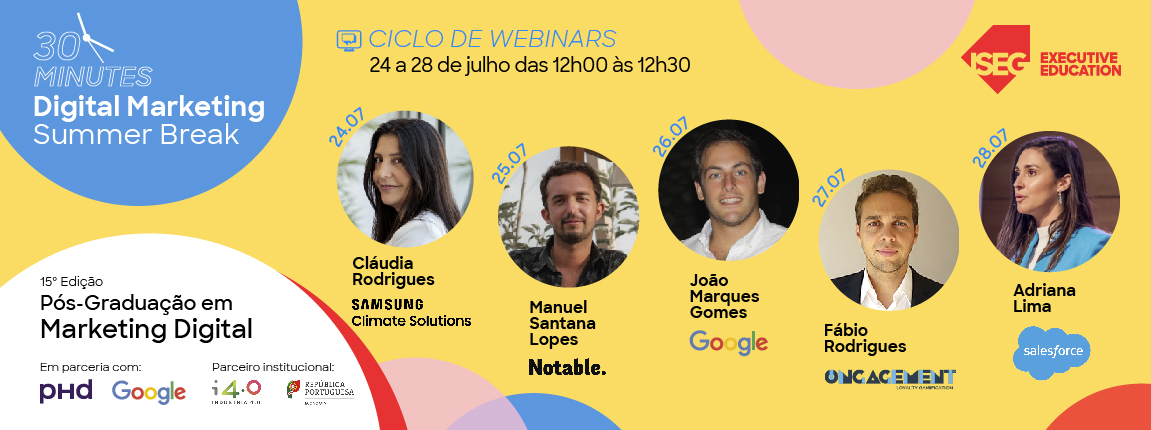
Accordingly, within the framework of the Postgraduation in Digital Marketing, whose 15th edition starts on September 19, we invite all marketing, communication and sales professionals, as well as young students and the curious, to take a break before the summer break to get up to date with some of the trends and areas of most interest for the development of integrated and effective digital marketing strategies.
The Digital Marketing Summer Break is a cycle of 5 webinars, of 30 minutes each, which will take place from the 24th to the 28th July, always at the same time of 12.00 to 12.30.
| 24th July, 12.00 | The Value of Content Cláudia Rodrigues, Marketing Head, Samsung Climate Solutions |
| 25th July, 12.00 | Influencers Manuel Santana Lopes, Associate Partner & Chief of Operations, Notable |
| 26th July, 12.00 | International Growth - How brands should think digital to address the global marketplace João Marques Gomes, Industry Manager, Google |
| 27th July, 12.00 | Loyalty programmes: How to maximize results with 3 key pillars Fábio Rodrigues, CEO, Ongagement |
| 28th July, 12.00 | Artificial Intelligence and CRM Adriana Lima, Senior Account Executive Marketing, Salesforce |
The series is organised by faculty members Helena Gonçalves and Carolina Afonso, and all the speakers are experienced professionals who represent leading brands.
The event is free but subject to registration. Secure your place now below: