










The next presentation as part of the "Topics in Development Studies 2023" will take place on the 15 May, from 6PM to 8PM, in Room 1.2. at IGOT (Rua Branca Edmée Marques, Edifício IGOT, Cidade Universitária, 1600-276 Lisboa; Metro Station: Cidade Universitária).
The researcher Jonathan Davies (DeMontfort University) will address the topic "Between Realism and Revolt: Governing cities in the crisis of Neoliberal Globalism".
The event is hybrid and can be followed on Zoom (LINK).
This seminar promotes advanced debate in the area of Development Studies and is an integrated initiative of ISEG's PhD in Development Studies The complete programme can be consulted on CEsA's website.
On the 17th May Julia Bredtmann (RWI - Leibniz Institute for Economic Research) will present the study on "Discrimination in grading? Evidence on teachers' evaluation bias towards minority students".
Free admission.
Abstract:
We analyze whether teachers discriminate against minority students in terms of grading. Based on comprehensive data on students in German primary and secondary schools, we compare students' scores in standardized, anonymized achievement tests with non-anonymous teacher assessments within a difference-in-differences framework. We find that minority students receive lower grades in both German and Math than majority students. However, these differences are not due to discrimination in grading against minority students. Instead, we find that performance gaps between minority and majority students are significantly reduced when being graded by the teacher compared to being assessed through the anonymized test. This result holds for different groups of minority students. Our findings thus reveal that, if anything, teachers have a positive evaluation bias towards minority students.
The UECE - Unit for the Study of Complexity and Economics , REM – Research in Economics and Mathematics and ISEG are organising the "11th UECE Conference on Economic and Financial Adjustments," on the 21 July.
Important dates:
| Deadline for the submission of papers | June 5, 2023 |
| Acceptance Decisions | June 15, 2023 |
| Registration | June 30, 2023 |
The papers should be submitted by email to: rem@iseg.ulisboa.pt
Programme Committee:
Further information and registration HERE.
On May 2nd, at 9:00 a.m., the seventh IT & Management Talk will be dedicated to the theme "AI-generated Text, Synthetic Genres, and Misinformation". The keynote speaker will be Ashley Rose Mehlenbacher, from the University of Waterloo (Canada).
The designated room will be announced soon.
Free admission.
The IT & Management Talks are a series of conferences that are dedicated to the scientific area of Information Systems and Operations Management and are integrated in the syllabus of the PhD in Management .
On the 3rd May, ISEG's GHES - the Economic and Social History Research Group is organising a seminar on "How to reduce child poverty: Lessons from the UK".with Kitty Stewart, Associate Professor of Social Policy and Associate Director of the Centre for Analysis of Social Exclusion - CASE, from LSE - London School of Economics and Political Science.
The seminar will take place at 14.00, in the Staples Room (Quelhas Building).
Free admission.
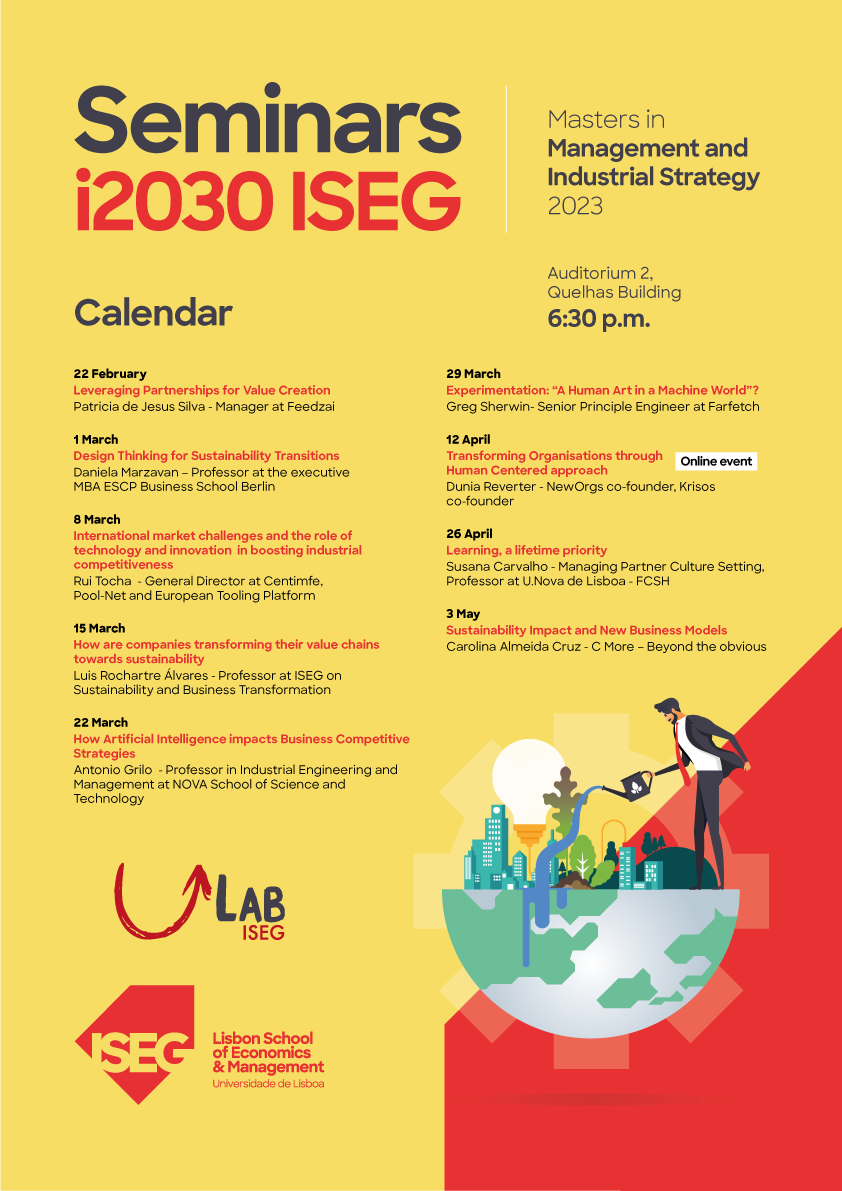
The seminar on "Sustainability Impact and New Business Models" will be held on the 3rd May, with guest speaker Carolina Almeida Cruz (C More, Beyond the obvious).
The seminar will be presented in English and starts at 18:30, in Auditorium 2 (Quelhas).
This initiative is an integral part of the i2030 ISEG Seminars cycle, which is organised every year within the context of ISEG's Masters in Management and Industrial Strategy , when an external (specialist) guest presents a current topic followed by discussion and debate, with the aim to associate and complement the topics with issues such as innovation and sustainability in operations and in industry.
Free admission.
Calendar:
On the 10th May, Matthijs Oosterveen (ISEG) will present the study "The quality of school track assignment decisions by teachers'.
Free admission.
Abstract:
We study the quality of secondary school track assignment decisions in the Netherlands, using a regression discontinuity design. In 6th grade, primary school teachers assign each student to a secondary school track. If a student scores above a track-specific cutoff on the standardized end-of-primary test, the teacher can upwardly revise this assignment. By comparing students just left and right of these cutoffs, we find that between 50-90% of the students are trapped in track: these students are on the high track after four years, only if the teacher assigned them to the high track. The remaining (minority of) students are always low: they are always on the low track after four years, independently of the teacher's assignment. These proportions hold for students near the cutoffs that shift from the low to the high track in first year by scoring above the cutoff. Hence, for a majority of these students the initial (unrevised) track assignment decision is too low. The results replicate across most of the test score cutoffs and secondary school tracks, from the vocational to the academic tracks, and stand out against an education system with a lot of upward and downward track mobility.
On the 3rd May, Denni Tomasifrom the University of Bologna will present the study on "Street Food Safety in Urban Markets'.
Free admission.
Abstract:
Street food is a popular and affordable source of food for many people in low- and middle-income countries, as well as a reliable source of income for vendors. However, it is also a leading cause of foodborne illnesses. Governments worldwide are trying to transform the industry by introducing regulations, licensing, formalization, and better health and hygiene standards, but progress has been sluggish. Our research focuses on understanding the factors that influence the production and consumption of safer street food. We conducted two experiments in Kolkata, India, to address this issue. On the demand side, we conducted a discrete choice experiment among consumers and discovered that they are willing to pay more for safer street food. On the supply side, we conducted a randomized controlled trial among vendors to test the hypothesis that vendors may not be supplying safer food due to credit constraints or lack of know-how. We provided vendors in both treatment arms with infrastructure to improve food safety during preparation, and vendors in one treatment arm also received weekly food safety training. While vendors in both groups utilized the infrastructure provided, we did not find any spillover effects on other food safety practices or kiosk activities. At the end of the study, we explored potential reasons for the results. Vendors mentioned that the main reason they do not invest in their kiosks is because the infrastructure is frequently stolen on the street. Additionally, there is a high degree of coordination on prices and goods, and deviation from common practices is not favorable. We also found evidence of inertial business practices.
On the 26th AprilMarisa Gaspar (ISEG) will present the study "The economy of culture in Macao, China: Global tourism and identity imaginaries'.
Free admission.
Abstract:
The Macao Special Administrative Region of the People's Republic of China, designated as the Macao SAR once it was reintegrated into China in 1999 under the 'One country, Two systems' policy, has an important role to play in China's contemporary worldwide economic power history. The Macao SAR has been one of the cities in the world with the highest income generated by the tourism sector, in particular, by the gambling industry. Tourism promotion of a mixed culture and an East-West identity has been developed simultaneously. This strategy of governmental institutions not only seeks to diversify tourism economy, as well as, to reinforce Macao's role as a platform between China and Portuguese-speaking countries. In this seminar, I'll approach Macao tourism policies for culture and heritage in articulation with the Chinese Belt and Road Initiative of economic expansion and global alliances establishment.
The next presentation as part of the "Topics in Development Studies 2023 cycle,"will be held on the 8th May, from 18.00 to 20.00, in Room 1.2 of IGOT, with Sonia Arbaci, a researcher at University College London.
The seminar is an integral part of the syllabus of ISEG's PhD in Development Studies and will address the topic of "Housing: A machine for the accumulation of capital or redistribution of resources?'.
Further information about the event is available on CEsA's website.