






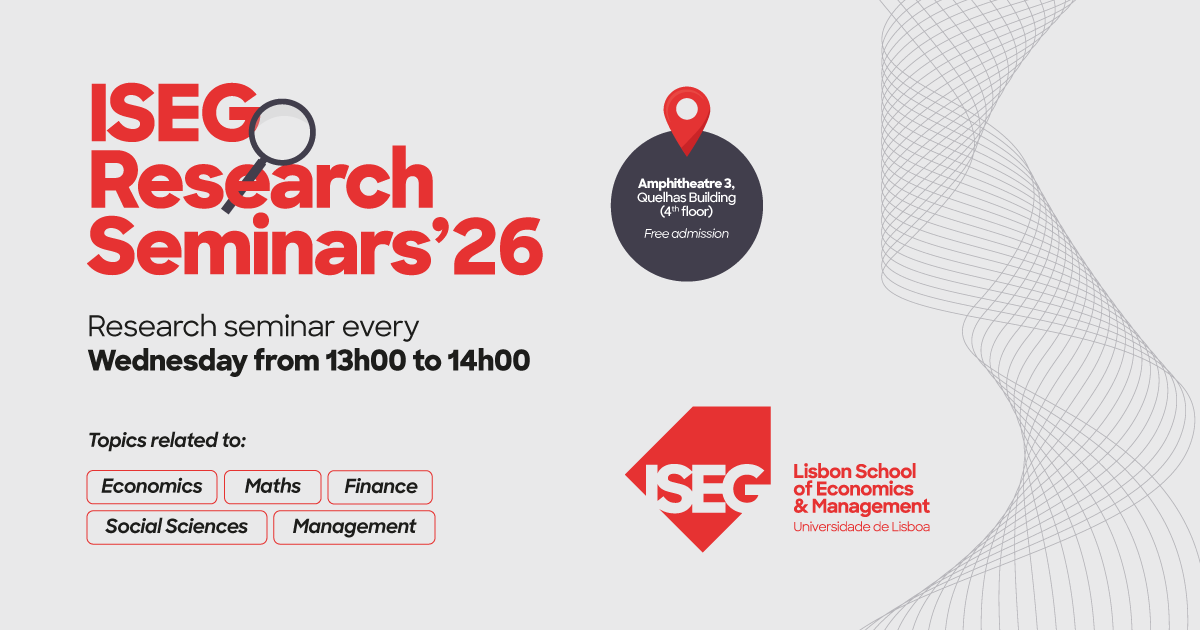
On Monday, 6 May, a session of the ISEG Research Seminars will take place. The guest speaker will be Hanna Wang.
Title
Job Search and Mobility Over the Life-Cycle: Implications for the Child Penalty
Abstract
Using Dutch administrative and survey data, we document that women's job mobility drops around childbirth. Women make fewer job-to-job transitions starting one year before birth and continuing for many years after. They are also less likely to engage in on-the-job search and tend to work in jobs with low amenities, such as irregular hours. We develop a life-cycle model of labour supply, job search and job switching in which pregnant women and mothers face higher search costs. Jobs are characterised as bundles of wages and amenities, where amenities reduce work disutility. We use the model to quantify a novel channel through which the child penalty operates: because (expecting) mothers search less, they remain in jobs with lower wages and fewer amenities, leading to lower employment and earnings. We find that search costs related to childbirth reduce lifetime earnings by 1.8%, accounting for 18.45% of the child penalty. We validate the model using a recent reform that eliminated tenure requirements for parental leave. Following the reform, mothers increased job switching before birth but decreased employment in the year of birth.
As part of the commemoration of the 125th anniversary of the birth of Bento de Jesus Caraça, ISEG will be holding on 28 Mayand presentation of the documentary “Bento de Jesus Caraça, Mathematician and Citizen” by Diana Andringa, directed by Cristina Antunes.
The sitting begins at 18.00, in Auditorium 2, Quelhas Building.
Free admission.
As part of the commemoration of the 125th anniversary of the birth of Bento de Jesus Caraça, ISEG will be holding on 14 Mayand conference “Bento de Jesus Caraça and the Economy”. The speaker will be Carlos Bastien, retired professor at ISEG.
The sitting begins at 18.00, in Auditorium 2, Quelhas Building.
Free admission.
As part of the commemoration of the 125th anniversary of the birth of Bento de Jesus Caraça, ISEG will be holding on 7 Mayand "Bento de Jesus Caraça and Citizenship" conference. The speaker will be Fernando Rosas, a retired full professor in the History department of the School of Social Sciences and Humanities of Universidade NOVA de Lisboa and a researcher at the Institute of Contemporary History of the same university, of which he was founder and Chairman of the Board from 1994 to February 2013.
The sitting begins at 18.00, in the Auditorium 2.
Free admission.
As part of the commemoration of the 125th anniversary of the birth of Bento de Jesus Caraça, ISEG will be holding on 30 Apriland conference “Bento de Jesus Caraça and Mathematics”. The speaker will be Paulo Almeida, Professor at the Instituto Superior Técnico.
The sitting begins at 18.00, in the ISEG Library.
Free admission.
On Monday, 27th April, a session of the ISEG Research Seminars will take place from 13:00-14:00 in the Staples room, Quelhas Building, 3rd floor. The guest speaker will be Beniamino Pisicoli.
Title
Real domestic effects of banks’ cross-border lending
Abstract
In this paper we investigate empirically whether having a domestic banking sector that lends more abroad is beneficial for the productivity of the domestic real economy. We investigate this question by using both cross-country / cross-sector and within-country / cross-firm panel data, thus providing aggregate and micro evidence. The analysis, that comprises the estimation of several OLS, system GMM, local projection and IV models, points to the beneficial role of a higher internationalisation of the domestic banking system on the productivity of the domestic economy. Results emerge both when using cross-country / cross-sector data from a panel of European economies, and when adopting a more granular approach by using UK company and bank panel data. This effect is stronger when the domestic banking system lends more to companies in foreign advanced economies, is not limited to exporting companies, and is more pronounced during the early phase of a new banking relationship. In contrast, the inflow of lending from foreign banks does not result in productivity improvements for the domestic real economy.
On Wednesday 29 April, a session of the ISEG Research Seminars will take place from 13.00 to 14.00. The guest speaker will be Olga Chiappinelli.
The ISEG Research Seminars are held every week on Wednesdays, with the participation of professors from ISEG, as well as from other Portuguese and international educational institutions.
Title
The Greener, the Better? Evidence from Government Contractors
Abstract
Governments support the green transition through green public procurement. Using US data, this paper provides the first empirical analysis of the causal effects of green contracts on corporate greenhouse gas emissions and economic performance. We focus on an affirmative programme for sustainable products, which represents one-sixth of the total federal procurement budget, and publicly traded firms, which account for one-third of total US emissions. Our results show that securing green contracts reduces emissions relative to firm size and increases productivity. We find no evidence that the programme selects greener firms, nor that green public procurement sales crowd out private sales.
As part of the initiatives aimed at the teaching staff, the following seminar was held “Lessons with Impact: PRME and i5”, organized by the Sustainable Development Goals (SDG) Working Group for Education and the OAIP.
The session was attended by Professors Winnie Picoto and Helena Jerónimo, who presented new teaching methodologies in line with the principles of responsible education, promoting the integration of innovative practices in the context of higher education.
This initiative stood out as a moment of sharing and reflection on the role of teaching in promoting a positive impact on society, reinforcing ISEG's commitment to education geared towards sustainability and global challenges.
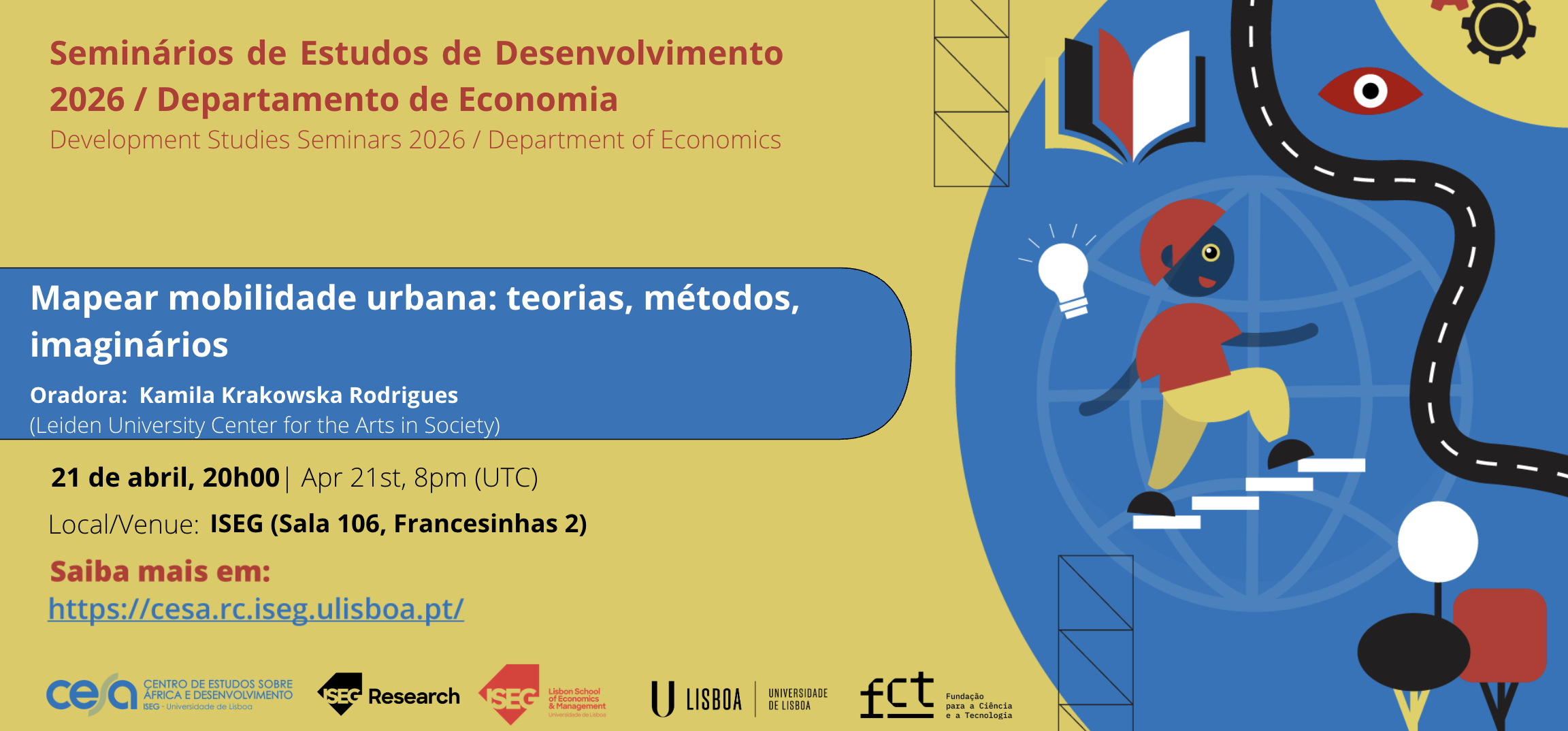
As part of the Development Studies Seminars 2026, organised by CEsA - Centre for Studies on Africa and Development (ISEG Research), a session will be held on “Mapping Urban Mobility: Theories, Methods, Imaginaries”.
This seminar will be a critical reflection on the dynamics of urban mobility, exploring different theoretical and methodological approaches and the imaginaries that shape the way urban spaces are experienced and represented. The session invites interdisciplinary discussion around the contemporary challenges of cities and forms of mobility.
Date:21 April 2026
Time: 20.00
Location: Room 106, Francesinhas 2, ISEG
Free participation, subject to room capacity.
The Group LxDS - Lisbon Dynamical Systems Group (João Lopes Dias, Pedro Duarte, José Pedro Gaivão, Telmo Peixe, Alexandre Rodrigues, Pedro Soares) together with ISEG Research and CEMS.UL, is organising the LxDS Spring School’26 for three days (from May 27-29, 2026) on Dynamical Systems, which will take place at FCUL (Room C6.2.33).
The Spring School is organised around three mini-courses:
More than an academic event, this Spring School is a vibrant intergenerational platform. It is the ideal space to discuss innovative ideas, unlock ongoing research projects and master new concepts in a collaborative and stimulating environment. We therefore invite all researchers and students dedicated to dynamic systems to join us on this journey of knowledge sharing. If you would like to actively contribute to the programme, we are accepting proposals for 25-minute oral presentations - just get in touch with the organisers.
Participation is completely free of charge and open to the entire scientific community, although registration is mandatory. Don't miss the opportunity to take part in this event: consult the details here and ensure your presence using this form.