








As part of the Biomass project in Portugaltakes place at ISEG on October 28th. Project Closing Conference.
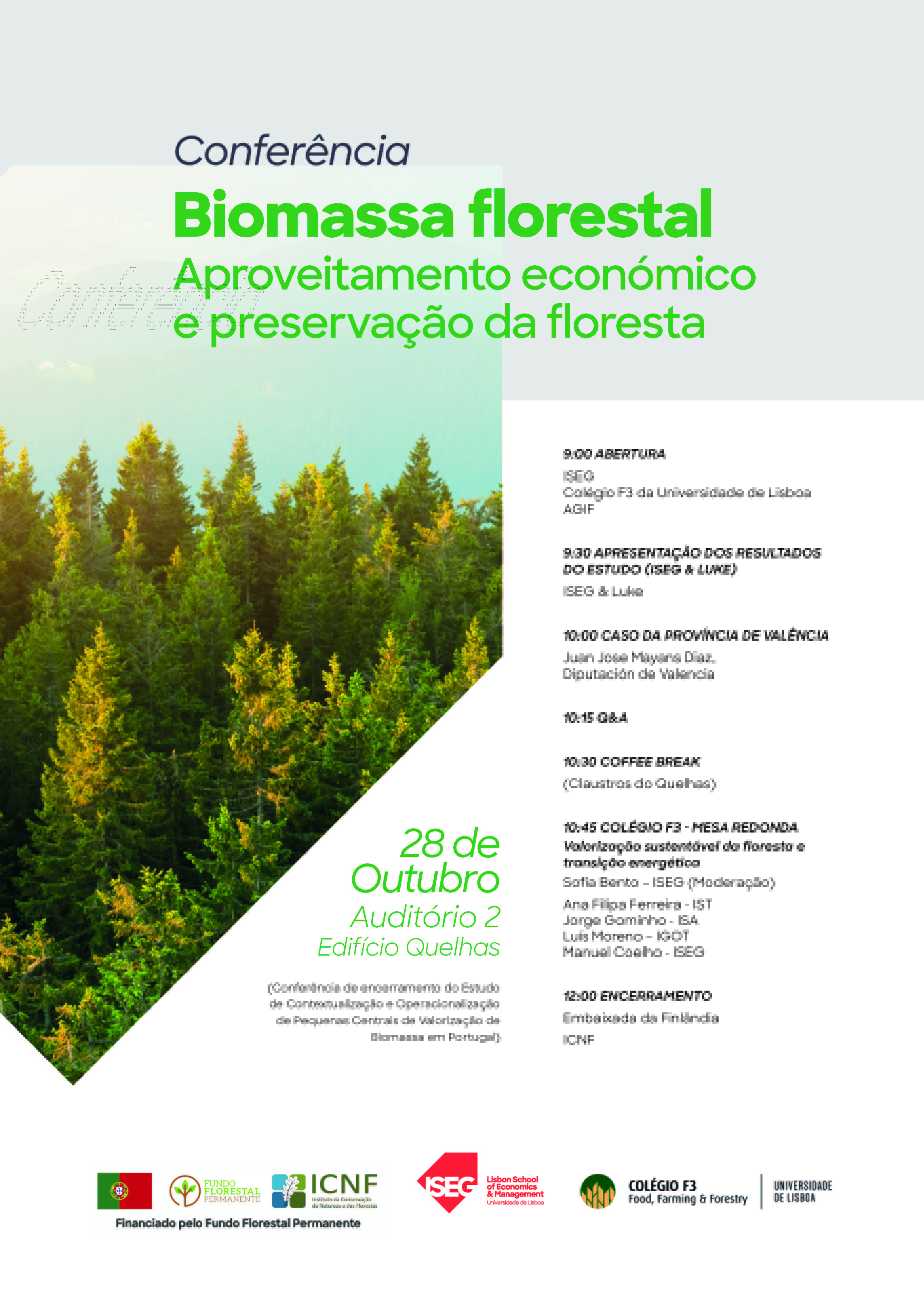
This event also includes a Round Table organized by the University of Lisbon's Food, Farming and Forestry College (Colégio F3) to discuss the topic of "Sustainable forestry and energy transition".
The session will take place between 9 a.m. and 12 p.m. in Auditorium 2 (Quelhas Building, 2nd floor).
Free entry, subject to pre-register HERE.
The Biomass in Portugal project, led by ISEG, was created to meet multiple objectives, including preserving forest areas by improving their economic sustainability and preventing fires. It began on September 1, 2021 and will last for one year.
More information about the project on this link.
On October 19, Professor Carlos Lourenço (ISEG) will present at ISEG the study "The effect of range of outcomes and magnitude of rewards on lying behavior in anonymous dice-under-cup trials".
Abstract:
We examine the effect of changing the structure of the lying opportunity by conducting a laboratory experiment. In particular, we vary the range of possible false outcomes and the magnitude of rewards. We apply the dice-under-cup paradigm which uses anonymous dice rolls to record actual lying behavior by comparing the distribution of participants stated outcomes to the expected statistical distribution of dice roll outcomes. We find that although some small changes in lying behavior can be achieved with an increase in the possible range of outcomes and by exponentially increasing rewards, lying behavior is generally robust to changes in the lying opportunity structure. Our study concludes that lying behavior seems to be driven by the aim to achieve a certain payoff regardless of conditions.
Working paper here.
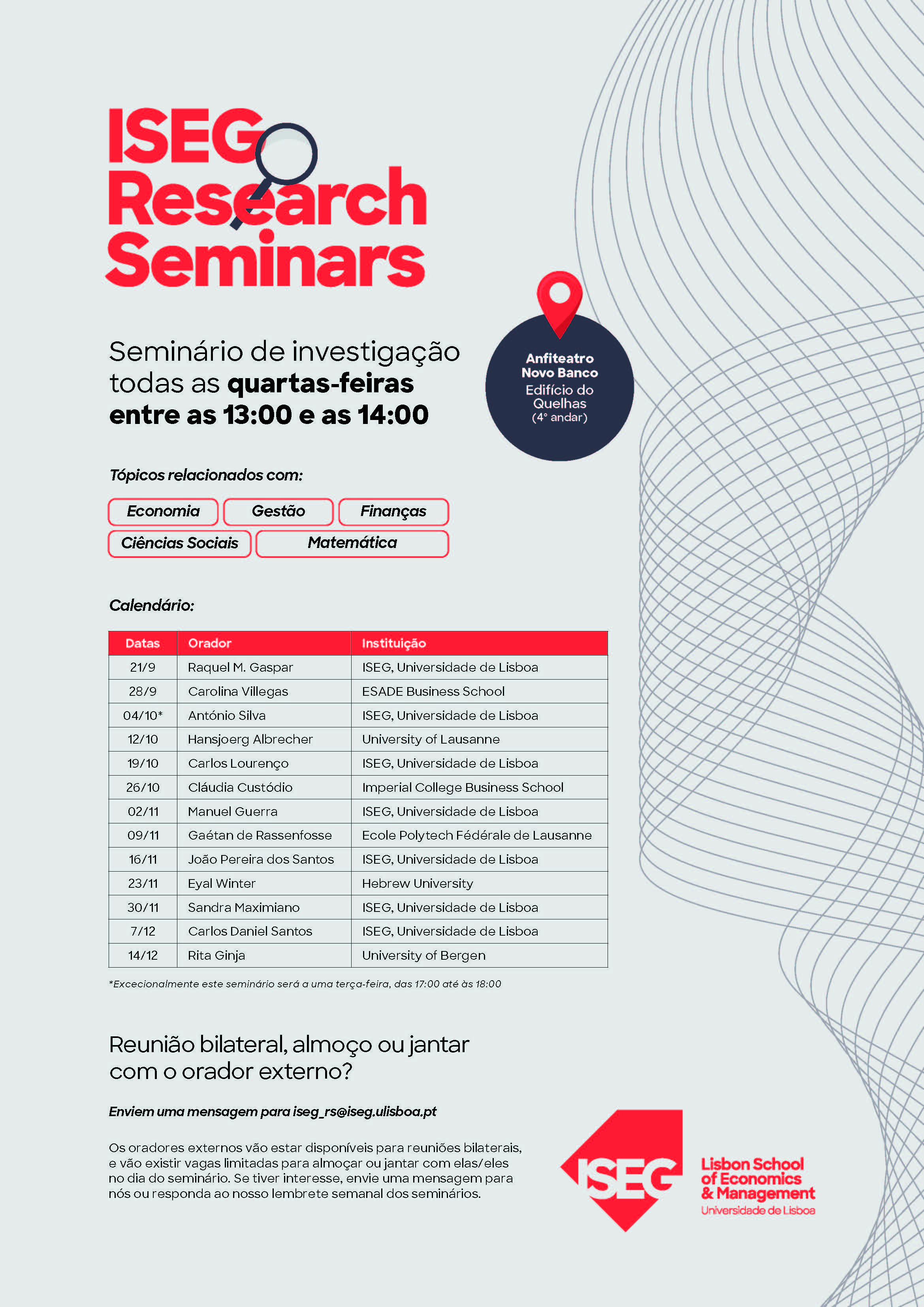
The research seminars will take place from September 21 to December 14, on Wednesdays, from 1:00 PM to 2:00 PM, at the Novo Banco Amphitheater (Quelhas Building, 4th floor).
Faculty from ISEG and other national and international schools will participate in the sessions, when they will address topics related with Economics, Management, Finance, Social Sciences, and Mathematics.
Free admission.
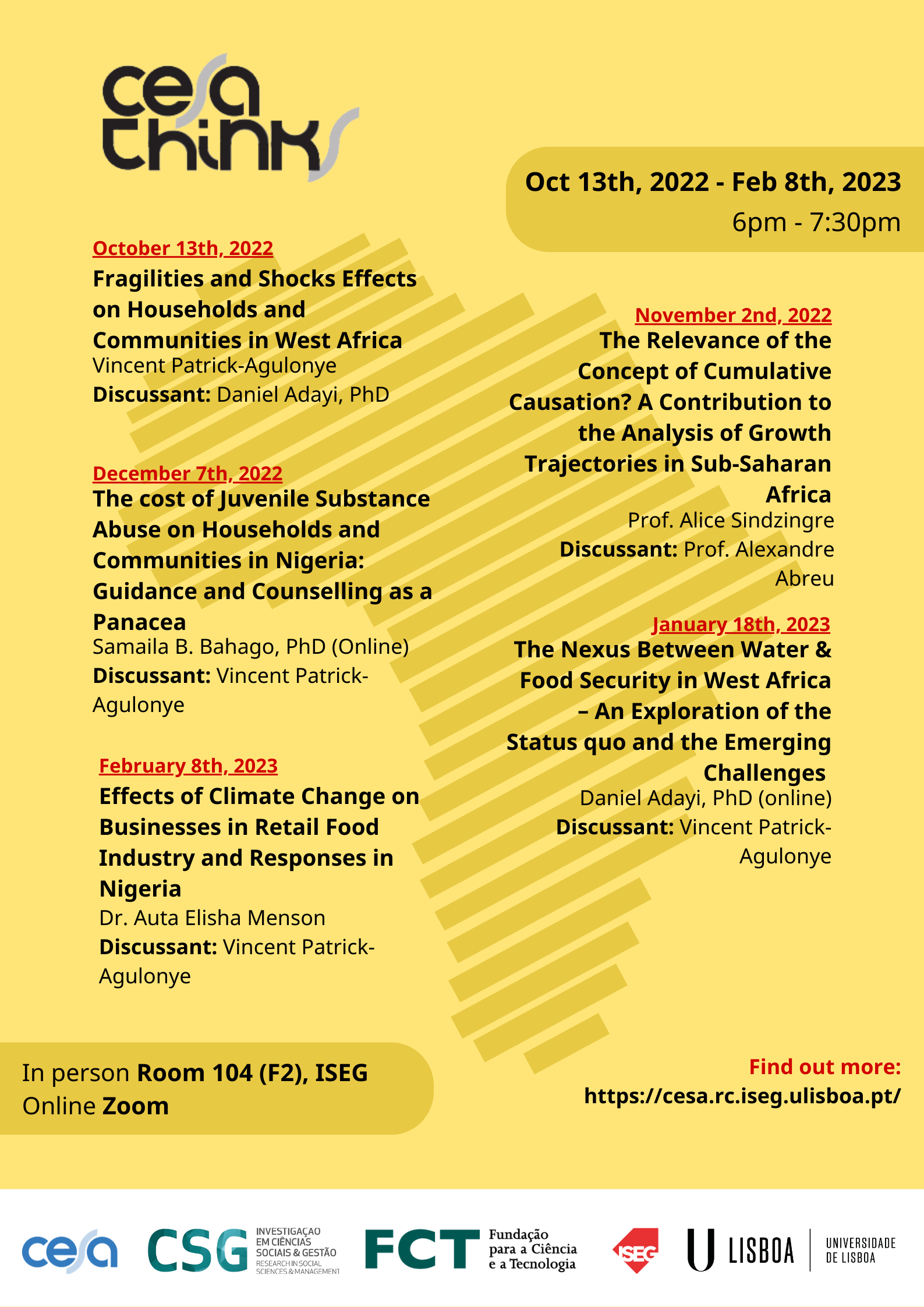
On October 13, the seminar "Fragilities and Shocks Effects on Households and Communities in West Africa". The session will feature Vincent Patrick-Agulonyee and Daniel Adayi.
This seminar is part of the Cycle of Seminars CEsA Thinksorganized by CEsA - Centre for Studies on Africa and Development - CSG/ ISEG/ Ulisboa from October 13, 2022 to February 8, 2023.
The session will take place at ISEG, in room 104 (Edifício Francesinhas 2) and online at Zoom.
The Seminar Cycle provides a space for social studies researchers to reflect on contemporary Africa and its development. Another objective is to encourage debate and constructive criticism, thus helping researchers to improve the quality of their projects.
The sessions take place once a month, from 18:00 to 19:30.
More information about the CEsA Thinks Seminar Series HERE.
On October 12, Hansjoerg Albrecher, from the University of Lausanne (Switzerland), will present the study "Optimal ratcheting of dividends in insurance" at ISEG.
Abstract:
We give an overview of recent developments in identifying optimal strategies for paying out dividends in an insurance company. In particular, we will focus on the case when dividend rates are not allowed to decrease over time. The optimality criterion here is to maximize the expected value of the aggregate discounted dividend payments up to the time of ruin. In the framework of the classical risk model and its Brownian approximation, the solution of the corresponding two-dimensional optimal control problem is presented and optimal strategies are given for several concrete examples. They illustrate that the restriction of ratcheting does not lead to a large efficiency loss when compared to the classical unconstrained optimal dividend strategy. We also consider an extension of the results to drawdown constraints on the dividend rate, where a curious square-root rule emerges.
The research seminars will take place from September 21 to December 14, on Wednesdays, from 1:00 PM to 2:00 PM, at the Novo Banco Amphitheater (Quelhas Building, 4th floor).
Faculty from ISEG and other national and international schools will participate in the sessions, when they will address topics related with Economics, Management, Finance, Social Sciences, and Mathematics.
Free admission.
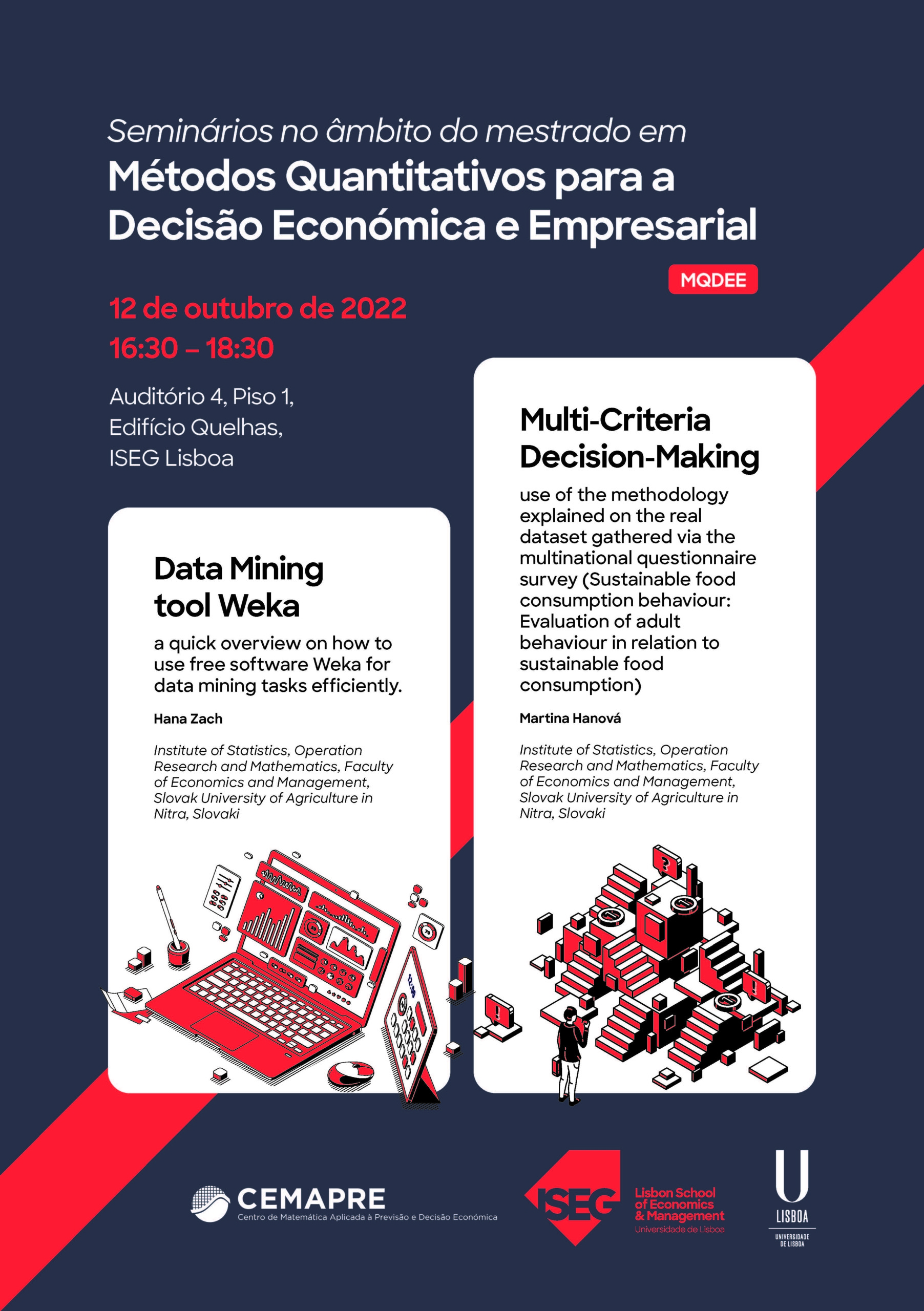
On October 12, two seminars will be held as part of the Master's Degree in Métodos Quantitativos para a Decisão Económica e Empresarialfrom 4:30 p.m. to 6:30 p.m. in Auditorium 4 (New Quelhas Building).
The sessions will feature two international speakers.
Hana Zach (Institute of Statistics, Operation Research and Mathematics, Faculty of Economics and Management, Slovak University of Agriculture in Nitra, Slovaki) will be the speaker at the seminar "Data Mining tool Weka'.
E, Martina Hanová (Institute of Statistics, Operation Research and Mathematics, Faculty of Economics and Management, Slovak University of Agriculture in Nitra, Slovaki) will address the topic "Multi-Criteria Decision-Making'.
Free admission.
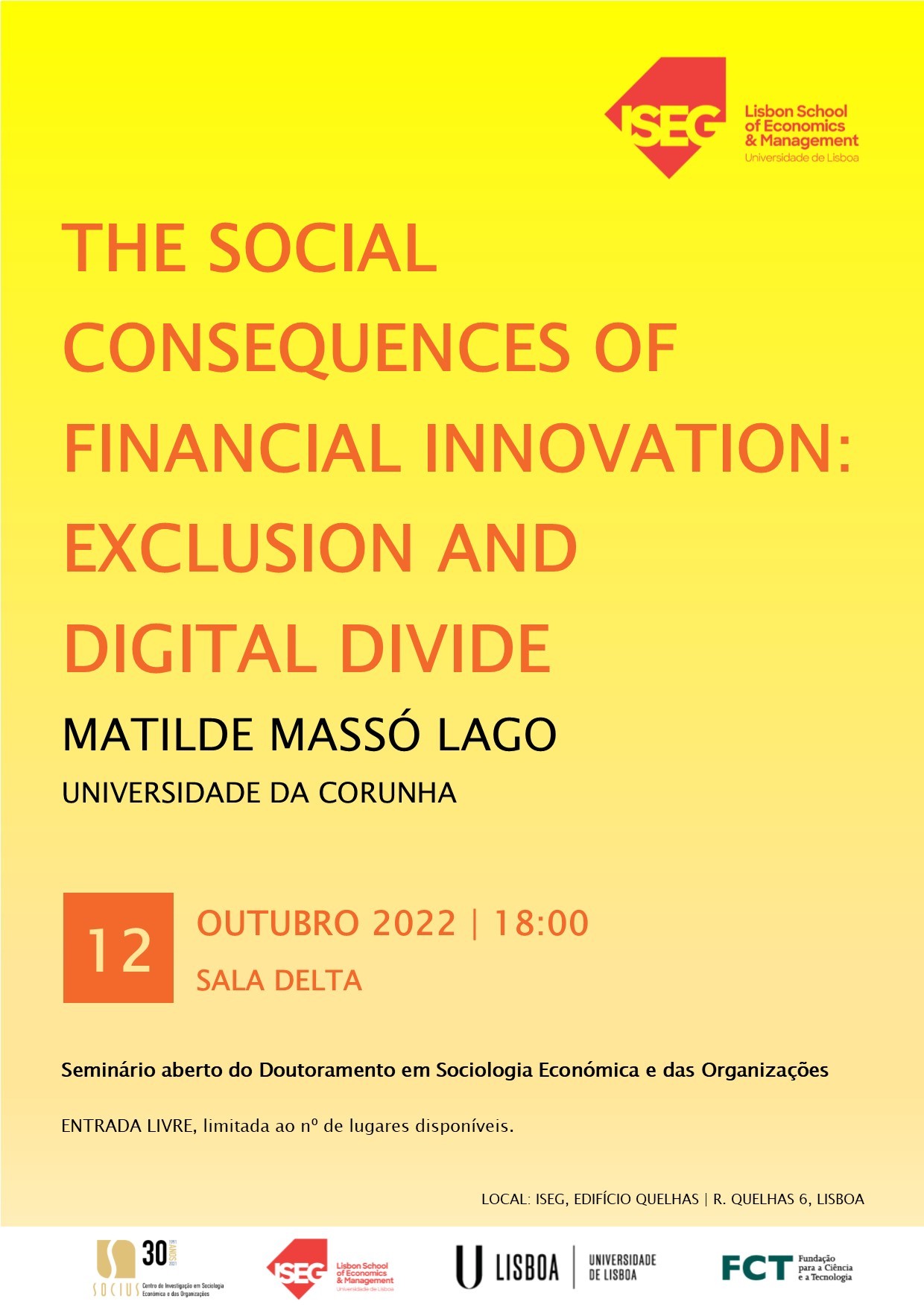
On October 12, at 18:00, the seminar "The Social Consequences of Financial Innovation: Exclusion and Digital Divide", with a presentation by professor and researcher Matilde Massó Lago, from the University of A Coruña (Spain).
Matilde Massó Lake is a sociologist, with research in the areas of economic and financial sociology. She was a Marie-Curie Fellow at the Bauman Institute (University of Leeds) between 2016 and 2019. A list of her publications can be found at here.
The Seminar is open to all PhD students and other researchers with an interest in the topic.
This event takes place in the Delta room (Quelhas Building, 3rd floor).
On October 4, António Silva (ISEG) presents the study "Reducing speeding at zero-cost using behavioral science - a large scale experimental field trialport Switching and Productivity".
This week's seminar runs from 5pm to 6pm on Tuesday, due to the public holiday.
Abstract:
Do firms respond to local customer and supplier cost shocks by reducing their share of imported intermediate goods? We compute changes in relative unit labor costs vRoad traffic accidents are one of the leading causes of death globally: Over 3,500 people die on roads every day, resulting in 1.3 million preventable deaths each year. Our research explores whether low-cost behavioral interventions can provide cost-effective increases in driver safety by reducing the likelihood of drivers exceeding speed limits. We redesigned information sent to drivers who had been caught exceeding speeding limits using a series of behavioral insights. To evaluate the redesigned information, we conducted a randomized control trial in Sussex, United Kingdom, where we sent 51,829 drivers who were caught exceeding the speed limit either the original materials or our redesigned materials. We found that the redesigned information resulted in a 1.06pp (23%) reduction in the likelihood of exceeding the speed limit again within 6 months of being sent materials compared to the control. This difference remained at 1.02pp 12 months post-intervention. Our findings demonstrate that a zero-cost behavioral intervention can materially change driver behavior, and suggests the potential for behavioral interventions to reduce traffic accidents.
The research seminars will take place from September 21 to December 14, on Wednesdays, from 1:00 PM to 2:00 PM, at the Novo Banco Amphitheater (Quelhas Building, 4th floor).
Faculty from ISEG and other national and international schools will participate in the sessions, when they will address topics related with Economics, Management, Finance, Social Sciences, and Mathematics.
Free admission.
To mark the start of Master in Business Science 2022/23 at ISEG next Thursday, September 29thseminar will take place Social Economy, Non-Profit Organizations and the Challenges of Management.
The event, which will take place via Zoom by 18h, is aimed at students in the 1st and 2nd years of the Master's Degree in Business Sciences. Its purpose is to raise awareness of recent challenges in this area of management, as well as to present a sector where there are many career opportunities.
The session will feature two experts:
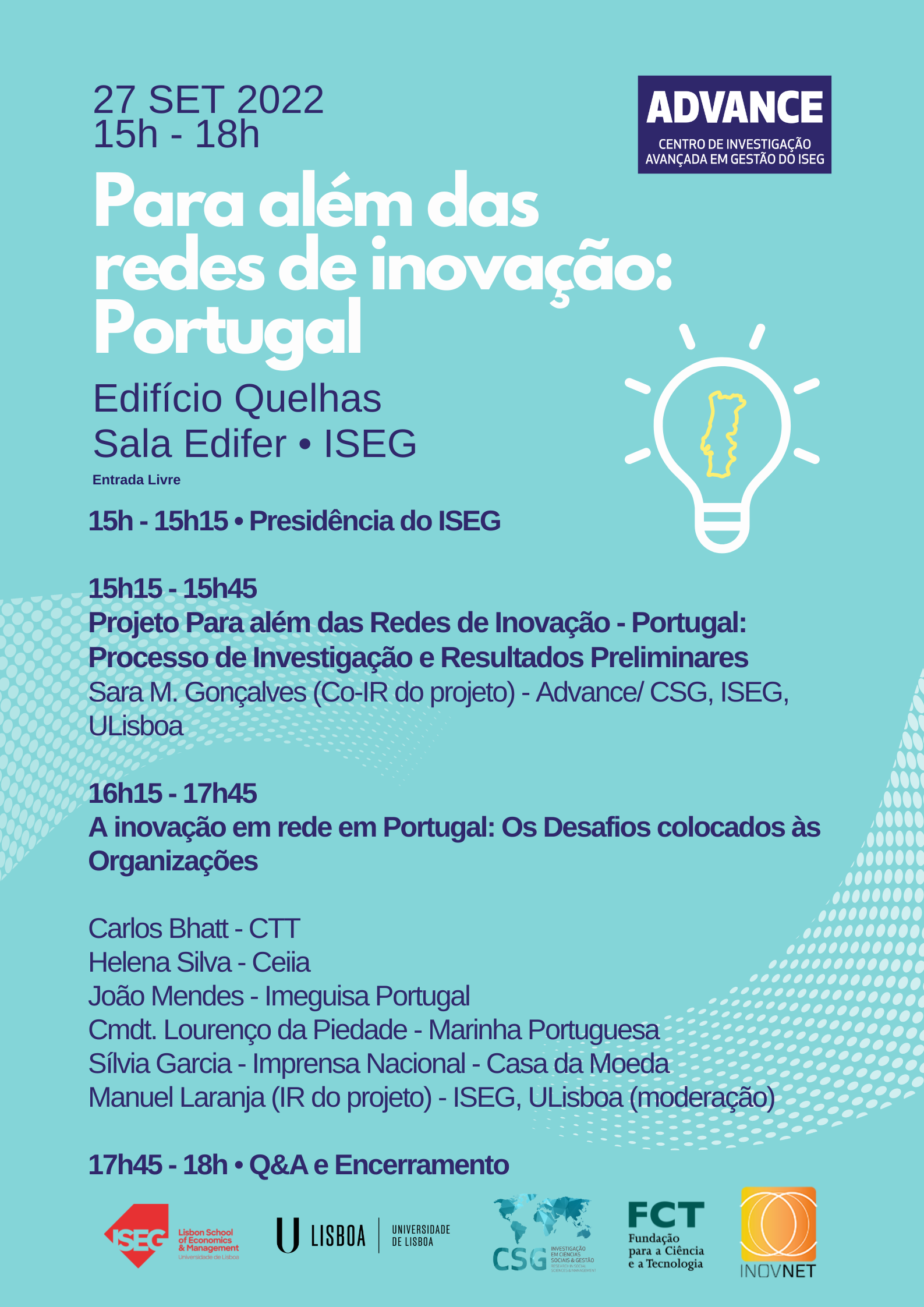
The project Beyond innovation networks: Portugal - InovNet Portugal studies the networks that are created between different actors, be they companies, public bodies, other organizations or even individuals, in order to jointly develop innovation processes.
In 2022, the project seminar will take place on September 27 at ISEG (Edifer room in the Quelhas Building), at 15:00.
Free admission.
Complete program here
On September 28, Carolina Villegas, from ESADE Business School (Barcelona), will present the study "Made in Spain: Import Switching and Productivity" at ISEG.
Abstract:
Do firms respond to local customer and supplier cost shocks by reducing their share of imported intermediate goods? We compute changes in relative unit labor costs vis-a-vis main trading partners in upstream and downstream sectors post-Spanish internal devaluation and combine with the quasi-universe of Spanish manufacturing firms. Firms' import share is unresponsive to supplier competitive gains however, there is import switching by firms selling to downstream sectors exhibiting international competitive losses and producing highly substitutable goods. Estimates from a structural model imply import switching explains 40% of the cumulative productivity losses of the Spanish manufacturing sector during this period.
The research seminars will take place from September 21 to December 14, on Wednesdays, from 1:00 PM to 2:00 PM, at the Novo Banco Amphitheater (Quelhas Building, 4th floor).
Faculty from ISEG and other national and international schools will participate in the sessions, when they will address topics related with Economics, Management, Finance, Social Sciences, and Mathematics.
Free admission.