








Join us as we share the main results, innovations and lessons learned from the SustInAfrica research project, highlighting how sustainable intensification approaches can improve productivity, resilience, ecosystem services, and market development in West and North Africa, and how these results can be taken forward into policy and practice.
SustInAfrica is an EU-funded Horizon 2020 research project which aims to empower West and North African smallholder farmers and small- and medium-sized enterprises (SMEs) to facilitate sustainable intensification of African farming systems, and to develop and deploy a reference framework on agricultural practices and technologies. Through seven interlinked work packages (WPs), the project is developed in 5 North and West African countries: Egypt, Tunisia, Niger, Ghana, and Burkina Faso.
The project's overarching approach is to assess the environmental, economic and social impacts of tested practices and technologies, and to develop strategies and sustainable business models that enable their scaling and adoption.
🎤 Our Speakers:
Idalina Dias Sardinha, Lisbon School of Economics & Management (ISEG) - WP1: Baseline analysis & monitoring system's design of farming systems.
Michael Schirrmann, Leibniz Institute for Agricultural Engineering and Bioeconomy (ATB) Germany - WP2: Smart farming technologies for plant production.
Kwame Agyei Frimpong, University of Cape Coast, Ghana - WP3: ‘The targeted design & implementation of demonstration trials for resilient & sustainable agricultural production & delivery of ecosystem services’.
Adam Standring, Lisbon School of Economics and Management (ISEG), Portugal, WP4: Education & training approaches to sustainable agriculture.
Paul Wagstaff, Self Help Africa in Ireland - WP5: Sustainability, replicability and exploitation of successful practices.
🎙️ Moderated by: Giles Young, Senior Scientist at The Natural Resources Institute Finland (Luke), and Project Manager of SustinAfrica.
Register here
On Wednesday 22 April, a session of the ISEG Research Seminars will take place from 13.00 to 14.00. The guest speaker will be Libertad González.
The ISEG Research Seminars are held every week on Wednesdays, with the participation of professors from ISEG, as well as from other Portuguese and international educational institutions.
Title
Maternity Benefits, Consumption and Labour Supply: Estimating Causal Effects with Bank Transaction Data
Abstract
We estimate the causal effects of a generous maternity benefit introduced in Madrid in 2022, which granted €500 per month until a child's second birthday to mothers under the age of 31. We exploit the sharp eligibility cutoff on 1 January 2022, using a regression discontinuity design and high-frequency bank transaction data covering daily spending, earnings, and account balances. Eligible mothers received, on average, over €7,000 in benefit payments in the 24 months following childbirth. Total spending increased by about €1,200, implying an average MPC of 0.16, with strong heterogeneity: the MPC is zero among higher-income mothers and rises to 0.4 among lower-income mothers, who show sizable increases in basic-necessity spending and sharp, short-lived spikes in expenditure after each deposit. Higher-income mothers exhibit no meaningful change in consumption and save more than half of the benefit, with no robust evidence of changes in labour earnings. Across administrative, survey and transaction data, we find no aggregate decline in employment. Overall, the benefit appears to alleviate liquidity constraints for lower-income mothers while leaving the labour supply largely unaffected.
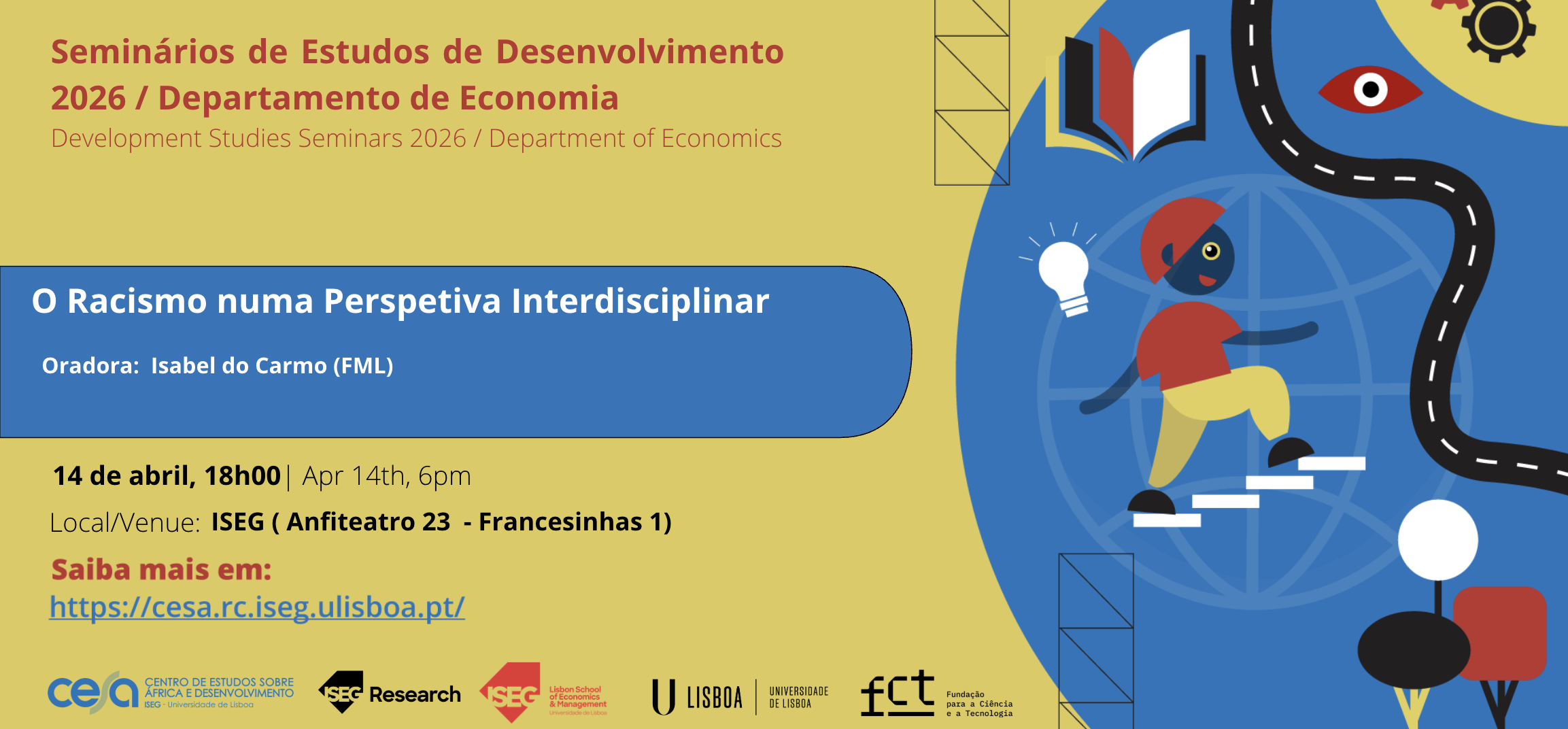
The Development Studies Seminars 2026, organized by CEsA - Centre for African and Development Studies / ISEG Research, will host a session entitled “Racism from an Interdisciplinary Perspective”.
This seminar proposes an interdisciplinary reflection on racism, analyzing it as a historical, social and political phenomenon, and promoting debate on its dynamics and impact on contemporary society.
Speaker: Isabel do Carmo - Faculty of Medicine of Lisbon (FML)
Date: April 14th, 2026
Time: 6 p.m.
Location: Amphitheater 23, Francesinhas 1, Floor 1
The session is in person, open to the public and free to attend.
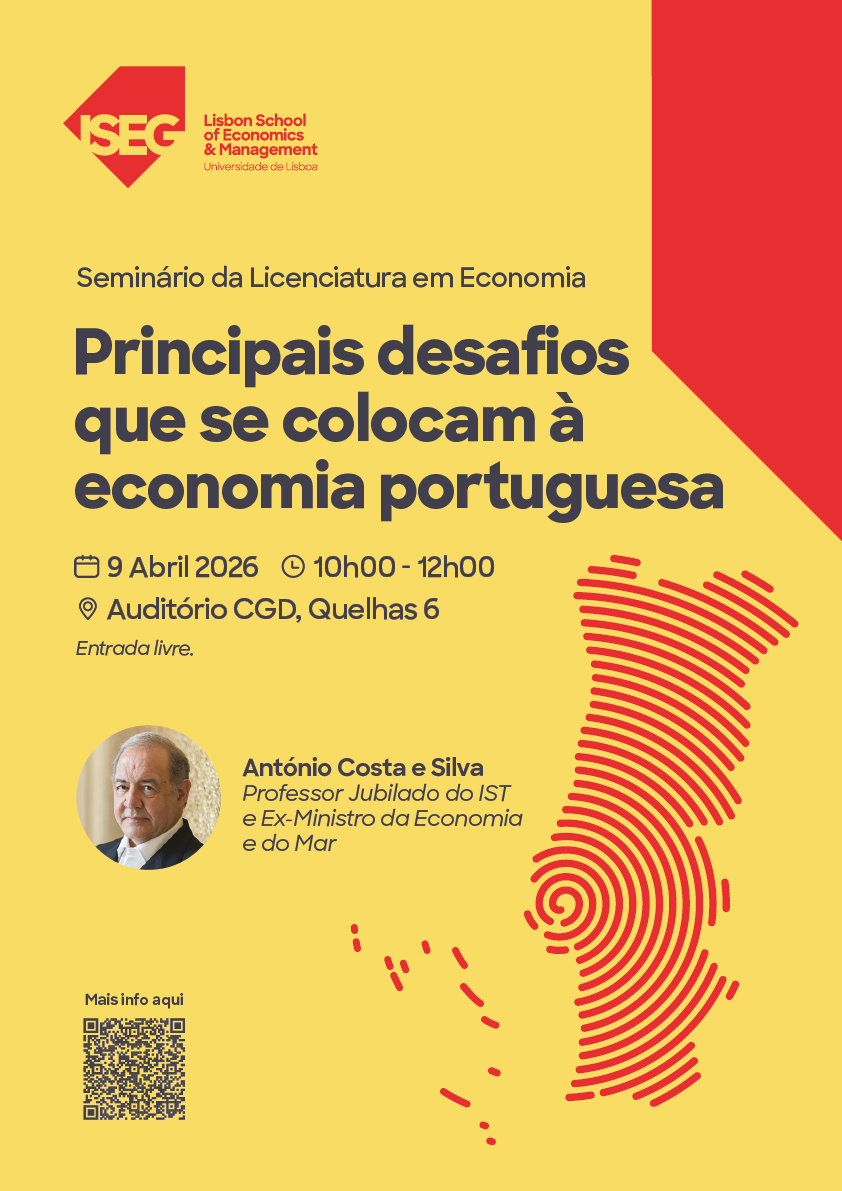
On April 9th, 2026, from from 10:00 to 12:00, takes place at CGD Auditorium a new Degree in Economics, on the theme “The main challenges facing the Portuguese economy”.
The webinar will feature António Costa e Silva, Emeritus Professor at the Instituto Superior Técnico and Former Minister of Economy and the Sea.
This seminar will be an opportunity to reflect on the main challenges facing the Portuguese economy, at a particularly relevant time for the debate on competitiveness, growth and economic development.
On April 16th, 12:30 p.m., A seminar dedicated to the presentation and discussion of the main results of the study will be held in Auditorium 2 at Quelhas. “Indicators of School (In)Success: Old Questions, New Challenges”.
The session will be led by Professor Carlos Farinha Rodrigues (ISEG), author of the study, and will be a time for joint analysis and reflection on the conclusions reached and the challenges they pose in the current educational context.
Summary: The aim of this study is to update previous analyses on academic failure in the 1st cycle at ISEG, developed within the scope of the Observatory for Pedagogical Action and Innovation. To this end, a longitudinal analysis is carried out of the administrative records relating to the number of students enrolled, assessed and passed in the different curricular units, covering the period between the academic years 2015/2016 and 2023/2024.
The analysis is structured around three key indicators - non-participation rate in assessment, effective failure rate and school failure rate - which are used to identify and quantify persistent patterns of failure. These indicators are disaggregated by course, department, curricular year and type of curricular unit, making it possible to isolate critical factors and structural heterogeneities in academic performance.
In addition, the study seeks to evaluate the impact of the measures implemented in recent years to mitigate school failure, contributing to a more in-depth understanding of their effectiveness and to inform future interventions in the context of higher education.
The seminar will be delivered in Portuguese.
We are counting on your presence to make the session more dynamic and to share experiences! A light meal will be served.
Free admission.
On Wednesday 8 April, a session of the ISEG Research Seminars will take place from 13.00 to 14.00. The guest speaker will be Ricardo Rodrigues.
The ISEG Research Seminars are held every week on Wednesdays, with the participation of professors from ISEG, as well as from other Portuguese and international educational institutions.
Title
A dynamic approach to unmet needs in long-term care for older people across Europe
Abstract
Studies on unmet needs in long-term care (LTC) have focused on specific time points and have not taken a dynamic approach that considers changes across time. Using longitudinal data from the SHARE survey (2011-2022), this study analyzes trajectories of unmet needs for care and support with ADLs and IADLs across Europe, following individuals for up to nine years after the onset of needs. Latent Profile Analysis shows five types of trajectories defined by time till onset of unmet needs, number of changes of state, time spent with unmet needs, limitations with ADLs and IADLs and age at onset of needs. Three of these trajectories are marked by early periods of unmet needs (Short and Long Delayed Met Needs, and High Needs and Delayed Met Needs). Two trajectories are more ambivalent (U-shaped Met Needs) or outright positive (Met Needs From the Onset) in their profiles. An overwhelming majority of older people experience unmet needs at some point after the onset of needs. Multivariate analysis of determinants of these trajectories shows that having a cohabiting spouse or partner and higher income are associated with trajectories where care is available early on. Country-level public expenditure on LTC is also a strong determinant of belonging to different trajectories. The research further explores the association of these trajectories with mortality and mean number of ADLs and IADLs.
On March 25, don't miss the seminar “Marketing in the Age of Algorithms: How AI is Rewriting the Rules of Engagement“, organized as part of ISEG's Master's in Marketing.
The topic will be presented by Catarina Silva Santos, Lead Solution Engineer at Salesforce, specializing in Marketing and E-Commerce.
The seminar takes place from 6:30 p.m. to 7:45 p.m. in Auditorium 5 (Novo Quelhas).
Admission is free, subject to pre-registration on this link.
On March 23rd, don't miss the seminar “MEO Sustainability: From Strategy to Action“, organized as part of ISEG's Master's in Marketing.
The topic will be presented by Catarina Corte-Real, MEO's Corporate Director of Projects, Audit and Sustainability.
The seminar takes place from 6:30 p.m. to 7:45 p.m. in Auditorium 5 (Quelhas).
Admission is free, subject to pre-registration on this link.
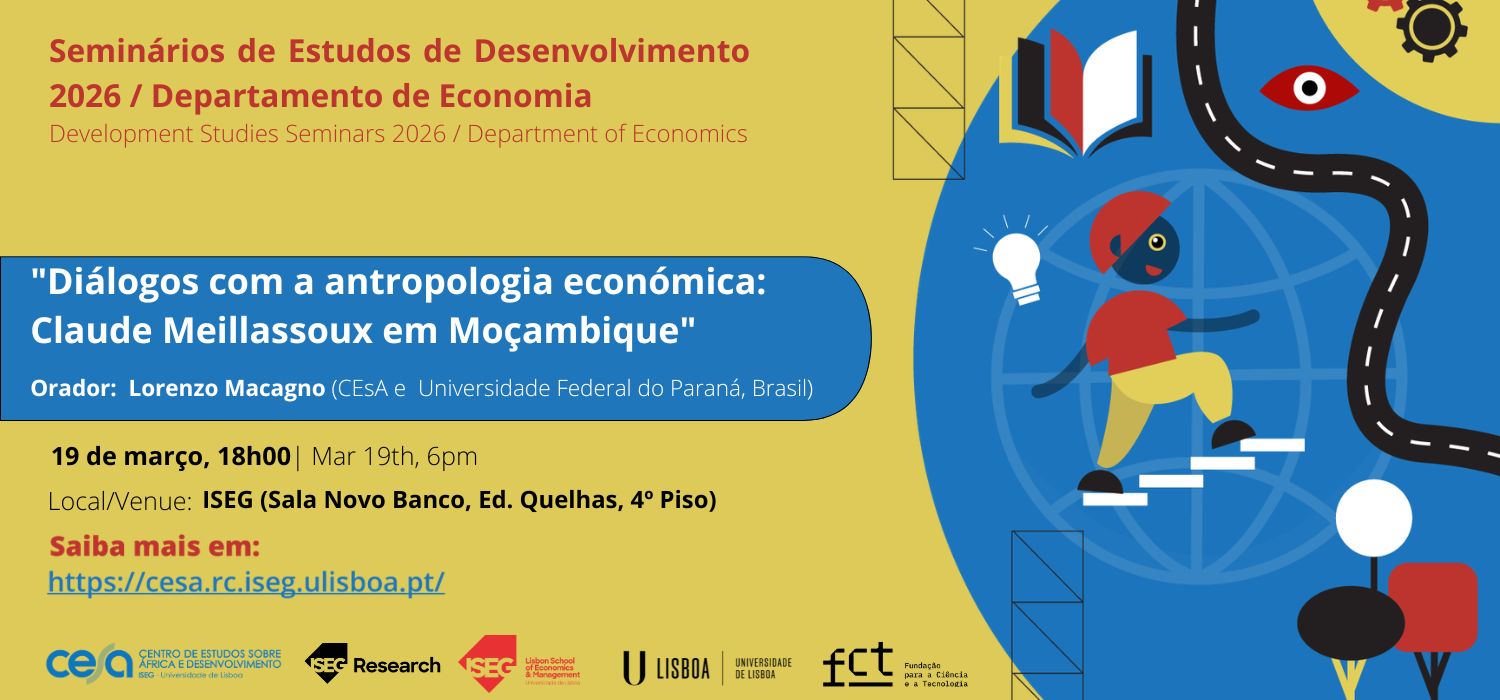
The Development Studies Seminars 2026, organized by CEsA - Center for African and Development Studies/ISEG Research, will host a session entitled “Dialogues with Economic Anthropology: Claude Meillassoux in Mozambique.”
This seminar proposes a reflection on the relevance of the work of the French anthropologist Claude Meillassoux in the context of Mozambique, exploring the interconnections between economic anthropology, colonial and post-colonial dynamics and social transformations in African societies.
Speaker: Lorenzo Macagno - Federal University of Paraná (Brazil)
The session invites discussion on the analytical contributions of economic anthropology to understanding social, economic and historical processes in Africa, with a particular focus on Mozambique.
Date: March 19th, 2026
Time: 18h
Location: Novo Banco Room, Ed Quelhas, 4th Floor
On April 10th, ISEG Alumni Económicas celebrates its 35th anniversary.
The program will be as follows:
18h00 | Conference “Where are the world, Europe and Portugal heading?”
José Maria Brandão de Brito
Assistant Secretary of State for the Budget
Eduardo Catroga
Chairman of the Committee for the 35th Anniversary Celebrations of ISEG Alumni Económicas
20h00 | 35th anniversary dinner of ISEG Alumni Económicas
Welcome, Pedro Janeiro
Keynote speaker, Vitor Constâncio
Registrations are limited and must be made using the form available. here, until March 31st.
We're counting on you to celebrate your Association!