




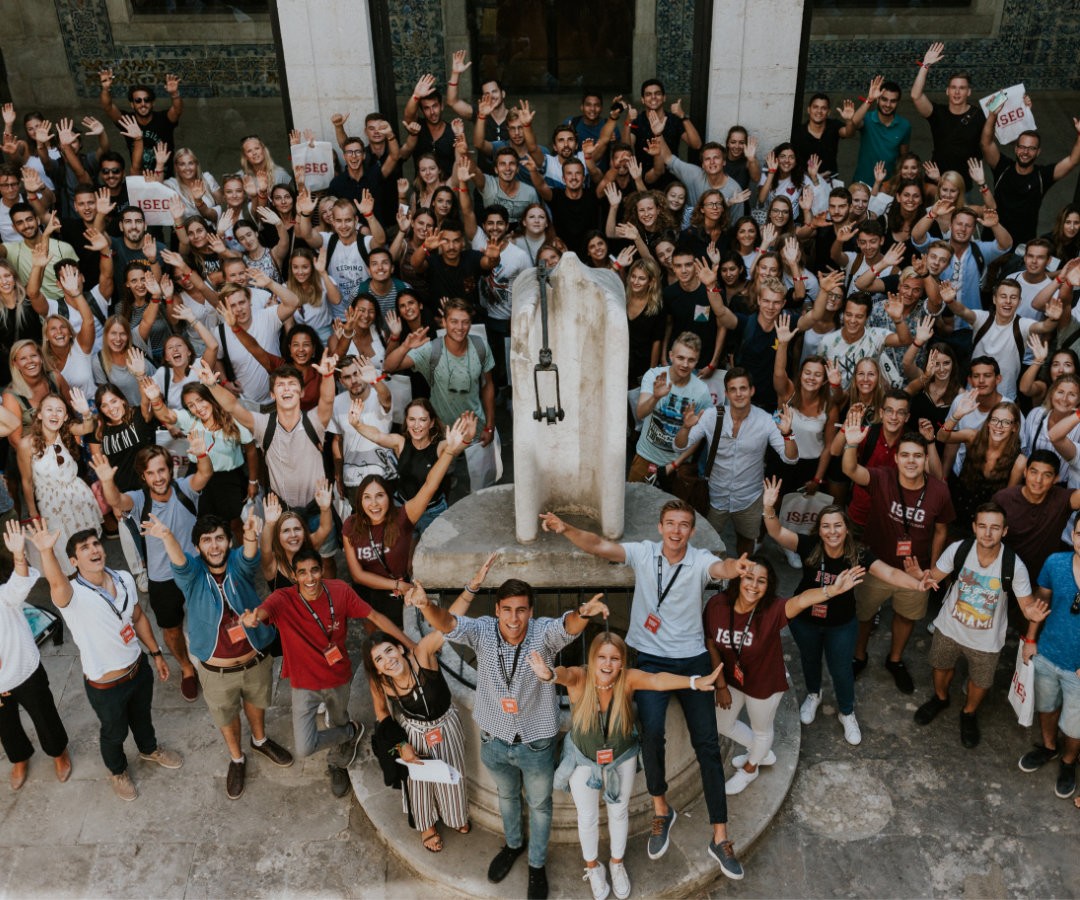





On November 27, at 7 p.m., the The Future of the Actuarial Profession“ seminar”, in Amphitheater 4 (Quelhas Building).
The session will feature Carla Sá Pereira, Partner from Ernst & Young.
Free admission.
On Wednesday November 19th, a session of the ISEG Research Seminars will take place from 13.00 to 14.00. The guest speaker will be João Pereira dos Santos (ISEG), who will present the paper 'Gendered Judgments of Misbehavior: Evidence from the World Youth Day Pilgrims and Lisbon citygoers.'.
The ISEG Research Seminars are held every week on Wednesdays in Lecture Theatre 4 of Quelhas (4th floor), with the participation of professors from ISEG and other Portuguese and international universities.
We present the results of the first field experiments on prescriptive gender stereotyping in moral judgments. The first survey experiment was conducted during the 2023 World Youth Day in Lisbon, an event with Pope Francis that gathered 2 million pilgrims from around the world. We asked 1,800 pilgrims from 80 nationalities to evaluate hypothetical norm-violating scenarios involving lying, sexual promiscuity, and parental care, with varying genders. To assess external validity, we replicated the same questionnaire in multiple non-religious field settings, allowing us to compare judgments across contexts with different levels of religiosity. What did we find? Join us to discuss whether moral judgments differ by gender, whether context matters, and how religiosity shapes these perceptions.
Deadline for Early Bird Registration: 30th of June 2026
For instructions on the Registration process click here
The European Social model is under pressure, both from external sources and from within.
Today's global geo-economic and strategic environment is shaped by commercial tensions, the heightening of (the threat of) military conflicts, the challenges imposed by climate change, and the structural change in economic processes as a result of technological innovation and AI.
At the same time, the increased popularity of radical right-wing and populist forces is reshaping the politics of the welfare state, in terms of both the composition of pro-welfare constituencies, and the welfare agendas these parties pursue.
The 24th ESPAnet Annual Conference in Lisbon, 2026, aims to assess how these and other key developments are re-shaping political and policy debates in Europe. What should be the mission and the perimeter of the Welfare State in European societies? Who is deserving of social protection? And how is social protection best delivered?
| Date | End | Results | |
| Call for Proposals | 4/12/2025 | 16/01/2026 | 31/01/2026 |
| Call for Papers | 01/02/2026 | 17/05/2026 | 31/05/2026 |
| Registration | 01/06/2026 | 14/08/2026 | – |
| Final Program | 15/08/2026 | – | – |
| On-site Conference | 26/08/2026 | 28/08/2026 | – |
Program Overview (Draft Version)
Stream Sessions – Summary Table
The European Social Model faces growing pressure from global economic tensions, rising military threats, climate change, technological transformation, and AI. At the same time, the rise of radical right-wing and populist movements is reshaping welfare politics, influencing both support for social protection and policy priorities. The 2026 ESPAnet Conference in Lisbon will examine how these changes are redefining the welfare state in Europe, including its purpose, scope and methods of delivering social protection.
With this in mind, we have organized the content into a series of streams, which we invite you to explore.
| 1. Welfare States, Demography and Bodies [more info] |
| 2. Time-Related Social Policies in the World of Work and Care [more info] |
| 3. Providing Social Security for Older People: Interactions of Different Social Policies, their Drivers and Outcomes [more info] |
| 4. Disability, Citizenship, and the Future of the Welfare State in Europe [more info] |
| 5. The Politics of Education [more info] |
| 6. The Matthew Effect in Social and Educational Policies and the Intergenerational Transmission of Disadvantages Over the Life Course [more info] |
| 7. Employment Policies and the Quest for a European Labour Market [more info] |
| 8. Families in Transition: Rethinking Social Policy Design [more info] |
| 9. The Role of the European Union in Caregiving and Parenting: What Direction are Family Policies Taking? [more info] |
| 10. New Perspectives on Poverty and Economic Inequality [more info] |
| 11. Pensions in the 21st century: Challenges, Policy Feedback and Political Dynamics [more info] |
| 12. Social Policy Context of Life-Course Transitions [more info] |
| 13. De-Standardization of Retirement Pathways: Conceptual, Institutional, and Life-Course perspectives [more info] |
| 14. Welfare States and Migration: Welfare Attitudes and Welfare Access [more info] |
| 15. Transformative Social Policy in Times of Climate Change [more info] |
| 16. Sustainable Welfare and Eco-Social Policy [more info] |
| 17. Scarring Effects of the Pandemic: Inequality, Poverty, and Social Policy After COVID-19 [more info] |
| 18. Food Insecurity and Food Assistance: The Need for Social Policy [more info] |
| 19. Reconfiguring Welfare in the Triple Transition: Comparative Perspectives from Europe and East Asia [more info] |
| 20. Southern European Welfare Model’ Revisited: 30 Years On [more info] |
| 21. The Future of Social Europe: Policies, Outcomes and Political Legitimacy [more info] |
| 22. The Political Economy of the Welfare State across Time and Space [more info] |
| 23. The Politics of Welfare State Reform [more info] |
| 24. Restructuring Welfare Under Pressure: Juridification, Fragmentation and “Wrong-Pocket” Dilemmas [more info] |
| 25. Territorial Inequalities and the Welfare State: The Spatial Politics of Service Delivery [more info] |
| 26. Data, AI and Digital Infrastructure. Reshaping the Moral Economy of Welfare States [more info] |
| 27. Who Deserves Support? Deservingness, Poverty, and Activation in Contemporary Welfare States [more info] |
| 28. Political Representation of the Poor in Social Policy [more info] |
| 29. Policy Engagement, Knowledge Exchange, and Impact: Strengthening Evidence-Based Social Policy Research [more info] |
| 30. Social Workers and Social Policy: Policy Takers or Policy Makers? [more info] |
| 31. Causal Inference in Social Policy Analysis [more info] |
| 32. The Future of Policy Analysis Using Artificial Intelligence [more info] |
| 33. Teaching Social Policy in Higher Education [more info] |
| 34. Open Stream [more info] |
| 35. ‘Pitch Your Book’ Sessions [more info] |
Abstract submissions are made in the Conference website, and must cover the following items:
Please note that:
Selection Procedure:
Mara Yerkes (Utrecht University) and Hervig Immervol (OECD) They are internationally recognized scholars whose work has significantly advanced research, informed policy debates, and shaped thinking in their respective fields. Through their keynote addresses, they will offer valuable insights, innovative perspectives, and thought-provoking reflections that will enrich our discussions throughout the conference.
We are honored to welcome these distinguished speakers and look forward to the knowledge, inspiration, and engagement they will bring to our international community of researchers, practitioners, and policymakers.
WORK-LIFE BALANCE: AN INVISIBLE CHALLENGE FOR THE EUROPEAN SOCIAL MODEL?
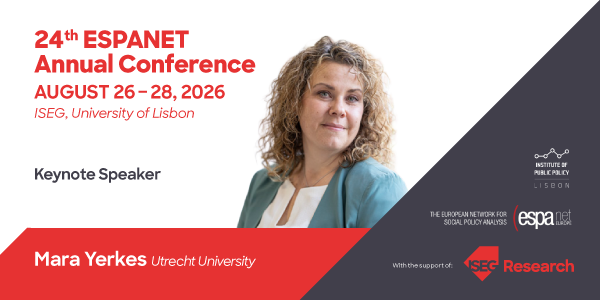
Work-life balance is a central pillar of the European Social Model. Yet despite far-reaching policy efforts, such as those contained in the European Work-Life Balance Directive, work-life ‘balance’ remains unequally distributed and experienced within and across countries. These inequalities cannot be addressed without going beyond work-life balance—to the core of social policy design, financing, and implementation in contemporary welfare states, characterized by decentralization, digitalization, and an emphasis on individual responsibility. In my keynote address, I will outline how—against this backdrop and given the decades-long invisibility of care work—the reality of work-life balance for many working parents and caregivers is a navigational nightmare. I will also explain how having to navigate multiple policy and system landscapes allows social inequalities to persist or even worsen. In short, I will discuss how the social policy infrastructures inherent in contemporary welfare states have contributed to work-life balance shifting from a central pillar to an invisible, internal challenge to the European Social Model itself.
Short Bio:
Mara Yerkes is a Full Professor of Comparative Social Policy in relation to Social Inequalities at Utrecht University. Yerkes conducts comparative research on welfare states and industrial relations at the national and local levels and how these relate to inequalities in work, care, communities, and families, with a particular focus on intersectional gender inequalities.
SOCIAL PROTECTION AND THE GREEN TRANSITION: EVIDENCE, KNOWLEDGE GAPS, AND POLICY CHALLENGES
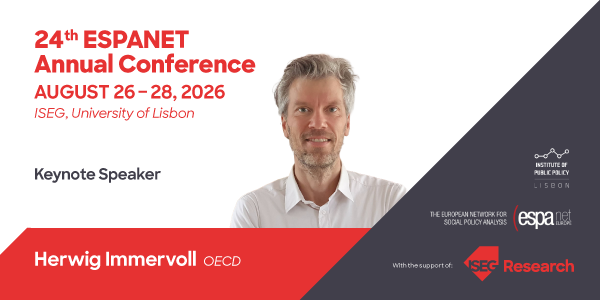
In this keynote address, I will discuss how contemporary welfare states can move beyond merely cushioning structural change to actively shaping a socially robust and politically durable green transition. I will argue, first, that a “just transition” is not only an equity imperative but also a central condition for sustaining public support for ambitious climate policies. Understanding public attitudes, perceived burdens, and trust in institutions is therefore integral to the design, sequencing, and communication of climate and social policies, rather than a secondary consideration. Second, I will present evidence suggesting that, on the one hand, the average household burden resulting from existing carbon prices is often overstated in political debate when compared to other shocks, such as recent spikes in inflation. On the other hand, disadvantaged households may already face additional carbon-related costs that are several times higher, as a share of income, than those experienced by high-income groups. Finally, I will explore why this potential for compensation remains underutilized in current policy practice and consider the implications for the future of European social models.
Short Bio:
Dr. Herwig Immervoll works in the Directorate for Employment, Labor, and Social Affairs at the OECD. He leads work on social benefits and the green transition and previously held staff positions at the World Bank and the University of Cambridge. Herwig has led research projects and policy dialogue on trends in inequality and redistribution, income and employment support, population aging, and social policy responses to economic crises. His current work includes advancing social protection in changing labor markets and climates, and supporting governments in making social policies more accessible, people-centered, and fiscally sustainable.
The Conference fee includes coffee breaks and lunches on all three days of the Congress, Welcome Reception and Conference Dinner (August 27). (Note: Insurance, accommodation, and travel costs are not included in the Conference fee.)
Payment: Payment can only be made via bank transfer. Payment must be made within 30 days of Registration. Further instructions provided during the Registration process.
Invoicing: An invoice will be issued within 15 days upon payment confirmation of payment by the Organizing Committee.
Cancellation policy: If participants need to cancel the registration, they will receive a 50% refund if they cancel until July 20, 2026 (50% cancellation fee). After July 20, 2026, no refund will be provided (100% cancellation fee).
| Registration 1 june - 14 august | Fees |
| Early Bird : 1 june - 30 june | 325€ / Phd Students - 175€ |
| Regular: 1 july - 31 july | 375€ / Phd Students - 225€ |
| Late: 1 august - 14 august | 400€ / Phd Students - 250 € |
More To Come Soon
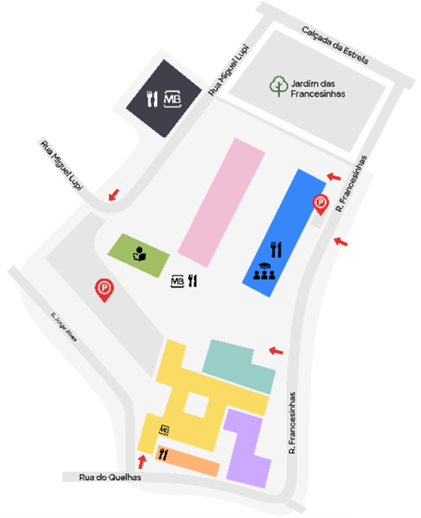
The use of public transport is recommended, with destinations at the the Parliament or Calçada da Estrela stops, both located just a few minutes’ walk from the campus. The following lines serve these areas:
Bus
706-727 Av. D. Carlos I 1 minute by foot
713-773 Rua Borges Carneiro | 5 minutes by foot
714-760-774 Largo Conde Barão | 5 minutes by foot
728 Av. 24 de Julho | 7 minutes by foot
Tram
28-25 Calçada da Estrela | 2 minutes by foot
15-18 Av. 24 de Julho | 5 minutes by foot
Metro
Yellow Line leave at Rato Station | 10 minutes by foot
Green Line leave at Station Cais do Sodré | 15 minutes by foot
Train
Cascais Line leave at Santos Station | 7 minutes by foot
Campus Access
The campus can be accessed through two main entrances:
• Entrance via Rua das Francesinhas: you should proceed up the interior campus stairs to the top, where you will find the Quelhas 6 building. Please then follow the signage on site.
• Direct entrance via Rua do Quelhas, no. 6, or through the parking access: these entrances provide direct access to the building. Please then follow the signage on site.
We recommend, to use the Rua das Francesinhas Entrance.
During the event, visible signage will be placed throughout the campus indicating the way to ‘ESPAnet Conference’.
The Conference does not have any specific protocols concerning discount prices for accommodation. However, there are a set of nearby hotels that you can check for accommodation:
We would remind participants that the Conference takes place during the tourism high season in Lisbon, which means that finding accommodation can be challenging and prices might be higher than expected - if you leave it late to book your accommodation. Therefore, we advise participants to book their accommodation as soon as possible.
The Institute of Public Policy - Lisbon (IPP) is an academic-based, independent and nonpartisan think tank dedicated to improving the quality of public debate and making political decision-making processes more informed and rigorous.
Its mission is to contribute to the continuous improvement of the analysis of institutions and public policies, with a particular focus on Portugal and Europe, through the production and dissemination of relevant research.
IPP operates as a multidisciplinary think tank, combining economic analysis with political science across four main areas:
Its research is shared through publications and regular media engagement, while also fostering scientific and cultural exchange between Portugal, Europe, Portuguese-speaking countries, and, secondarily, the United States.
The Institute is guided by values such as freedom, pluralism, independence, innovation and rigor, as well as reciprocity, solidarity, and the pursuit of knowledge and the common good, aiming to promote a more open, informed and just society.
The work of the Organizing Committee is supported by the members of the Scientific Committee:
Carlos Farinha Rodrigues, University of Lisbon, ISEG Research
Elvira Pereira, University of Lisbon, ISCSP
Alexandra Lopes, University of Porto
Rui Branco, New University of Lisbon
Alexandre Afonso, Leyden University
Amílcar Moreira, IPP / ISEG Research
Carlos Farinha Rodrigues, IPP / ISEG Research
Daniela Craveiro, ISEG Research
Helena Gata, ISEG Research
Paula Cristina Albuquerque, ISEG Research
Susana Brissos, ISEG Research
If you have any questions regarding the conference, please contact us at: espanetlisbon@iseg.ulisboa.pt
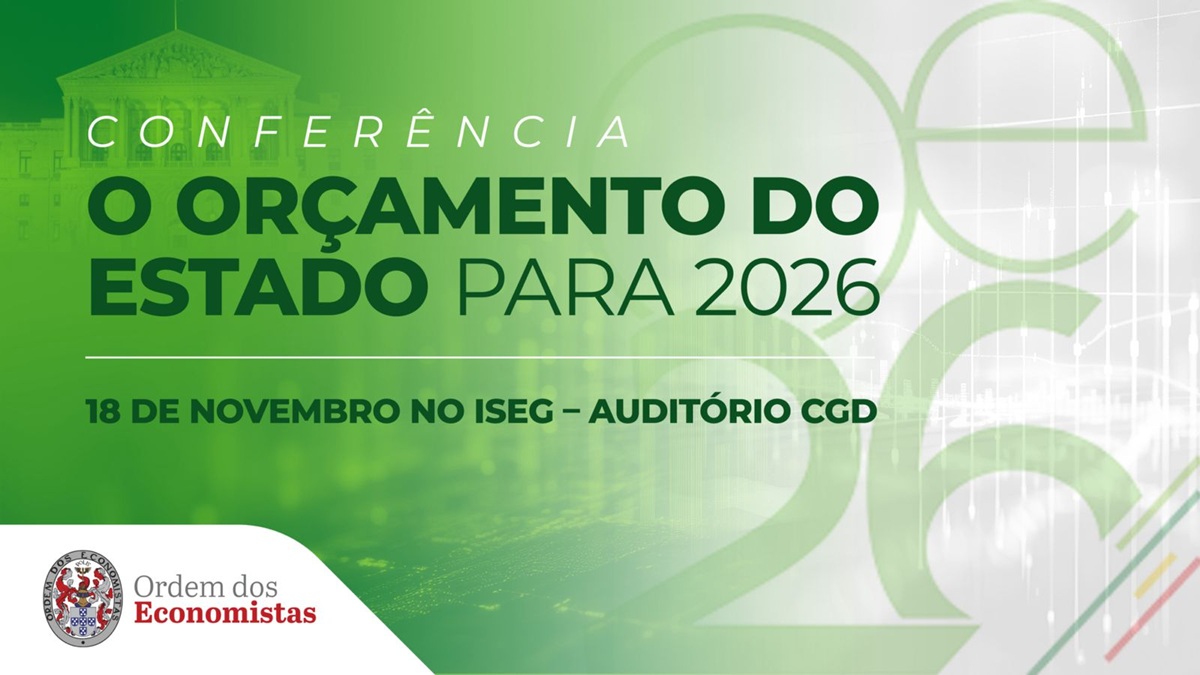
The Order of Economists will hold a Conference on the 2026 State Budgetfrom 9.00 to 13.00 on 18 November at ISEG (CGD Auditorium).
The Conference will be attended by Minister of State and of Finance, Professor Joaquim Miranda Sarmento, by the Vice-President of ISEG, Professor Joana Pais, by the former Governor of the Bank of Portugal, former EIB Vice-President and Member of the General Council of the Portuguese Bar Association, Carlos Costa, as well as leading figures from the academic and economic world.
Participation is free, subject to prior registration on the Ordem dos Economistas website.
A specialist in contemporary Portuguese colonial history, French researcher Michel Cahen (Science Po Bordeaux) will present a seminar at ISEG on 11th November, at 18.00 (Novo Banco Room, 4th floor of Quelhas), with free admission.
Entitled “From the Single ‘Marxist-Leninist’ Party to the Neoliberal Hegemonic Party: Fifty years of authoritarian paternalism in Angola and Mozambique”, the seminar is an initiative of the Development Studies Seminars, which promote the research carried out within the research group on Development Studies and Sustainable Transitions , part of ISEG Research.
Further information here.
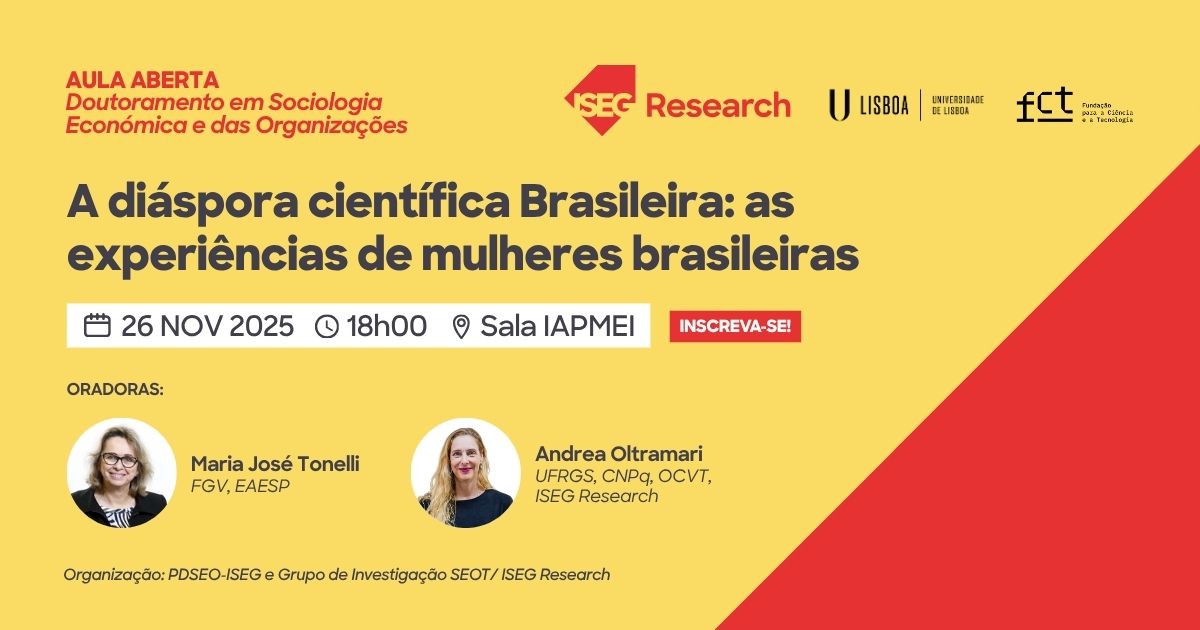
On 26 November, an Open Lecture on 'The Brazilian Scientific Diaspora: The Experiences of Brazilian Women', as part of the course unit 'Organisations and Work' of the PhD in Economic Sociology and Organisations at ISEG (PDSEO).
The session, organised by the PDSEO-ISEG and SEOT/ ISEG Research Group, will include Maria José Tonelli (FGV, EAESP) and Andrea Oltramari (UFRGS, CNPq, OCVT, ISEG Research).
The Open Lecture starts at 6 p.m., in the Iapmei room (Quelhas, 3rd Foor).
Free admission, subject to prior registration on this link.
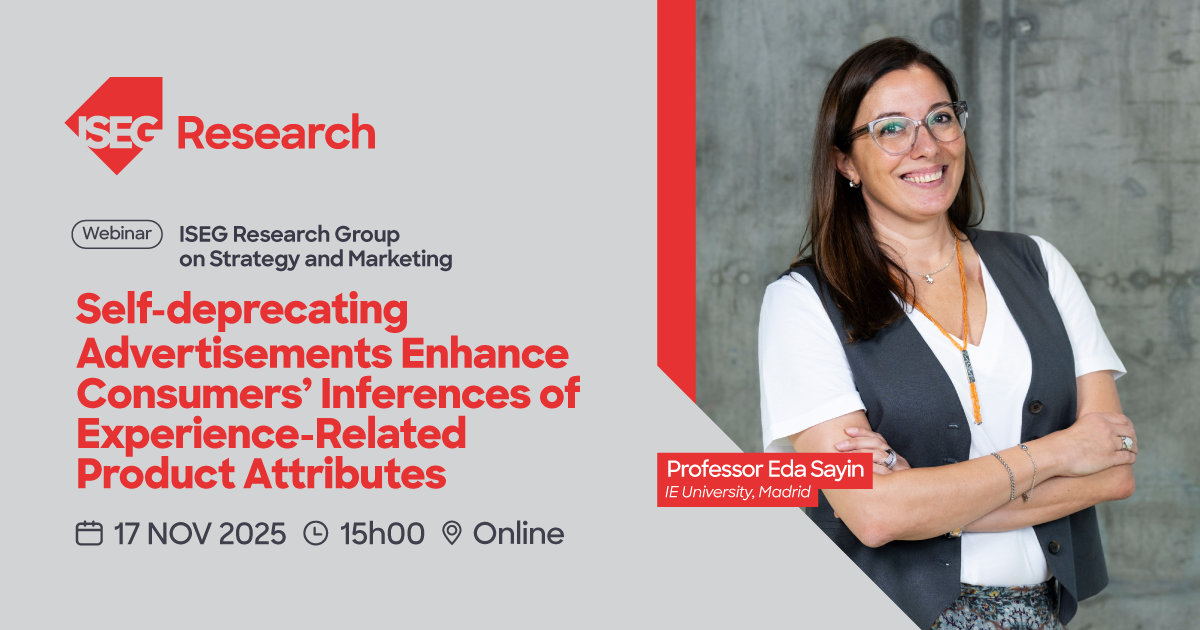
On 17 November, at 15.00, there will be a webinar on 'Self-deprecating Advertisements Enhance Consumers’ Inferences of Experience-Related Product Attributes'. The speaker will be Eda Sayin, from IE University (Madrid).
In this webinar, organised by the Strategy and Marketing research group at ISEG Research, Professor Eda Sayin will talk about her research, which explores how different communication and branding strategies influence consumer perceptions and reactions.
Free participation. Access the webinar on this link.
On Wednesday 5 November, a session of the ISEG Research Seminars will take place from 13.00 to 14.00. The guest speaker will be Cecelmo Joaquim (ISEG), who will present the paper 'The case of Mapping Institutional Change in Accounting Education: A Bibliometric Review'.
The ISEG Research Seminars are held every week on Wednesdays in Lecture Theatre 4 of Quelhas (4th floor), with the participation of professors from ISEG and other Portuguese and international universities.
Free admission
This study examines institutional change in accounting education through a systematic literature review and bibliometric analysis of 508 articles from Web of Science and Scopus up to August 2025. Using Bibliometrix (R) and VOSviewer, key themes, actors and mechanisms shaping curricular and pedagogical reforms are identified. Findings show that change is driven by coercive, normative and mimetic pressures. In the Global North, normative and mimetic pressures linked to accreditation and professional networks foster curricular convergence and internationalisation. In the Global South, coercive pressures from multilateral agencies prevail, often producing symbolic rather than substantive reforms. The analysis highlights epistemological asymmetries, with research concentrated in Northern journals and authors, while Africa, Latin America and Asia remain underrepresented. Over time, the literature has shifted from regulatory harmonisation to topics emphasising digital skills, data analytics, sustainability, ethics and employability. This study maps the field, identifies gaps and proposes a research agenda focused on Global South contexts, pedagogical innovation and hybrid approaches that reconcile global standards with local needs.
On 6th Novemberthe seminar "The SDGs in Action - Communities and Territories: the Healthy Neighborhoods Program and the ODSlocal Platform", an initiative within the curricular unit of Social Sciences and Development of ISEG Master's Degree in International Development and Cooperation.
The meeting will be attended by Helena Roseta (CICS.NOVA), coordinator of the 1st edition of the Healthy Neighborhoods Program, and of João Ferrão (ICS-ULisboa), coordinator of the ODSlocal Platform.
The seminar proposes a reflection on the implementation of Sustainable Development Goals (SDGs) in local contexts, analyzing concrete experiences of citizen participation, territorial cohesion and sustainability-oriented public policies.
The session, to be held between 18.00 to 20.00, in Auditorium 2is open to the academic community and the public interested in learning about good practices and projects that translate the SDGs into concrete actions in Portuguese communities and territories.
Free admission.
On Wednesday, 29 October, from 13.00 to 14.00, a joint session has been held of the ISEG Research Seminars and the Research Seminar Series in Mathematics Applied to Economics and Management. The guest speaker was Otilia Boldea (Tilburg University), who presented a paper on "Bootstrapping GMM tests for an unknown threshold'.
The ISEG Research Seminars are held every week on Wednesdays in Lecture Theatre 4 of Quelhas (4th floor), with the participation of professors from ISEG and other Portuguese and international universities.
Free admission
We prove that the test for an unknown threshold in models with endogenous regressors - proposed in Caner and Hansen (2004) - can exhibit severe size distortions due to the behavior of the test sequence at the edge of the sample. We propose two GMM LR-type and two GMM LM-type tests that rectify these size distortions. Just like the test in Caner and Hansen (2004), our tests are non-pivotal, and we prove their bootstrap validity. The empirical application revisits the question in Ramey and Zubairy (2018) whether government spending multipliers are larger in recessions, but using tests for an unknown threshold. Consistent with Ramey and Zubairy (2018), we do not find strong evidence that these multipliers are larger in recessions.