




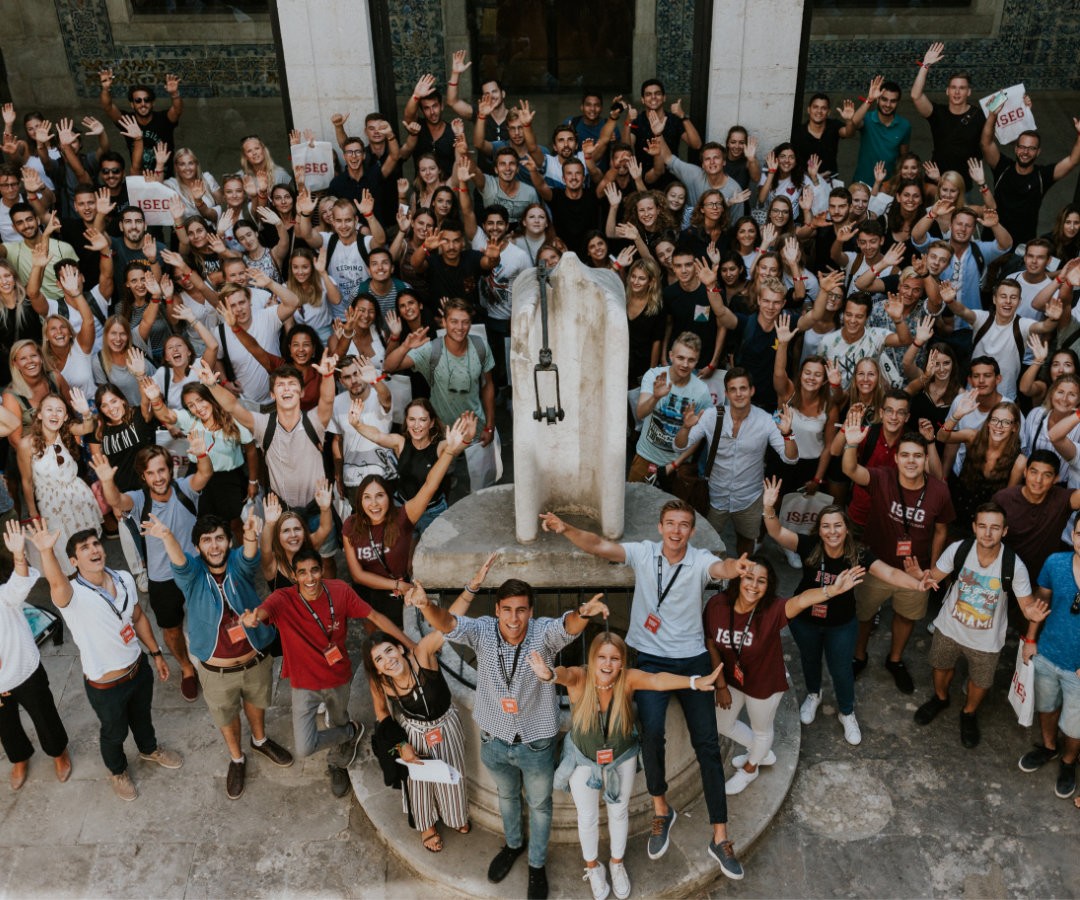





With the concept of "No one has the Numbers that ISEG has", the first school of Economics and Management in the country translates ISEG's unique numbers into its best arguments for a great institutional and product campaign. A campaign developed with the strategy and creativity of Saint Pirate and the production company El Hey.
With a wide online and offline presence - covering print, digital, outdoor, radio and cinema - this campaign's basic idea is to capitalize on a series of assets numbers that attest to the excellence of teaching, the avant-garde DNA, and the pluralistic, inclusive, and humanistic nature found in ISEG's teaching matrix.
The new campaign has kicked off in force among students who will enter Higher Education this year and who are precisely at the peak of their decision-making process.
To support the campaign's numerical narrative, a thorough quantitative research work was carried out with the students, from which some of the information that can be seen in the films, ads, and radio spots that materialize this work emerged.
"We were very pleased with the final result of this campaign. Once again we escaped the usual clichés of higher education communication and presented an institutional and product campaign which, besides being professional and coherent with ISEG's values and quality, is assertive, clean and fun. Ultimately, those who pay attention to the campaign will conclude that although there are many percentages, averages and rankings, no one has the numbers that ISEG has.” says Helena Laymé, ISEG's Marketing Director.
Note that this campaign is the result of a thorough work of positioning the ISEG brand that began in 2020, with this same agency and producer, and which has resulted in an increase in the School's notoriety, that is even reflected in the recognition in the Financial Times ranking, where ISEG has already won three entries - Top 50 in Executive Education, TOP 65 of the Best Business Schools in Europe, and also, the recognition of its Masters in Finance in the TOP 35 of the same ranking.






Last April 29th we welcomed again at ISEG dozens of high school students who wanted to get to know life@ISEG.
Watch the best moments of this memorable day in this video:
These Open Days are organised for high school students to find out more about ISEG's degrees in Economics, Management, Finance and Mathematics.
You will be able to find out all about our degrees, possible career paths, applications, and also our view about studying in the fields of economics and management.
We look forward to welcoming you, with all the energy and good disposition that define us as a School.
Upcoming open days:
20th May (Saturday)
27th May (Saturday)
Enrolment for the training here.
ISEG deeply regrets the deaths that occurred yesterday at the Ismaiali Center in Lisbon, in particular that of student Mariana Jadaugy, ISEG student, master in Development and International Cooperation.
Mariana finished her master's degree in December 2021 with an average of 15 points, where she defended her thesis with the theme “Women's Participation in Non-Governmental Organizations: Contributions to its Study”.
ISEG vehemently repudiates any type of violence and discrimination, and associates itself with the pain of the Ismaili community in Portugal, also conveying its deepest feelings to the families, colleagues and friends of the victims.
From April 3 to May 5, 2023, an Internal Audit will take place at ISEG, in the scope of the ISO9001, ISO14001 and Data Privacy standards.
The meetings will take place face-to-face at the location where the service is allocated.
In some specific sessions - PIUs, Student Associations, Course Coordinating Professors, Pedagogical Council and Observatory for Pedagogical Action and Innovation, Scientific Council, Secretariat of the Presidency, Secretariat of the Scientific Council, Secretariat of the Pedagogical Council and Secretariat of the Departments) the Santander Room (Quelhas) was scheduled.
The GEP will monitor the audits, being present on the various days in the Plan.
We thank all the participants for their availability and active participation.
The Audit Plan is available for consultation here!
Within the scope of the Development of ISEG's Mission and Strategy, ISEG's Presidency published the Regulation for hiring Tutors and Graders for Degrees for the academic year 2023/2024. Consult the Regulation on this link.
Applications open until March 31, 2023, by completing the form.
For any additional questions, please send an email to the following address: tutoresegraders@iseg.ulisboa.pt
In 1911, two months after the birth of our School, a terrible fire at the fabric factory in New York “Triangle Shirtwaist”, decimated 23 men and 123 women who worked there. The speed and voracity of the flames, combined with the practice of locking the doors of the facilities to inhibit work stops during the working day, transformed the building where those workers earned their bread into an immense and horrific bonfire. They worked like men, but earned significantly less. Consciences could not remain inactive.
On March 8, 1917, a day of struggle in Saint Petersburg brought to the streets, in demonstration, a crowd of Russian women who demanded bread, better living conditions and Russia's exit from World War I.
Women's fight for equality is not a left or right flag. It's from humanity. In Portugal, leftist parties in the 1st republic were against women's right to vote because they feared its manipulation by the church. Doctor Beatriz Ângelo was the first woman to vote in Portugal after having litigated and won in court showing that she had, under the law, electoral capacity. This was followed by the explicit and shameful loss of the right to vote by Portuguese women with the approval, by the revolutionaries of the time, of the electoral code of 1913.
Today we continue to celebrate International Women's Day. We do not celebrate International Men's Day. This should already explain why. After all, women, and not only that, still continue to demand, justifiably, that they be treated as human beings without their gender being a factor of discrimination in the places where it is relevant, namely in access to education, access to the labor market, in the access to remuneration, access to decision-making posts, access to government posts, access to active and passive electoral capacity, access to leisure, access to showing their face, etc.
And the hardest thing to understand is how it is that so many years have passed since the beginning of this struggle, we continue to read statistics that show us that inequality persists. Worse, we even see societies that have regressed in the path of equal treatment of women.
And if they think that this reality is far from us, they are wrong. Unfortunately, even today, ISEG welcomes young female students who flee countries where their treatment and access to education is outrageously denied, or who desperately try to prolong their connection to the School to avoid repatriation.
I know that the fight against discrimination is done with discrimination. We have to force the course of events to accelerate the path of dignifying women or other genders. And for that reason, running the risk of being accused of discriminating against a part of my teaching colleagues, non-teaching staff or students, and taking advantage of the new digital age, I symbolically offer all the women in our ISEG universe two imaginary carnations: a white and another red one, the colors of our flag and of the faculties of economics and management. Red, which reminds us of the blood spilled by those who fought for fair equality of rights, but which alerts us to the fair fight that continues to be fought by all on this path. White because it symbolizes peace, the light that illuminates the right path and that we want to follow, for that equality, and the peaceful but firm way of achieving it.
Finally, carnations, because they are a flower that means, in most cultures, good luck and the ability to attract blessings and victories.
May we use this day to alert ourselves to the situations of inequality that persist in our society, not only in terms of the female gender, but extending it to other genders or other aspects. Rest assured!
João Duque,
Chair
ISEG Lisbon School of Economics & Management
Universidade de Lisboa
Application period:
2nd Phase (Excess spaces) | Bachelors and Masters: February 24, 2023 (from 10:00 am) to March 2, 2023 (until 11:59 pm)
Applications will be made through the “FENIX” Portal → Candidate Tab → Outgoing Mobility
You can check the list of vacancies on our site.
For further clarification, consult the FAQs (Frequently Asked Questions), or contact us.
Within the scope of the Development of ISEG's Mission and Strategy, ISEG's Presidency published the Regulation for hiring Tutors and Graders for Degrees for the academic year 2023/2024. Consult the Regulation on this link.
Applications open until March 10, 2023, by filling out form.
For any additional questions, please send an email to the following address: tutoresegraders@iseg.ulisboa.pt
It is up to us to inform the ISEG community, with deep regret, that Dr. João Maurício Fernandes Salgueiro passed away on the 18th.
The Doctor. João Maurício Fernandes Salgueiro was born in Braga, on September 4, 1934, having graduated in Economics from our School in 1956 and a post-graduate degree in Economic Planning and Public Accounting, from the Institute of Social Studies in The Hague, in the Netherlands. A brilliant student, featured on ISEG's Honor Roll, considered by his peers to be endowed with superior intelligence, he taught various disciplines in the fields of Economic Theory, Development Economics and Portuguese Economy, having contributed to the training of several generations of economists.
He was a great driver of the Economic Planning methodologies applied in the preparation of the National Development Plans of the 1960s, and which greatly contributed to the leap that took place at the time in the economic and social development of the Country and to the opening of the Portuguese economy to the outside world. He began his professional life as a technician at Banco de Fomento Nacional and was also, as an executive, director of the Central Planning Department.
In 1969 he was appointed Undersecretary of State for Planning by Marcello Caetano, a position he held until 1971.
After the 25th of April, he joined the PSD – Social Democratic Party, was a member of the Assembly of the Republic and chaired the Economy and Finance Commission. He was Minister of State, Finance and Planning in the VIII Constitutional Government, under Pinto Balsemão, between 1981 and 1983.
In the financial sector, his passages as president of Banco de Fomento Nacional, president of Caixa Geral dos Depósitos, president of the Portuguese Association of Banks and vice-governor of Banco de Portugal stand out.
He was also a member of the Economic and Social Council, a member of the Deposit Guarantee Fund and a member of the Council of the Ancient Military Orders.
Founding member and first President of SEDES – Association for Economic and Social Development, he remained, until his death, its president of the General Assembly, also remaining active in the presidency of the Consultative Council of the Forum for Competitiveness.
Appointed in 2013 Honorary Member of MIL: Movimento Internacional Lusófono, he was awarded the Grand Cross of the Military Order of Christ on June 8, 2010.
A man of thought, integrity and independence, João Salgueiro has always had a strategic vision for Portugal towards the consolidation of a pluralist democracy and a political-economic model of a competitive and socially inclusive market economy, João Salgueiro was an advocate and active participant in the process of European construction.
He made pedagogy of his vision in teaching, politics, and in the various positions he held, before and after the 25th of April 1974.
João Salgueiro always used his high pedagogical qualities when pointing out the paths for the country's economic and social development, making important civic interventions almost until the end of his life.
ISEG is in Mourning. He lost one of his former students and teachers who most influenced the life of Portugal in recent decades.
Eduardo Catroga and João Duque
PS: We share information about Funeral Ceremonies:
– Tuesday (February 21st) from 5:30 pm: Wake at the Basilica da Estrela
– Wednesday (February 22) at 3:00 pm: Body Mass at the Basilica da Estrela followed by a funeral procession to the Alto de São João cemetery
On February 13, the ESC Plenary met for the election of the four vice-presidents and the five personalities of recognized merit for the 2022-2026 four-year period. Sara Falcão Casaca, professor and president of the Social Sciences Department at ISEGwas reappointed vice-president of CES, a constitutional body for consultation and social concertation, whose main objectives are to promote the participation of economic and social agents in the decision-making processes of the sovereign bodies, in the scope of socioeconomic matters.
It has been confirmed that CES is, par excellence, the space for dialogue between the Government, the Social Partners, and other representatives of organized civil society.
Find out more HERE.