









The 2025 edition of the ISEG i2030 Seminars starts on February 12 (Wednesday), with a session dedicated to the ever-present topic of sustainability.
The speaker of the inaugural session of the seminar series, titled 'How Companies are Transforming their Value Chains Towards Sustainability', will be Luís Rochartre Álvares, from ISEG Executive Education.
ISEG's i2030 Seminars will take place as part of the Master's Degree in Industrial Management, Operations and Sustainability. The sessions will be conducted in English, open to the general public and feature a range of speakers and guests from such different fields as education, telecom, energy or local administration.
Admission is free, subject to the maximum capacity of the room.

On 7 February, Espaço Caleidoscópio will host the final seminar of the MASTI - Mobility as a Service and Socio-Territorial Inequalities research project.
This seminar will present the results of this project, which has been created with the objective to understand whether Mobility as a Service (MaaS) is reducing or increasing socio-territorial inequalities (STIs), and whether and how it can contribute to more sustainable mobility patterns, with a focus on the population of the Lisbon Metropolitan Area, particularly the municipalities of Cascais, Lisbon and Vila Franca de Xira.
There will be 2 keynote speakers, João Bigottefrom Universidade de Coimbra, and Rafael Pereira, from the Institute of Applied Economic Research (Brazil), and the seminar will also include the presence of representatives from IMT, Instituto da Mobilidade e Transportes, TML - Transportes Metropolitanos de Lisboa, Bird and Lime (scooter and bicycle rental services), who will participate in the round table debate on the future of MaaS.
Free admission.
Complete programme and registration available here.
In alignment with the Observing and Learning project which promotes the observation of lectures by peer members of faculty, conducted in small groups from the different scientific areas, the OAIP - Observatory for Pedagogical Action and Innovation has organised the 'Peer Lecture Observation: Sharing Practices and Professional Learning" seminar, on 6 February.
With the presence of Professors Joana Viana, from the Institute of Education, Miguel Matos Neves, from Instituto Superior Técnico and Amélia Branco, from ISEG, the objective of the seminar is to show that teaching practice and knowledge can be improved through the peer lecture observation, both from the perspective of the feedback received by the observer and also through the observation of lectures by peer members of faculty.
The session will be conducted in Portuguese, from 12:30 to 13:30, in Novo Banco Lecture Theatre, Quelhas (4th Floor).
The first ADVANCE Seminar of 2025, which will take place on Tuesday, 28 January, is dedicated to the topic of "Developing High-Performance Teams in Healthcare: an app based on a human digital twin".
This session will be presented by PhD student Joselice Siebra Moura, from Universidade do Vale do Rio dos Sinos, a visiting researcher at ISEG - Lisbon School of Economics & Management, as an integral part of the international programme of the PhD in Management.
The session will take place at ISEG, in the Staples Room, at 16.00, with free admission. We're counting on you!
On 28 January, from 14.30 onwards, ISEG will host Hansjoerg Albrecher, a Professor at the University of Lausanne, for a seminar entitled 'Optimal dividend strategies for an insurer facing NatCat claims'.
The seminar will address some of the challenges that the insurance sector faces in natural disaster situations, such as the recent fires that ravaged a large area of the State of California in the United States.
This event is organised by CEMAPRE – Centre for Applied Mathematics for Forecasting and Economic Decision-making, where Hansjoerg Albrecher is a member. The eventwill take place in ISEG's Lecture Theatre 1 (Quelhas, 4th Floor).
Free admission, subject to the maximum capacity of the room.
Abstract:
We study the problem of optimally paying out dividends from an insurance portfolio, when the criterion is to maximize the expected discounted dividends over the lifetime of the company. In the situation where the portfolio contains claims due to natural catastrophes, the classical Poisson assumption on insurance claim arrivals is no longer feasible and a shot-noise Cox claim number process is more appropriate, which considerably complicates the analysis. We solve the resulting two-dimensional stochastic control problem, and uniformly approximate the optimal value function through a discretization of the space of the free surplus of the portfolio and the current claim intensity level. It is shown that the nature of band strategies known from classical solutions under a Poisson claim intensity is extended into action regions that depend on the claim intensity level. It turns out that there is an upward potential for shareholders when including catastrophe risks in the portfolio. We also extend the analysis to include the scenario of a systematic increase of the risk after a climate tipping point.

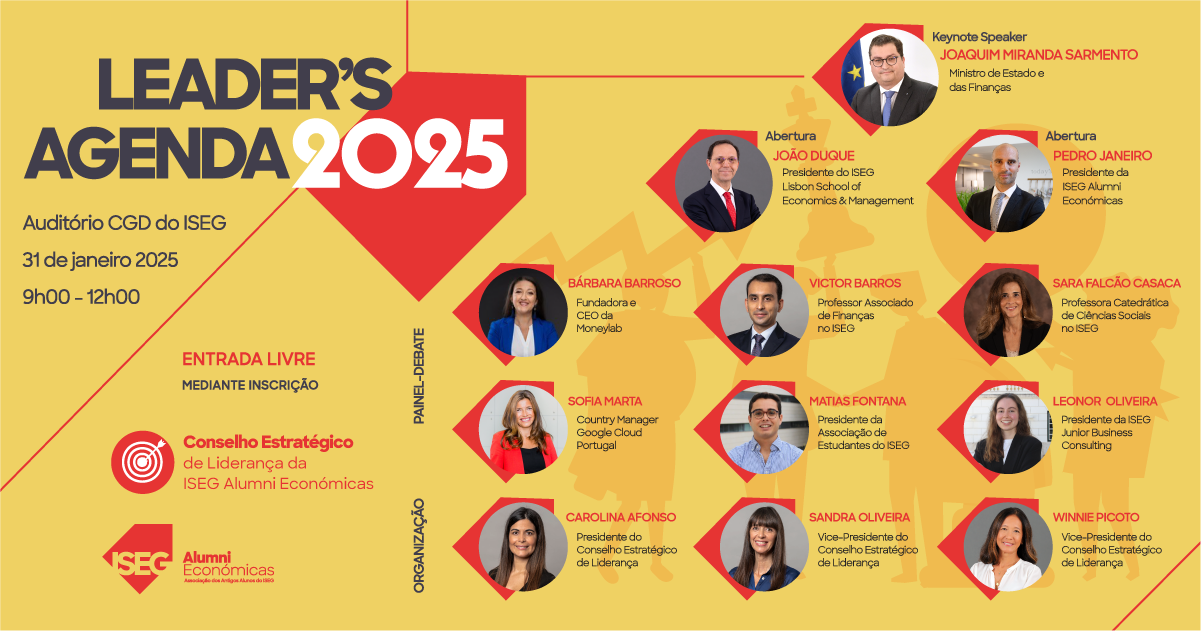
On the morning of 31 January, there will take place in CGD Auditorium of ISEG , the Leader's Agenda 2025event will take place in ISEG's CGD Auditorium. The objective of this event is to discuss important topics that should be on every leader's agenda at the start of the year. The event will include the participation as keynote speaker of the Minister of Finance, Joaquim Miranda Sarmento (an ISEG professor), who will address the Strategic Financial parameters for 2025.
The conference forms part of the activities of the new Strategic Leadership Board, an entity of Economic Alumni of ISEG that is dedicated to promoting innovative practices and strategic reflections in the area of leadership. The Board is chaired by Carolina Afonso, with Sandra Oliveira and Winnie Picoto as vice-chairs.
Leader's Agenda 2025 will be a unique opportunity for professionals and leaders to discuss trends, challenges and strategies over the course of a morning that promises to be full of insights and opportunities for networking.
Free admission, subject to prior registration.
The next ISEG Research Seminar will take place on the 4th December, with the participation of Francesco Alosafrom the University of Paris Dauphine-PSL, who will present the paper "The Gendered Effects of Working From Home".
The seminar will be held from 13.00 to 14.00 in Lecture Theatre 4 (Quelhas, 4th Floor).
Free admission.
Abstract:
The shift to remote work, with roots predating Covid-19, marks a major transformation in labor markets. This paper investigates its medium-run impact on labor market outcomes, using plant-level variation in remote work agreements implemented between 2014 and 2017. Employing an event study approach, we find that access to remote work yields moderate wage increases and facilitates upward occupational mobility. This upward mobility aligns with increased commuting distances, suggesting that remote work options alleviate job search constraints, allowing workers to seek higher-paying jobs. Our analysis further reveals gendered effects, with female workers experiencing slightly larger wage gains and occupational mobility. These findings support evidence in the literature that commuting constraints impact women more heavily, and that remote work mitigates these constraints, expanding their employment opportunities. Overall, our results underscore remote work's role in reshaping labor market dynamics, particularly for female workers.
We invite you to participate in the webinar "The Web of Science Core Collection perimeter. Why does it matter to you?", to be held on November 27, from 14:00 to 15:00.
More information and registration at this link: https://clarivatesupport.webex.com/weblink/register/reaf191538da89e299a3a1ec761e5dd02
On 4th December, from 18.00 to 19.30, the results of the study on Information Systems Governance in Higher Education Institutionswill be presented at ISEG. This initiative has been developed by ISEG, in collaboration with European Information Systems Governance (Pt).
The event will also feature a debate with the participation of renowned experts in the field, namely: Professor Almiro de Oliveira (President of the European GovSI Club - Pt); Admiral António Gameiro Marques (Director General of the National Security Office & CNCS); and Eng. Nuno Fórneas (CIO Banco CTT); Prof. Dr. G. K. Rui Ribeiro (Univ. Lusofona, Consultant and Startup Advisor).
Carried out in 2023, the objective of this study was to evaluate how the Governance of Information Systems (GovSI) is being addressed in higher education institutions in Portugal. The analysis focused on the inclusion of the subject in different degrees and course units that have a greater affinity with this subject area.
Participation in the event is an opportunity to understand the challenges and advances in the teaching of information systems governance, as well as to debate the future of this critical area in the educational and professional context.
The event will take place in Auditorium 5 (New Quelhas).
Free admission.
Programme
| 18:05 | Opening remarks (Professor Mário Caldeira) |
| 18:10 | Motivating the initiative (Prof. Mario Romão) |
| 18:20 | Presentation of the results obtained (Prof. Henrique O'Neill) |
| 18:45 | Debate (moderated by Bruno Horta Soares) |
| 19:30 | Closing session |
On 4th December, 2024, CEMAPRE (Centre for Applied Mathematics for Economic Forecasting and Decision Making) will hold a seminar on 'Mathematical Optimisation in Explainable Machine Learning', presented by Emilio Carrizosa, a professor at the University of Seville. The event will take place in ISEG's Lecture Theatre 3 (ISEG, Quelhas Building), from 14.30 to 15.30.
The seminar will address the key role of mathematical optimisation in the development of explainable machine learning models. Although traditional explainable machine learning models are widely used in technology, science, and decision-making, they are often seen as 'black boxes'. This characteristic can limit their acceptance and social support, leading to the emergence of new models within the concept of Explainable Machine Learning.
According to Emilio Carrizosa, mathematical modelling and optimisation tools are not only essential for traditional methods of explainable machine learning, but they also have even more relevance in the explainable context. This is because they make it possible to integrate desirable properties, such as thrift and justice, through constraints or penalty terms in optimisation problems.
The presentation will highlight two specific challenges that the speaker's research team has been working on:
The event will be a unique opportunity for academics, professionals, and students who are interested in explainable artificial intelligence , and will discuss how applied mathematics can enhance the creation of explainable machine learning models and make them more transparent and reliable.
Free admission.
Abstract
Machine Learning (ML) is becoming a common tool in Technology, Science and Decision Making. Since ML methods are usually seen as a black box, limiting their use and social support and the emergence of new models and methods that are assumed to be trustworthy have ben developed under the umbrella of Explainable Machine Learning.
While Mathematical Modelling and Mathematical Optimisation play a crucial role in traditional ML, they are even more useful in Explainable Machine Learning, as they enable practitioners to include desirable properties in the model, such as sparsity or fairness via constraints or penalty terms in an optimisation problem. In this talk, we will illustrate two challenges on which the research team has been working: Counterfactual problems, which are a very special case of projection problem, and Collective LIME, which is a sparse linearisation method for a prediction functional.