









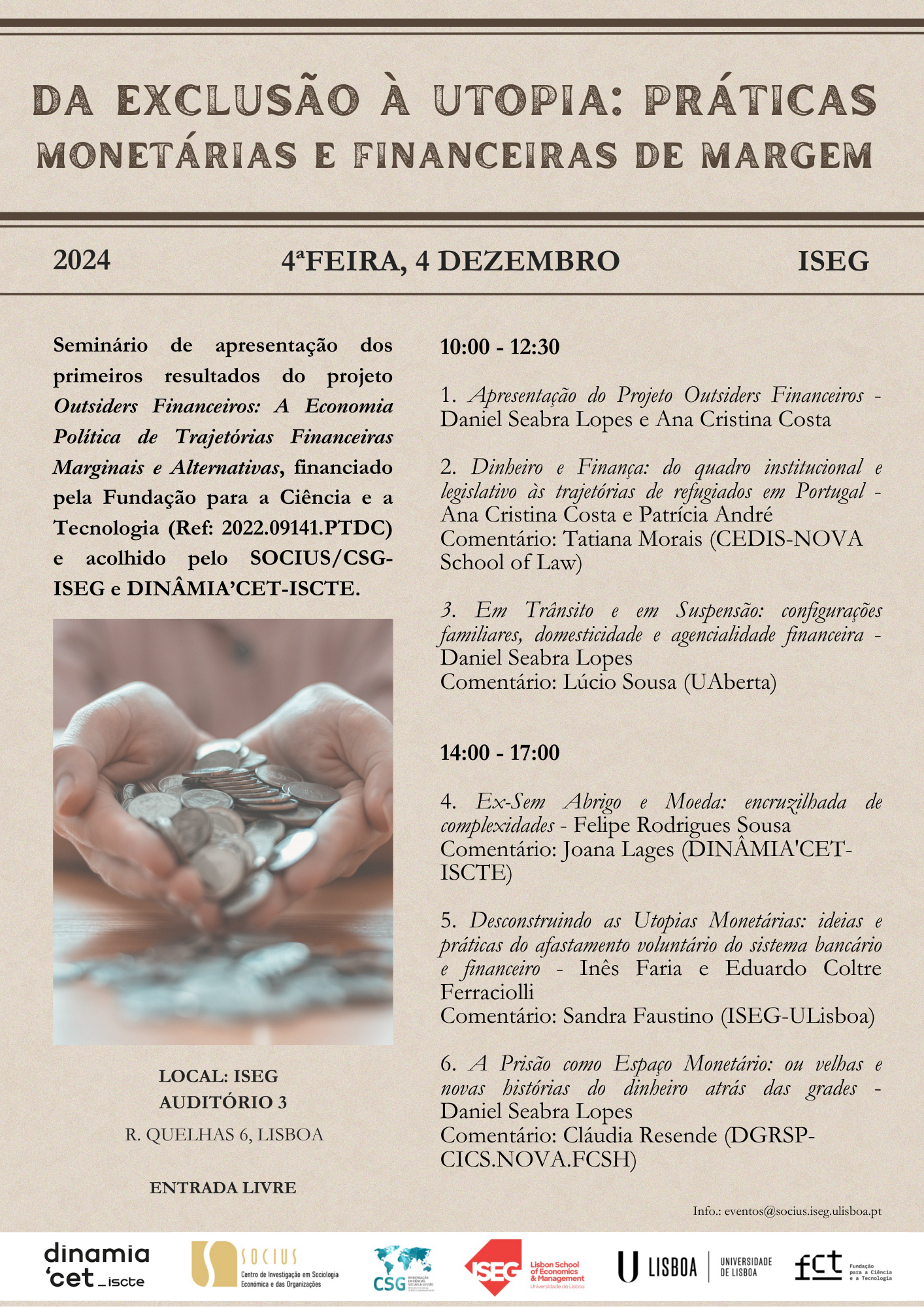
SOCIUS invites you to attend the seminar where the first results will be presented of the project entitled Financial Outsiders: The Political Economy of Marginal and Alternative Financial Trajectories", financed by FCT - Foundation for Science and Technology (Ref: 2022.09141.PTDC) and hosted by SOCIUS/CSG-ISEG and DINÂMIA'CET-Iscte.
The seminar will take place on the 4th December , 2024, from 10.00 to 17.00, in ISEG, in Rooftop (New Quelhas Building, floor 2).
Free admission.
The next ISEG Research Seminar will take place on the 27th November, with the participation of Yannick Hoga, from the University of Duisberg-Essen, who will present the paper on "Regressions under Adverse Conditions".
The seminar will be held from 13.00 to 14.00 in Lecture Theatre 4 (Quelhas, 4th Floor).
Free admission.
Abstract:
We introduce a new regression method that relates the mean of an outcome variable to covariates, under the "adverse condition" that a distress variable falls in its tail. This allows to tailor classical mean regressions to adverse scenarios, which receive increasing interest in economics and finance, among many others. In the terminology of the systemic risk literature, our method can be interpreted as a regression for the Marginal Expected Shortfall. We propose a two-step procedure to estimate the new models, show consistency and asymptotic normality of the estimator, and propose feasible inference under weak conditions that allow for cross-sectional and time series applications. Simulations verify the accuracy of the asymptotic approximations of the two-step estimator. Two empirical applications show that our regressions under adverse conditions are a valuable tool in such diverse fields as the study of the relation between systemic risk and asset price bubbles, and dissecting macroeconomic growth vulnerabilities into individual components.
The next ISEG Research Seminar will take place on the 20th November, with the participation of Erik Plug, from the University of Amsterdam, who will present the paper entitled 'Is there really a child penalty in the long run? New evidence from IVF treatments' (in collaboration with Peter Lundborg and Astrid Wurtz Rasmussen).
The seminar will be held from 13.00 to 14.00 in Lecture Theatre 4 (Quelhas, 4th Floor).
Free admission.
Abstract:
Newly matched data on in vitro fertilization (IVF) treatments are used to estimate the long-run consequences of children on the labor market earnings of women and men (often referred to as child penalties). We measure long-run child penalties in IVF-treated families by comparing the earnings of successfully and unsuccessfully first-time treated women and men up to 25 years after the first IVF treatment. In the short run, we find a large penalty immediately after the birth of the first child. In the long run, however, we find that the child penalty fades out, disappears completely after 10 years, and even turns into a child premium after 15 years, offsetting the initial setbacks experienced when children are young. Our findings therefore challenge the widely held view that children are the primary drivers behind the long-run gender gap in earnings.
CEsA - Centre for African and Development Studies invites you to the Seminar on "Mozambique Island and the Indian Ocean: between fragments and borders", which will take place on the 14th November, at 16.30 in the Novo Banco Room - ISEG (Rua do Quelhas 6, Quelhas, 4th Floor), with free admission.
The presentation will be given by Tarik Almeida, a PhD candidate in Literary Theory and History at the Institute of Language Studies of the Universidade Estadual de Campinas (IEL/Unicamp - CAPES/Brazil). Since September, the researcher has been carrying out an internship hosted by CEsA, under the supervision of researcher Jessica Falconi and as part of the Sandwich PhD Abroad Programme (PDSE/CAPES).
The event will take place from 16.30 to 18.00, in the Novo Banco room (ISEG, Quelhas, 4th Floor).
Free admission.
Further information HERE.
About the Island of Mozambique and the Indian Ocean between fragments and borders
This seminar aims to interrogate and revisit two important locations for a systematic study of Mozambican poetry, as part of its Indian character: the Island of Mozambique and the Indian Ocean. To do this, we attempt to conceptualise the relationship between fragment(s) and border(s) in order to revisit: 1) some historical and historiographical issues of the Island of Mozambique and the Indian Ocean; 2) the possible genealogical position of the Island and the Indian Ocean as "aesthetic and conceptual" lcations (Brugioni, 2021) for the study of African Literature; 3) the role of literary criticism of African Literature in the Contemporary Era, within the area of ecocriticism. The relationship between border and fragment accordingly acquires a methodological and conceptual vision and will be studied as units of analysis to (re)think the Island of Mozambique and the Indian Ocean and their ecological, historical, and cultural borders. The corpus adopted for this seminar originate mainly from Mozambican poetry, based on the poetic production of authors such as Luís Carlos Patraquim, Ana Mafalda Leite, and Sangare Okapi, while at the same time seeking to insert them into into their intertext networks within the Mozambican correspondence context.
On November 14, at 2:30 p.m., a seminar organized by CEMAPRE takes place, with the theme "Total value adjustments for counterparty credit risk in multicurrency setting". The presentation will be given by Carlos Vásquezfrom the Department of Mathematics and CITIC, University of A Coruña (Spain).
The session takes place in Amphitheater 1 of the Quelhas Building (floor 4).
Free admission.
Abstract:
In a global economy, financial institutions operate in different currencies. Therefore, in the context of total valuation adjustments (XVA) related to the presence of counterparty credit risk, they can either fund or post collateral in different currencies. Recently, some attention has been addressed to the extension of the different adjustments included in XVA from the single currency to the multicurrency setting.
In this work, we propose appropriate models to compute the total valuation adjustments in a multicurrency setting by means of dynamic hedging methodologies. In this way, we extend previous works in the single currency setting (for exxample, see [1] and the references therein). Besides the stochastic evolution of the assets in different currencies, the presence of stochastic intensities of default and the consideration of constant or stochastic exchange rates are assumed when computing the XVA associated to European options contracts. These models can be formulated in terms of (non)linear parabolic partial differential equations (PDEs) or in terms of expectations.
When the number of stochastic factors is not greater than two, we propose a Lagrange-Galerkin scheme for solving the PDEs, combined with fixed point techniques for the nonlinear problems [2]. For problems that include more than two underlying stochastic factors (assets, intensities of default, and/or stochastic FX rates), we propose the use of Monte Carlo simulations applied to the formulations based on expectations, combined with a Picard method and the more efficient Multilevel Picard iteration (MPI) scheme for the nonlinear cases [3]. We apply these techniques to different European style options.
References:
[1] Iñigo Arregui, Beatriz Salvador, Daniel Ševčovič, Carlos Vázquez. Total value adjustment for European options with two stochastic factors. Mathematical model, analysis and numerical simulation, Computers and Mathematics with Applications, 76 (2018), 4 725-740.
[2] Iñigo Arregui, Roberta Simonella, Carlos Vázquez. Models and numerical methods for XVA pricing under mean reversion spreads in a multicurrency framework, Communications in Nonlinear Science and Numerical Simulation, 130 (2024) Article Nr. 107725... [3] Roberta Simonella, Carlos Vázquez. XVA in a multi-currency setting with stochastic foreign exchange rates, Mathematics and Computers in Simulation, 207 (2023) 59-79.
On 11th November, and don't miss the seminar on 'Tradition and future at Revigrés - how to position the industry Portuguese ceramic tiles', which has been organised as an integral part of ISEG's Masters in Marketing.
The topic will be presented by Victor Ribeiro, the CEO of Revigrés.
The seminar takes place from 10.00 to 12.00, in Auditorium 4, Quelhas.
Admission is free, subject to pre-registration on this LINK.

With the objective to disseminate good practices and educational experiences that respond to new pedagogical challenges, the OAIP invites all faculty to attend the seminar led by Tiago Gonçalves (ISEG) on 'AI as a co-supervisor: AI Tools for Research Productivity', on the 20th November, at 12.30, in Room 101 - New Quelhas.
In this seminar we will discuss the potential of AI (ChatGPT and others) in carrying out research, particularly in the context of TFMs.
These tools enable us to not only leverage our research work, but also to support the guidance of our students during their TFM, as long as the various risks are mitigated.
We will also cover some applied examples of tools ranging from developing the research on a topic through to the final editing of the respective report.
The seminar will be delivered in Portuguese.
Free admission.
On 7th November, when ISEG hosts a conference on the topic of Sovereign State Functions: transparency and the fight against corruption, at 13.30, in the CGD Auditorium (Quelhas, 2nd Floor).
The conference is co-organised by the Portuguese Judges Trade Union (ASJP), the Criminal Investigation Employees Trade Union (ASFIC), the Judicial Employees Trade Union (SFJ), the Public Prosecutors Trade Union (SMMP), the Tax Workers Trade Union (STI), and the Registry and Notary Workers Trade Union (STRN).
Programme:
| 13h30 | Welcome session |
| 14.00 | Opening Session João Duque (Dean of ISEG) Joaquim Miranda Sarmento (Minister of Finance) - attendance subject to confirmation Rita Júdice (Minister of Justice) - attendance subject to confirmation |
| 14.30 | 1st Panel (round table) Centred on reflection on the words of Joana Marques Vidal: "There is a normalisation of a certain type of behaviour and practices that go against transparency and undermine the functioning of the rule of law" e "Corruption has the seriousness of being the crime that corrodes the democratic rule of law'. Participants: Alessandra Silveira (Associate Professor of the School of Law of Universidade do Minho and Director of CEDU) João Duque (Full Professor of Finance and Dean of ISEG) Orlando Mascarenhas (Director of the Institute of Judicial Police and Criminal Sciences (IPJCC) and Specialist in Financial Investigations) Paulo Sande (Visiting Professor at the School of Political Studies of Universidade Católica Portuguesa) Vasco Guimarães (PhD in Financial and Tax Law) Moderator: Rita Marrafa de Carvalho (Journalist) |
| 16h10 | Debate |
| 16.30 | Coffee-break |
| 16h45 | 2nd Panel (round table) It is essential to think about the future - a future that will necessarily ,include policies to be defined in the short, medium and long term by those who have the obligation to do so once and for all. This round table will hear the voice of politicians. Participants: Representatives of the Parliamentary Groups / Single Member Moderator: Luís Rosa (Journalist) |
| 19h10 | Debate |
| 19h30 | Closing Session João Duque (Dean of ISEG) Pedro Aguiar Branco (Speaker of the Portuguese Parliament) - attendance subject to confirmation Marcelo Rebelo de Sousa (President of the Republic) - attendance subject to confirmation |
The next ISEG Research Seminar will take place on the 6th November. It will feature Ana Martins (ISEG), who will present the paper entitled "Sailing through Troubled Waters: Evidence from the APOIAR Program" (in collaboration with Fernando Ponzobbon and João Pereira dos Santos).
The seminar will be held from 13.00 to 14.00 in Lecture Theatre 4 (Quelhas, 4th Floor).
Free admission.
Abstract:
We exploit the assignment mechanism of the APOIAR Program, a generous initiative designed to support firms during the COVID-19 pandemic, to provide causal evidence on the impact of grants on firm performance in times of crisis. Using a regression discontinuity design and drawing on a combination of administrative datasets, we find that eligible firms experienced a short-term increase in profitability in 2021, though these effects did not persist into 2022. No significant differences were detected in revenue growth or cost reduction, indicating that the profitability increase stemmed from the subsidy. Firms allocated part of the support to rental payments and office supplies, including modest investments in digitalization. We observe no effects on firm survival or employment levels.
The II POWER Conference will take place on the 11th October at ISEG, starting at 09.00 in Auditorium 2, Quelhas.
The programme features the participation of Ariana Simões de Almeida, who will debate the challenges and achievements in the fight for Gender Equality, and also of Manuela Doutel Haghighi, who will discuss the importance of female leadership in business and for the economy.
ISEG professors Pilar Mosquera and Helena Jerónimo will speak on the topic of 'Gender equality in Portugal - invited to the party, but not to dance', offering a reflection on the future.
The event will also feature a presentation by the students who won the FedEx Access Award at Gen-E 24, highlighting their innovative work in the early detection of breast cancer. The session will close with an award ceremony recognising the work carried out by the participants.
Full programme available HERE.
Enrolment for the training on this LINK.
The POWER - Portuguese Observatory for Women's Equality is to develop a continuously-updared data observatory to change the mindset regarding gender equality in business (Ref. 2022.08793.PTDC). It is funded by the Foundation for Science and Technology and is hosted by ADVANCE-CSG/ISEG- ULisboa.